 FotonMedix












Superare l’ischemia nervosa nella radicolopatia cervicale refrattaria
Deliver high forward photon flux directly into compressed cervical nerve roots. Target microvascular congestion and swollen perineural water matrices with dual-wavelength precision. Eliminate epidermal thermal saturation through sub-millisecond gated duty cycles.
A specialized neck and spine physical therapy room frequently sees this clinical roadblock: a 48-year-old architectural draftsman sits slouched forward, supporting her left forearm with her right hand to prevent sharp, burning pain shooting down her lateral arm into the thumb and index finger. Her MRI scans confirm a chronic C5-C6 disc extrusion with severe left-sided neuroforaminal stenosis. Over the past eight months, she has tried continuous cervical traction that exacerbated her neck spasms, high-dose pregabalin that clouded her concentration at work, and repeated visits to outpatient facilities where underpowered wands delivered zero lasting relief. She found herself frustrated by the mounting class 4 laser therapy price quoted by clinics that merely applied non-contact superficial arrays for fifteen minutes at a time. Palpation over the left scalene triangle and upper trapezius reveals a dense, hypertonic muscular band, while the underlying compressed C6 root 5 centimeters beneath remains ischemic, inflamed, and hypoperfused. When past therapists dialed up output on basic continuous units to drive light through the thick cervical paraspinals, the patient winced from sharp, burning sensations across her skin long before photons reached the neural exit foramen.
Low-power modalities cannot overcome the steep optical scattering of stratified neck muscles, cervical fascia, and dense subcutaneous fat. When uncalibrated continuous systems run at higher wattages, epidermal heat builds up within seconds. The patient complains of intolerable surface stinging, forcing the operator to stop the session well before the deep radicular target receives an adequate therapeutic dose.
Overcoming this cervical impasse requires projecting high-irradiance optical energy through dense paraspinal musculature directly to the nerve root while shielding the surface skin from thermal saturation.
Optical Penetration Across Cervical Musculature and Fascial Planes
Reaching a compressed cervical nerve root presents a difficult anatomical challenge. Photons must pass through stratified epidermis, cervical subcutaneous adipose tissue, the thick investing layer of deep cervical fascia, the splenius capitis, levator scapulae, and the deep scalene complex before reaching the intervertebral foramen. Under the Kubelka-Munk optical scattering model, light scatters across these layered fibrous boundaries, creating an exponential drop in forward irradiance.
All’interno del tessuto biologico umano, tre principali assorbitori endogeni controllano la distribuzione dei fotoni: la melanina, l’emoglobina microvascolare e l’acqua interstiziale.
In chronic C5-C6 radiculopathy, the primary pathology involves mechanical nerve impingement combined with localized capillary stasis and axonal ischemia, located 4.0 to 6.0 centimeters beneath the posterolateral neck surface. Class III low-level therapy systems fail to penetrate this depth; more than 96% of their light scatters into shallow dermal and muscular layers. The nerve root remains starved of photons, locked in an ongoing cycle of endoneurial hypoxia and neuropathic firing.
Per superare questa ripida curva di decadimento è necessario un laser terapeutico di classe IV ad alta intensità, in grado di erogare un’elevata potenza di picco senza superare le soglie termiche superficiali.
Posterolateral Cervical Dermis & Adipose (Scattering Interface)
         │
         ▼
Deep Cervical Fascia & Scalene Complex (Dense Muscular Shield)
         │ (1470nm Interstitial Water Absorption & Decongestion)
         ▼
Periradicular Capillary Loops (Ischemic Microvascular Congestion)
         │ (980nm Hemoglobin Hyperemia & NO Offloading)
         ▼
Compressed C6 Nerve Root & Dorsal Root Ganglion (Cellular ATP Surge)
L'azione simultanea sui cromofori dell'emoglobina e dell'acqua trasforma il modo in cui il tessuto neurale compresso risponde:
At 980nm, photon capture aligns with absorption peaks for oxygenated and deoxygenated hemoglobin. In chronic cervical radiculopathy, mechanical compression of the nerve root chokes venous return, creating localized ischemia and trapping inflammatory cytokines like interleukin-1-beta and tumor necrosis factor-alpha. The 980nm wavelength triggers immediate localized vasodilation, prompting circulating red blood cells to offload bound nitric oxide, clearing sluggish microcirculation and restoring oxygen delivery to starving axons.
A 1470 nm, l’assorbimento dei fotoni si sposta verso le molecole d’acqua legate all’interno delle guaine perineurali gonfie e dei piani fasciali spessi. L’acqua interstiziale assorbe la luce a 1470 nm a velocità significativamente superiori rispetto alla zona degli 800 nm. Questo assorbimento controllato crea microcampi termici che rompono le matrici rigide e polimerizzate di proteoglicani, eliminando l’edema infiammatorio stagnante attorno al forame intervertebrale compresso e riducendo la pressione meccanica sul nervo.
Delivering this combined optical power deep into the cervical spine without scorching the skin requires precise pulse gating.
Meccanismi del ciclo di lavoro e dissipazione termica cutanea
Continuous-wave light delivery encounters a hard biological limit over the lateral neck: the thin, highly sensitive cervical skin absorbs surface heat quickly, but damaged local autonomic tone prevents adequate microvascular flushing of that thermal load. When continuous photons strike the scalene gutter, surface temperatures spike within seconds, setting off intense burning sensations.
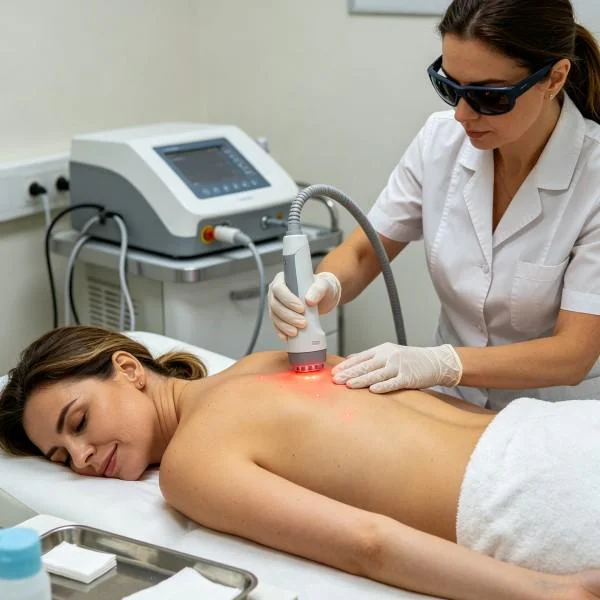
Il gating di precisione degli impulsi nell’ordine dei microsecondi elimina questo accumulo di calore superficiale. Suddividendo la luce ad alta intensità in impulsi della durata di microsecondi, separati da intervalli di oscurità controllati, le strutture articolari profonde ricevono un’irradianza di picco elevata, mentre la pelle sensibile si raffredda in modo sicuro tra un impulso e l’altro.
$$\text{Ciclo di lavoro (\%)} = \left( \frac{\tau_{\text{impulso}}}{\tau_{\text{impulso}} + \tau_{\text{intervallo}}} \right) \times 100$$
Dove $\tau_{\text{pulse}}$ rappresenta l'emissione ottica attiva e $\tau_{\text{interval}}$ rappresenta la pausa di rilassamento termico.
Applying 20W of continuous laser energy over the posterolateral cervical spine triggers uncomfortable skin heating within 3 seconds. In contrast, running that same power through a 20% duty cycle delivers powerful peak bursts that penetrate through dense cervical muscles, while the 80% dark phase allows surface tissues to shed heat safely into the air and the moving handpiece.
Il flusso sanguigno capillare dissipa il calore residuo superficiale, mentre la radice nervosa ipoperfusa e compressa assorbe un’elevata densità di fotoni, avviando il processo di guarigione cellulare senza irritare l’epidermide.
Multi-Wavelength Synergies in Cervical Neurovascular Rehab
Treating complex cervical nerve compression with a single wavelength leaves critical parts of the pathology unaddressed. Cervical radiculopathy involves skin, adipose layers, thick fascial sheaths, deep paraspinal muscle bellies, and inflamed neural tissue. Each distinct anatomical layer features unique water content, vascular density, and optical scattering properties.
La combinazione di lunghezze d'onda coordinate crea un gradiente terapeutico continuo in tutte le profondità dei tessuti:
[ Cervical Neurovascular Interaction Matrix ]

810nm  ──► Mitochondrial Cytochrome c Oxidase (Surge in Axonal ATP Synthesis)
980nm  ──► Radicular Capillary Perfusion & NO Release (Flushing Inflammatory Fluid)
1064nm ──► Deep Splenius & Scalene Masses (Forward Directional Penetration)
1470nm ──► Perineural Water Matrices (Decongesting Foraminal Edema)
L’abbinamento dei raggi a 980 nm e 1470 nm produce immediati miglioramenti biomeccanici e circolatori. Il raggio a 980 nm apre i letti microvascolari compressi, fornendo ossigeno fresco alle radici nervose ischemiche. Allo stesso tempo, la lunghezza d’onda a 1470 nm agisce sulle molecole d’acqua legate all’interno della guaina nervosa gonfia, ammorbidendo i legami incrociati rigidi del collagene e drenando il liquido localizzato.
Clinicians use this dual-action delivery to loosen tight, guarded spinal structures, making subsequent manual therapy and cervical postural stabilization exercises far more productive.
Efficacia clinica della terapia laser per tessuti profondi di classe IV
Le piattaforme ad alta potenza hanno rivoluzionato il modo in cui i centri specializzati nella cura della colonna vertebrale e gli studi di fisioterapia trattano la radicolopatia grave e il dolore discogenico.
Therapists managing chronic cervical radiculopathy, thoracic outlet syndrome, or severe cervicogenic headaches often spend extensive time on slow, painful manual interventions. Low-intensity modalities require 35 to 45 minutes of scanning to deliver minimal joules through deep cervical musculature. Delivering class iv deep tissue laser therapy cuts treatment times to under eight minutes while driving meaningful, therapeutic energy directly to the injury site.
Le pratiche riabilitative che valutano i sistemi ad alta produttività riconoscono chiari vantaggi clinici e operativi:
First, practitioners achieve meaningful therapeutic energy doses in 6 to 8 minutes, optimizing daily patient throughput and eliminating physical strain from aggressive manual friction.
Second, rapid pain relief breaks the patient’s antalgic guarding, allowing active cervical range-of-motion exercises earlier in their treatment plan.
In terzo luogo, un’efficace riparazione cellulare dei tessuti profondi ripristina il flusso sanguigno microvascolare, alleviando il dolore radicolare lancinante e favorendo la conservazione a lungo termine del disco.
Documentazione dei casi clinici
The following case record details the clinical application of multi-wavelength high-intensity laser therapy for severe, treatment-resistant C5-C6 cervical radiculopathy that had failed to respond to oral gabapentinoids, transforaminal epidural injections, and manual traction.
Dettagli della scheda del caso
Case Identification: SPINE-2026-C5120
Patient Demographics: 48-year-old female, senior architectural draftsman
Primary Diagnosis: Subacute-on-Chronic C5-C6 Left Posterolateral Disc Extrusion with C6 Radiculopathy (Moderate Neuroforaminal Stenosis and Secondary Scalene Anterior Hypertonicity)
Chronicity: 32 weeks of worsening radicular pain; failed two fluoroscopically guided cervical epidural steroid injections, failed high-dose pregabalin (300mg/day) due to daytime dizziness and cognitive blunting
Clinical Assessment: Sharp, shooting electric shock pain traveling down the left lateral arm, forearm, and into the thumb and index finger. Spurling’s test positive on the left side, triggering sharp radiating distal pain (Numeric Pain Rating Scale: 8/10 during head rotation, 6/10 constant dull ache at rest). Diminished brachioradialis reflex (1/4 on left vs 2/4 on right), with weakness in wrist extension (4-/5 manual muscle test).
| ID sessione | Protocollo di fase | Configurazione della lunghezza d'onda | Potenza media (W) | Frequenza di impulso e ciclo di lavoro | Area di scansione (cm²) | Durata del trattamento | Energia totale (Joule) | Parametro di risposta clinica |
| Sessione 01 | Desensibilizzazione radicolare | 980 nm (75%) + 1470 nm (25%) | 12,0 W | 120 Hz con ciclo di lavoro 20% | 140 | 05:45 | 4.140 J | Resting NPRS drops from 6/10 to 4/10; arm burning eases |
| Sessione 03 | Decongestione foraminale | 980 nm (45%) + 1470 nm (55%) | 15,0 W | 250 Hz con ciclo di lavoro 25% | 110 | 06:40 | 6,000 J | Spurling test triggers local pain only; arm numbness recedes |
| Sessione 06 | Biostimolazione assonale | 810 nm (30%) + 980 nm (45%) + 1470 nm (25%) | 18,0 W | 800 Hz con ciclo di lavoro 35% | 150 | 07:25 | 8.010 J | Radiating pain clears past elbow; wrist extension hits 4+/5 |
| Sessione 09 | Rimodellamento profondo delle radici nervose | 980 nm (40%) + 1470 nm (60%) | 16,0 W | 20 Hz con ciclo di lavoro 25% (modalità Deep Impact) | 90 | 06:40 | 6.400 J | Full active cervical rotation achieved; Spurling negative |
| Sessione 12 | Consolidamento cinetico | 980 nm (50%) + 1470 nm (50%) | 14,0 W | Onda continua (scansione dinamica) | 160 | 07:00 | 5.880 J | Zero resting or active pain; return to drafting duties |
Note sull'evoluzione del caso
Sessions 01 through 03 focused on relieving perineural inflammation, reducing lateral exit foraminal congestion, and dampening hyperactive C-fiber nociceptive signaling. The combination of 980nm and 1470nm cleared inflammatory edema around the C6 nerve root, reducing nocturnal burning and allowing the patient to sleep without waking by the end of the first week.
Sessions 04 through 08 targeted the deep scalene muscular contracture and ischemic foraminal sheath. High water absorption at 1470nm softened the rigid fascial bands, while 980nm and 810nm stimulated capillary blood flow to flush out metabolic waste and recruit reparative cells. Active cervical rotation toward the left opened from 24° to 62° without electric radiating pain into the hand.
By Session 12, the patient demonstrated complete centralization of radicular symptoms, with no remaining peripheral dysesthesia in the thumb or forearm. Motor strength in left wrist extension fully normalized, the brachioradialis reflex returned to a symmetric 2/4 baseline, and the patient resumed drafting architectural blueprints full-time without neck bracing or pain flare-ups.
Biological Mechanisms of Cervical Nerve Decompression
La terapia laser ad alta intensità per i tessuti profondi stimola il processo di guarigione attraverso meccanismi cellulari ed extracellulari integrati:
Assorbimento fotonico (mitocondri e matrice acquosa perineurale)
 │
 ├──► Dissociazione dell’ossido nitrico inibitorio ──► Sintesi accelerata di ATP assonale
 │
         ├──► Scissione dell’idratazione interstiziale ────────► Eliminazione della stasi del fluido foraminale
 │
 └──► Attivazione delle cellule endoteliali ─────────────► Reperfusione dei vasi nervosi
Quando i fotoni colpiscono la citocromo c ossidasi all’interno degli assoni e delle cellule di Schwann sottoposti a stress, spostano le molecole inibitorie di ossido nitrico. Ciò consente all’ossigeno di legarsi in modo efficiente, accelerando la catena di trasporto degli elettroni mitocondriale e determinando un’impennata nella produzione di adenosina trifosfato (ATP). Le cellule affette da affaticamento cronico recuperano l’energia metabolica necessaria per mantenere i potenziali di membrana assonali.
Contemporaneamente, i fotoni a 1470 nm eccitano le molecole d’acqua legate all’interno del denso gel di proteoglicani che circonda la radice nervosa compressa. I microcampi termici che ne derivano rompono i legami trasversali rigidi del collagene, trasformando la sostanza fondamentale viscosa in uno stato fluido e aprendo vie per il drenaggio venoso.
La segnalazione genica a valle subisce rapidi cambiamenti. Le citochine infiammatorie come l’interleuchina-1-beta, il fattore di necrosi tumorale alfa e la cicloossigenasi-2 diminuiscono, mentre il fattore di crescita nervoso e il fattore di crescita endoteliale vascolare aumentano.
Questi cambiamenti biochimici inducono le cellule di Schwann a rimielinizzare i segmenti nervosi danneggiati e a ripristinare le normali velocità di conduzione nervosa, eliminando l'attività neuropatica.
Moving Beyond Injections and Cervical Fusion
Conventional management for severe cervical radiculopathy relies heavily on oral anticonvulsants, repeated cervical epidural steroid injections, and invasive surgical decompression such as anterior cervical discectomy and fusion (ACDF).
Systemic medications dull central pain perception while doing nothing to resolve the mechanical ischemia or axonal degeneration of the nerve root. Repeated epidural cortisone injections provide short-term symptom relief, but carry risks of dural puncture, epidural hematoma, and structural weakening of surrounding ligaments. Spinal surgery decompresses the nerve mechanically, but introduces surgical risks like vocal cord paralysis, adjacent segment disease, hardware failure, and months of restrictive neck bracing.
High-power Class IV laser therapy provides a focused, non-invasive alternative. It avoids systemic drug toxicity, preserves native cervical motion, and eliminates surgical trauma. Clinicians can deliver thousands of therapeutic joules deep into compressed intervertebral foramina and ischemic paraspinal muscles within minutes.
Applying high-intensity multi-wavelength phototherapy targets radicular nerve pain at its biological and vascular source. Foraminal edema drains, vasa nervorum circulation rebounds, and damaged nerve fibers heal cleanly. It turns disabling cervical nerve compression into a predictable, lasting return to active, pain-free living.