 フォトンメディックス












難治性頸部神経根症における神経虚血の克服
Deliver high forward photon flux directly into compressed cervical nerve roots. Target microvascular congestion and swollen perineural water matrices with dual-wavelength precision. Eliminate epidermal thermal saturation through sub-millisecond gated duty cycles.
A specialized neck and spine physical therapy room frequently sees this clinical roadblock: a 48-year-old architectural draftsman sits slouched forward, supporting her left forearm with her right hand to prevent sharp, burning pain shooting down her lateral arm into the thumb and index finger. Her MRI scans confirm a chronic C5-C6 disc extrusion with severe left-sided neuroforaminal stenosis. Over the past eight months, she has tried continuous cervical traction that exacerbated her neck spasms, high-dose pregabalin that clouded her concentration at work, and repeated visits to outpatient facilities where underpowered wands delivered zero lasting relief. She found herself frustrated by the mounting class 4 laser therapy price quoted by clinics that merely applied non-contact superficial arrays for fifteen minutes at a time. Palpation over the left scalene triangle and upper trapezius reveals a dense, hypertonic muscular band, while the underlying compressed C6 root 5 centimeters beneath remains ischemic, inflamed, and hypoperfused. When past therapists dialed up output on basic continuous units to drive light through the thick cervical paraspinals, the patient winced from sharp, burning sensations across her skin long before photons reached the neural exit foramen.
Low-power modalities cannot overcome the steep optical scattering of stratified neck muscles, cervical fascia, and dense subcutaneous fat. When uncalibrated continuous systems run at higher wattages, epidermal heat builds up within seconds. The patient complains of intolerable surface stinging, forcing the operator to stop the session well before the deep radicular target receives an adequate therapeutic dose.
Overcoming this cervical impasse requires projecting high-irradiance optical energy through dense paraspinal musculature directly to the nerve root while shielding the surface skin from thermal saturation.
Optical Penetration Across Cervical Musculature and Fascial Planes
Reaching a compressed cervical nerve root presents a difficult anatomical challenge. Photons must pass through stratified epidermis, cervical subcutaneous adipose tissue, the thick investing layer of deep cervical fascia, the splenius capitis, levator scapulae, and the deep scalene complex before reaching the intervertebral foramen. Under the Kubelka-Munk optical scattering model, light scatters across these layered fibrous boundaries, creating an exponential drop in forward irradiance.
ヒトの生体組織内では、メラニン、微小血管内のヘモグロビン、および組織間液の3つの主要な内因性吸収体が、光子の分布を制御している。.
In chronic C5-C6 radiculopathy, the primary pathology involves mechanical nerve impingement combined with localized capillary stasis and axonal ischemia, located 4.0 to 6.0 centimeters beneath the posterolateral neck surface. Class III low-level therapy systems fail to penetrate this depth; more than 96% of their light scatters into shallow dermal and muscular layers. The nerve root remains starved of photons, locked in an ongoing cycle of endoneurial hypoxia and neuropathic firing.
この急峻な減衰曲線を克服するには、表面の熱的閾値を超えずに高いピーク出力を供給できる、高強度のクラスIV治療用レーザーが必要となる。.
Posterolateral Cervical Dermis & Adipose (Scattering Interface)
         │
         ▼
Deep Cervical Fascia & Scalene Complex (Dense Muscular Shield)
         │ (1470nm Interstitial Water Absorption & Decongestion)
         ▼
Periradicular Capillary Loops (Ischemic Microvascular Congestion)
         │ (980nm Hemoglobin Hyperemia & NO Offloading)
         ▼
Compressed C6 Nerve Root & Dorsal Root Ganglion (Cellular ATP Surge)
ヘモグロビンと水のクロモフォアを同時に標的とすることで、圧縮された神経組織の反応様式が変化する:
At 980nm, photon capture aligns with absorption peaks for oxygenated and deoxygenated hemoglobin. In chronic cervical radiculopathy, mechanical compression of the nerve root chokes venous return, creating localized ischemia and trapping inflammatory cytokines like interleukin-1-beta and tumor necrosis factor-alpha. The 980nm wavelength triggers immediate localized vasodilation, prompting circulating red blood cells to offload bound nitric oxide, clearing sluggish microcirculation and restoring oxygen delivery to starving axons.
1470nmでは、光子の吸収が、膨潤した神経周囲鞘や厚い筋膜層内の結合水分子へとシフトする。 間質水は、800nm帯に比べて著しく高い率で1470nmの光を吸収する。この制御された吸収により、微小熱場が形成され、硬化した重合プロテオグリカンマトリックスが分解される。これにより、圧迫された椎間孔周囲の停滞した炎症性浮腫が解消され、神経にかかる機械的圧力が軽減される。.
Delivering this combined optical power deep into the cervical spine without scorching the skin requires precise pulse gating.
デューティサイクルのメカニズムと皮膚熱クリアランス
Continuous-wave light delivery encounters a hard biological limit over the lateral neck: the thin, highly sensitive cervical skin absorbs surface heat quickly, but damaged local autonomic tone prevents adequate microvascular flushing of that thermal load. When continuous photons strike the scalene gutter, surface temperatures spike within seconds, setting off intense burning sensations.
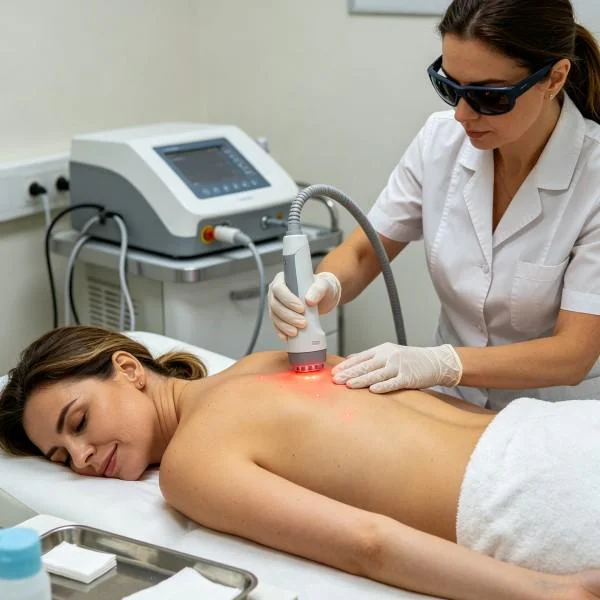
マイクロ秒単位の精密なパルスゲーティングにより、この表面の熱蓄積が解消されます。高強度の光を、制御された暗期間を挟んだマイクロ秒単位のバーストに分割することで、深部の関節構造に高いピーク放射照度を照射しつつ、敏感な皮膚はパルス間の間に安全に冷却されます。.
$$\text{デューティサイクル (\%)} = \left( \frac{\tau_{\text{パルス}}}{\tau_{\text{パルス}} + \tau_{\text{間隔}}} \right) \times 100$$
ここで、$\tau_{\text{pulse}}$ は能動的光送達を表し、$\tau_{\text{interval}}$ は熱的緩和の休止を表す。.
Applying 20W of continuous laser energy over the posterolateral cervical spine triggers uncomfortable skin heating within 3 seconds. In contrast, running that same power through a 20% duty cycle delivers powerful peak bursts that penetrate through dense cervical muscles, while the 80% dark phase allows surface tissues to shed heat safely into the air and the moving handpiece.
毛細血管の血流によって皮膚表面の残留熱が除去される一方で、血流が低下し圧迫された神経根は高光子密度を吸収し、表皮への刺激を与えることなく細胞の修復が開始される。.
Multi-Wavelength Synergies in Cervical Neurovascular Rehab
Treating complex cervical nerve compression with a single wavelength leaves critical parts of the pathology unaddressed. Cervical radiculopathy involves skin, adipose layers, thick fascial sheaths, deep paraspinal muscle bellies, and inflamed neural tissue. Each distinct anatomical layer features unique water content, vascular density, and optical scattering properties.
波長を調整して組み合わせることで、組織のあらゆる深さにわたって途切れることのない治療用濃度勾配が形成されます:
[ Cervical Neurovascular Interaction Matrix ]

810nm  ──► Mitochondrial Cytochrome c Oxidase (Surge in Axonal ATP Synthesis)
980nm  ──► Radicular Capillary Perfusion & NO Release (Flushing Inflammatory Fluid)
1064nm ──► Deep Splenius & Scalene Masses (Forward Directional Penetration)
1470nm ──► Perineural Water Matrices (Decongesting Foraminal Edema)
980nmと1470nmを併用することで、生体力学的および循環機能の即効的な改善が得られます。 980nmの光線は、圧迫された微小血管床を開き、虚血状態にある神経根に新鮮な酸素を供給します。同時に、1470nmの光線は、腫脹した神経鞘内部に結合している水分子に作用し、硬化したコラーゲンの架橋を軟化させ、局所的な体液を排出させます。.
Clinicians use this dual-action delivery to loosen tight, guarded spinal structures, making subsequent manual therapy and cervical postural stabilization exercises far more productive.
クラスIV深部組織レーザー療法による臨床的有効性
高出力治療プラットフォームの登場により、専門の脊椎センターや理学療法クリニックにおける重度の神経根症や椎間板由来の痛みの治療法は一変しました。.
Therapists managing chronic cervical radiculopathy, thoracic outlet syndrome, or severe cervicogenic headaches often spend extensive time on slow, painful manual interventions. Low-intensity modalities require 35 to 45 minutes of scanning to deliver minimal joules through deep cervical musculature. Delivering class iv deep tissue laser therapy cuts treatment times to under eight minutes while driving meaningful, therapeutic energy directly to the injury site.
高出力システムを評価するリハビリテーションの実践では、臨床面および運用面において明らかな利点が認められています:
First, practitioners achieve meaningful therapeutic energy doses in 6 to 8 minutes, optimizing daily patient throughput and eliminating physical strain from aggressive manual friction.
Second, rapid pain relief breaks the patient’s antalgic guarding, allowing active cervical range-of-motion exercises earlier in their treatment plan.
第三に、確実な深部組織の細胞修復により、微小血管の血流が回復し、神経根由来の鋭い痛みが解消され、椎間板の長期的な維持が促進されます。.
臨床症例記録
The following case record details the clinical application of multi-wavelength high-intensity laser therapy for severe, treatment-resistant C5-C6 cervical radiculopathy that had failed to respond to oral gabapentinoids, transforaminal epidural injections, and manual traction.
事件記録の詳細
Case Identification: SPINE-2026-C5120
Patient Demographics: 48-year-old female, senior architectural draftsman
Primary Diagnosis: Subacute-on-Chronic C5-C6 Left Posterolateral Disc Extrusion with C6 Radiculopathy (Moderate Neuroforaminal Stenosis and Secondary Scalene Anterior Hypertonicity)
Chronicity: 32 weeks of worsening radicular pain; failed two fluoroscopically guided cervical epidural steroid injections, failed high-dose pregabalin (300mg/day) due to daytime dizziness and cognitive blunting
Clinical Assessment: Sharp, shooting electric shock pain traveling down the left lateral arm, forearm, and into the thumb and index finger. Spurling’s test positive on the left side, triggering sharp radiating distal pain (Numeric Pain Rating Scale: 8/10 during head rotation, 6/10 constant dull ache at rest). Diminished brachioradialis reflex (1/4 on left vs 2/4 on right), with weakness in wrist extension (4-/5 manual muscle test).
| セッションID | フェーズ・プロトコル | 波長構成 | 平均出力 (W) | パルス周波数とデューティサイクル | スキャン領域(cm²) | 治療期間 | 総エネルギー(ジュール) | 臨床反応指標 |
| セッション01 | 歯根部の知覚鈍化 | 980nm (75%) + 1470nm (25%) | 12.0W | 120 Hz(デューティサイクル 20%) | 140 | 05:45 | 4,140 J | Resting NPRS drops from 6/10 to 4/10; arm burning eases |
| セッション03 | 椎間孔のうっ血解消 | 980nm (45%) + 1470nm (55%) | 15.0W | 250 Hz、デューティサイクル 25% | 110 | 06:40 | 6,000 J | Spurling test triggers local pain only; arm numbness recedes |
| セッション06 | 軸索の生体刺激 | 810nm (30%) + 980nm (45%) + 1470nm (25%) | 18.0W | 800 Hz、デューティサイクル 35% | 150 | 07:25 | 8,010 J | Radiating pain clears past elbow; wrist extension hits 4+/5 |
| セッション09 | 深部神経根のリモデリング | 980nm (40%) + 1470nm (60%) | 16.0W | 20 Hz、25% デューティサイクル(ディープインパクトモード) | 90 | 06:40 | 6,400 J | Full active cervical rotation achieved; Spurling negative |
| 第12回 | 動的締固め | 980nm (50%) + 1470nm (50%) | 14.0W | 連続波(ダイナミックスウィーピング) | 160 | 07:00 | 5,880 J | Zero resting or active pain; return to drafting duties |
症例の経過に関する記録
Sessions 01 through 03 focused on relieving perineural inflammation, reducing lateral exit foraminal congestion, and dampening hyperactive C-fiber nociceptive signaling. The combination of 980nm and 1470nm cleared inflammatory edema around the C6 nerve root, reducing nocturnal burning and allowing the patient to sleep without waking by the end of the first week.
Sessions 04 through 08 targeted the deep scalene muscular contracture and ischemic foraminal sheath. High water absorption at 1470nm softened the rigid fascial bands, while 980nm and 810nm stimulated capillary blood flow to flush out metabolic waste and recruit reparative cells. Active cervical rotation toward the left opened from 24° to 62° without electric radiating pain into the hand.
By Session 12, the patient demonstrated complete centralization of radicular symptoms, with no remaining peripheral dysesthesia in the thumb or forearm. Motor strength in left wrist extension fully normalized, the brachioradialis reflex returned to a symmetric 2/4 baseline, and the patient resumed drafting architectural blueprints full-time without neck bracing or pain flare-ups.
Biological Mechanisms of Cervical Nerve Decompression
高強度深部組織レーザー療法は、細胞内および細胞外のメカニズムが統合された作用を通じて、治癒を促進します:
光吸収(ミトコンドリアおよび神経周囲の水マトリックス)
 │
 ├──► 抑制性一酸化窒素の解離 ──► 軸索におけるATP合成の促進
 │
         ├──► 間質水分の分解 ────────► 神経孔内の体液うっ滞の解消
 │
 └──► 内皮細胞の活性化 ─────────────► 神経血管(Vasa Nervorum)の再灌流
ストレスを受けた軸索やシュワン細胞内のシトクロムcオキシダーゼに光子が当たると、抑制作用を持つ一酸化窒素分子が追い出されます。これにより、酸素が効率的に結合できるようになり、ミトコンドリアの電子伝達系が活性化され、アデノシン三リン酸(ATP)の生成が急増します。 慢性疲労状態にある細胞は、軸索の膜電位を維持するために必要な代謝エネルギーを取り戻す。.
同時に、1470nmの光子が、圧迫された神経根を取り囲む高密度のプロテオグリカンゲル内に結合している水分子を励起する。その結果生じる微小熱場が、硬化したコラーゲンの架橋を分解し、粘性のある基質を流動的な状態へと変化させ、静脈還流の経路を開く。.
下流の遺伝子シグナル伝達は急速に変化する。インターロイキン-1-ベータ、腫瘍壊死因子-α、シクロオキシゲナーゼ-2などの炎症性サイトカインは減少する一方で、神経成長因子や血管内皮成長因子は増加する。.
こうした生化学的変化により、シュワン細胞は損傷した神経部位の再髄鞘化を促し、正常な神経伝導速度を回復させ、神経障害性発火を解消する。.
Moving Beyond Injections and Cervical Fusion
Conventional management for severe cervical radiculopathy relies heavily on oral anticonvulsants, repeated cervical epidural steroid injections, and invasive surgical decompression such as anterior cervical discectomy and fusion (ACDF).
Systemic medications dull central pain perception while doing nothing to resolve the mechanical ischemia or axonal degeneration of the nerve root. Repeated epidural cortisone injections provide short-term symptom relief, but carry risks of dural puncture, epidural hematoma, and structural weakening of surrounding ligaments. Spinal surgery decompresses the nerve mechanically, but introduces surgical risks like vocal cord paralysis, adjacent segment disease, hardware failure, and months of restrictive neck bracing.
High-power Class IV laser therapy provides a focused, non-invasive alternative. It avoids systemic drug toxicity, preserves native cervical motion, and eliminates surgical trauma. Clinicians can deliver thousands of therapeutic joules deep into compressed intervertebral foramina and ischemic paraspinal muscles within minutes.
Applying high-intensity multi-wavelength phototherapy targets radicular nerve pain at its biological and vascular source. Foraminal edema drains, vasa nervorum circulation rebounds, and damaged nerve fibers heal cleanly. It turns disabling cervical nerve compression into a predictable, lasting return to active, pain-free living.