 FotonMedix












Überwindung der Nervenischämie bei therapieresistenter zervikaler Radikulopathie
Deliver high forward photon flux directly into compressed cervical nerve roots. Target microvascular congestion and swollen perineural water matrices with dual-wavelength precision. Eliminate epidermal thermal saturation through sub-millisecond gated duty cycles.
A specialized neck and spine physical therapy room frequently sees this clinical roadblock: a 48-year-old architectural draftsman sits slouched forward, supporting her left forearm with her right hand to prevent sharp, burning pain shooting down her lateral arm into the thumb and index finger. Her MRI scans confirm a chronic C5-C6 disc extrusion with severe left-sided neuroforaminal stenosis. Over the past eight months, she has tried continuous cervical traction that exacerbated her neck spasms, high-dose pregabalin that clouded her concentration at work, and repeated visits to outpatient facilities where underpowered wands delivered zero lasting relief. She found herself frustrated by the mounting class 4 laser therapy price quoted by clinics that merely applied non-contact superficial arrays for fifteen minutes at a time. Palpation over the left scalene triangle and upper trapezius reveals a dense, hypertonic muscular band, while the underlying compressed C6 root 5 centimeters beneath remains ischemic, inflamed, and hypoperfused. When past therapists dialed up output on basic continuous units to drive light through the thick cervical paraspinals, the patient winced from sharp, burning sensations across her skin long before photons reached the neural exit foramen.
Low-power modalities cannot overcome the steep optical scattering of stratified neck muscles, cervical fascia, and dense subcutaneous fat. When uncalibrated continuous systems run at higher wattages, epidermal heat builds up within seconds. The patient complains of intolerable surface stinging, forcing the operator to stop the session well before the deep radicular target receives an adequate therapeutic dose.
Overcoming this cervical impasse requires projecting high-irradiance optical energy through dense paraspinal musculature directly to the nerve root while shielding the surface skin from thermal saturation.
Optical Penetration Across Cervical Musculature and Fascial Planes
Reaching a compressed cervical nerve root presents a difficult anatomical challenge. Photons must pass through stratified epidermis, cervical subcutaneous adipose tissue, the thick investing layer of deep cervical fascia, the splenius capitis, levator scapulae, and the deep scalene complex before reaching the intervertebral foramen. Under the Kubelka-Munk optical scattering model, light scatters across these layered fibrous boundaries, creating an exponential drop in forward irradiance.
Im menschlichen biologischen Gewebe steuern drei primäre endogene Absorber die Photonenverteilung: Melanin, Hämoglobin in den Mikrogefäßen und interstitielles Wasser.
In chronic C5-C6 radiculopathy, the primary pathology involves mechanical nerve impingement combined with localized capillary stasis and axonal ischemia, located 4.0 to 6.0 centimeters beneath the posterolateral neck surface. Class III low-level therapy systems fail to penetrate this depth; more than 96% of their light scatters into shallow dermal and muscular layers. The nerve root remains starved of photons, locked in an ongoing cycle of endoneurial hypoxia and neuropathic firing.
Um diese steile Abklingkurve zu überwinden, ist ein hochintensiver therapeutischer Laser der Klasse IV erforderlich, der eine hohe Spitzenleistung liefern kann, ohne die thermischen Schwellenwerte der Oberfläche zu überschreiten.
Posterolateral Cervical Dermis & Adipose (Scattering Interface)
         │
         ▼
Deep Cervical Fascia & Scalene Complex (Dense Muscular Shield)
         │ (1470nm Interstitial Water Absorption & Decongestion)
         ▼
Periradicular Capillary Loops (Ischemic Microvascular Congestion)
         │ (980nm Hemoglobin Hyperemia & NO Offloading)
         ▼
Compressed C6 Nerve Root & Dorsal Root Ganglion (Cellular ATP Surge)
Die gleichzeitige Einwirkung auf Hämoglobin und Wasserchromophore verändert die Reaktion von komprimiertem Nervengewebe:
At 980nm, photon capture aligns with absorption peaks for oxygenated and deoxygenated hemoglobin. In chronic cervical radiculopathy, mechanical compression of the nerve root chokes venous return, creating localized ischemia and trapping inflammatory cytokines like interleukin-1-beta and tumor necrosis factor-alpha. The 980nm wavelength triggers immediate localized vasodilation, prompting circulating red blood cells to offload bound nitric oxide, clearing sluggish microcirculation and restoring oxygen delivery to starving axons.
Bei 1470 nm verlagert sich die Photonenabsorption hin zu gebundenen Wassermolekülen in geschwollenen perineuralen Scheiden und dicken Faszienebenen. Interstitielles Wasser absorbiert Licht bei 1470 nm in deutlich höherem Maße als im 800-nm-Bereich. Diese kontrollierte Absorption erzeugt mikrothermische Felder, die starre, polymerisierte Proteoglykan-Matrizen aufbrechen, wodurch stagnierende entzündliche Ödeme um das komprimierte Zwischenwirbelloch beseitigt und der mechanische Druck auf den Nerv verringert werden.
Delivering this combined optical power deep into the cervical spine without scorching the skin requires precise pulse gating.
Mechanismen des Arbeitszyklus und thermische Clearance der Haut
Continuous-wave light delivery encounters a hard biological limit over the lateral neck: the thin, highly sensitive cervical skin absorbs surface heat quickly, but damaged local autonomic tone prevents adequate microvascular flushing of that thermal load. When continuous photons strike the scalene gutter, surface temperatures spike within seconds, setting off intense burning sensations.
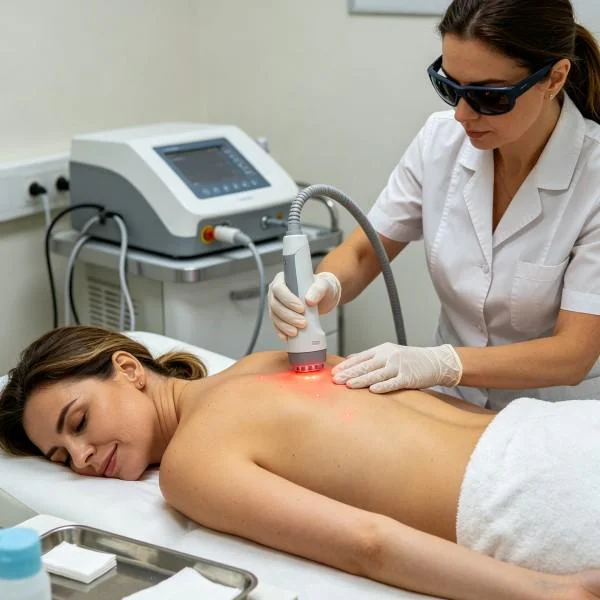
Durch präzises Mikrosekunden-Puls-Gating wird dieser thermische Aufbau an der Oberfläche verhindert. Indem hochintensives Licht in Mikrosekunden-Impulse aufgeteilt wird, die durch kontrollierte Dunkelintervalle voneinander getrennt sind, erhalten tiefe Gelenkstrukturen eine hohe Spitzenbestrahlungsstärke, während sich die empfindliche Haut zwischen den Impulsen sicher abkühlt.
$$\text{Tastverhältnis (\%)} = \left( \frac{\tau_{\text{Impuls}}}{\tau_{\text{Impuls}} + \tau_{\text{Intervall}}} \right) \times 100\text{$$}
Dabei steht $\tau_{\text{pulse}}$ für die aktive optische Übertragung und $\tau_{\text{interval}}$ für die thermische Relaxationspause.
Applying 20W of continuous laser energy over the posterolateral cervical spine triggers uncomfortable skin heating within 3 seconds. In contrast, running that same power through a 20% duty cycle delivers powerful peak bursts that penetrate through dense cervical muscles, while the 80% dark phase allows surface tissues to shed heat safely into the air and the moving handpiece.
Der kapillare Blutfluss leitet die verbleibende Oberflächenwärme ab, während die hypoperfundierte, komprimierte Nervenwurzel eine hohe Photonendichte absorbiert, wodurch der Zellheilungsprozess ohne Reizung der Epidermis in Gang gesetzt wird.
Multi-Wavelength Synergies in Cervical Neurovascular Rehab
Treating complex cervical nerve compression with a single wavelength leaves critical parts of the pathology unaddressed. Cervical radiculopathy involves skin, adipose layers, thick fascial sheaths, deep paraspinal muscle bellies, and inflamed neural tissue. Each distinct anatomical layer features unique water content, vascular density, and optical scattering properties.
Durch die Kombination aufeinander abgestimmter Wellenlängen entsteht ein durchgehender therapeutischer Gradient über alle Gewebetiefen hinweg:
[ Cervical Neurovascular Interaction Matrix ]

810nm  ──► Mitochondrial Cytochrome c Oxidase (Surge in Axonal ATP Synthesis)
980nm  ──► Radicular Capillary Perfusion & NO Release (Flushing Inflammatory Fluid)
1064nm ──► Deep Splenius & Scalene Masses (Forward Directional Penetration)
1470nm ──► Perineural Water Matrices (Decongesting Foraminal Edema)
Die Kombination von 980 nm mit 1470 nm führt zu sofortigen biomechanischen und durchblutungsfördernden Verbesserungen. Der 980-nm-Strahl öffnet komprimierte Mikrovaskulaturbetten und versorgt ischämische Nervenwurzeln mit frischem Sauerstoff. Gleichzeitig zielt die 1470-nm-Wellenlänge auf gebundene Wassermoleküle im Inneren der geschwollenen Nervenscheide ab, lockert starre Kollagenvernetzungen auf und leitet lokalisierte Flüssigkeit ab.
Clinicians use this dual-action delivery to loosen tight, guarded spinal structures, making subsequent manual therapy and cervical postural stabilization exercises far more productive.
Klinische Wirksamkeit der Tiefengewebelasertherapie der Klasse IV
Hochleistungsplattformen haben die Art und Weise revolutioniert, wie spezialisierte Wirbelsäulenzentren und Physiotherapiepraxen schwere Radikulopathien und diskogene Schmerzen behandeln.
Therapists managing chronic cervical radiculopathy, thoracic outlet syndrome, or severe cervicogenic headaches often spend extensive time on slow, painful manual interventions. Low-intensity modalities require 35 to 45 minutes of scanning to deliver minimal joules through deep cervical musculature. Delivering class iv deep tissue laser therapy cuts treatment times to under eight minutes while driving meaningful, therapeutic energy directly to the injury site.
Rehabilitationszentren, die Hochleistungssysteme einsetzen, erkennen klare klinische und betriebliche Vorteile:
First, practitioners achieve meaningful therapeutic energy doses in 6 to 8 minutes, optimizing daily patient throughput and eliminating physical strain from aggressive manual friction.
Second, rapid pain relief breaks the patient’s antalgic guarding, allowing active cervical range-of-motion exercises earlier in their treatment plan.
Drittens stellt eine zuverlässige zelluläre Reparatur des Tiefengewebes den mikrovaskulären Blutfluss wieder her, wodurch radikuläre, stechende Schmerzen beseitigt und der langfristige Erhalt der Bandscheibe gefördert werden.
Dokumentation klinischer Fälle
The following case record details the clinical application of multi-wavelength high-intensity laser therapy for severe, treatment-resistant C5-C6 cervical radiculopathy that had failed to respond to oral gabapentinoids, transforaminal epidural injections, and manual traction.
Details zur Fallakte
Case Identification: SPINE-2026-C5120
Patient Demographics: 48-year-old female, senior architectural draftsman
Primary Diagnosis: Subacute-on-Chronic C5-C6 Left Posterolateral Disc Extrusion with C6 Radiculopathy (Moderate Neuroforaminal Stenosis and Secondary Scalene Anterior Hypertonicity)
Chronicity: 32 weeks of worsening radicular pain; failed two fluoroscopically guided cervical epidural steroid injections, failed high-dose pregabalin (300mg/day) due to daytime dizziness and cognitive blunting
Clinical Assessment: Sharp, shooting electric shock pain traveling down the left lateral arm, forearm, and into the thumb and index finger. Spurling’s test positive on the left side, triggering sharp radiating distal pain (Numeric Pain Rating Scale: 8/10 during head rotation, 6/10 constant dull ache at rest). Diminished brachioradialis reflex (1/4 on left vs 2/4 on right), with weakness in wrist extension (4-/5 manual muscle test).
| Sitzungs-ID | Phase-Protokoll | Wellenlängen-Konfiguration | Durchschnittliche Leistung (W) | Impulsfrequenz und Tastverhältnis | Scanbereich (cm²) | Behandlung Dauer | Gesamtenergie (Joule) | Klinischer Wirksamkeitsindikator |
| Sitzung 01 | Radikuläre Desensibilisierung | 980 nm (75%) + 1470 nm (25%) | 12,0 W | 120 Hz bei einem Tastverhältnis von 20% | 140 | 05:45 | 4.140 J | Resting NPRS drops from 6/10 to 4/10; arm burning eases |
| Sitzung 03 | Entlastung des Foramens | 980 nm (45%) + 1470 nm (55%) | 15,0 W | 250 Hz bei einem Tastverhältnis von 25% | 110 | 06:40 | 6,000 J | Spurling test triggers local pain only; arm numbness recedes |
| Sitzung 06 | Axonal Biostimulation | 810 nm (30%) + 980 nm (45%) + 1470 nm (25%) | 18,0 W | 800 Hz bei einem Tastverhältnis von 35% | 150 | 07:25 | 8.010 J | Radiating pain clears past elbow; wrist extension hits 4+/5 |
| Sitzung 09 | Umgestaltung tiefer Nervenwurzeln | 980 nm (40%) + 1470 nm (60%) | 16,0 W | 20 Hz bei 25%-Tastverhältnis (Deep-Impact-Modus) | 90 | 06:40 | 6.400 J | Full active cervical rotation achieved; Spurling negative |
| Sitzung 12 | Kinetische Konsolidierung | 980 nm (50%) + 1470 nm (50%) | 14,0 W | Dauerstrich (dynamisches Sweeping) | 160 | 07:00 | 5.880 J | Zero resting or active pain; return to drafting duties |
Notizen zum Fallverlauf
Sessions 01 through 03 focused on relieving perineural inflammation, reducing lateral exit foraminal congestion, and dampening hyperactive C-fiber nociceptive signaling. The combination of 980nm and 1470nm cleared inflammatory edema around the C6 nerve root, reducing nocturnal burning and allowing the patient to sleep without waking by the end of the first week.
Sessions 04 through 08 targeted the deep scalene muscular contracture and ischemic foraminal sheath. High water absorption at 1470nm softened the rigid fascial bands, while 980nm and 810nm stimulated capillary blood flow to flush out metabolic waste and recruit reparative cells. Active cervical rotation toward the left opened from 24° to 62° without electric radiating pain into the hand.
By Session 12, the patient demonstrated complete centralization of radicular symptoms, with no remaining peripheral dysesthesia in the thumb or forearm. Motor strength in left wrist extension fully normalized, the brachioradialis reflex returned to a symmetric 2/4 baseline, and the patient resumed drafting architectural blueprints full-time without neck bracing or pain flare-ups.
Biological Mechanisms of Cervical Nerve Decompression
Die hochintensive Tiefengewebe-Lasertherapie regt die Heilung durch integrierte zelluläre und extrazelluläre Mechanismen an:
Photonenabsorption (Mitochondrien und perineurale Wassermatrix)
 │
 ├──► Dissoziation von hemmendem Stickstoffmonoxid ──► Beschleunigte axonale ATP-Synthese
 │
         ├──► Spaltung der interstitiellen Hydratation ────────► Beseitigung von Flüssigkeitsstau im Foramen
 │
 └──► Aktivierung der Endothelzellen ─────────────► Reperfusion der Vasa nervorum
Wenn Photonen auf die Cytochrom-C-Oxidase in gestressten Axonen und Schwann-Zellen treffen, verdrängen sie hemmende Stickstoffmonoxid-Moleküle. Dadurch kann Sauerstoff effizient gebunden werden, was die mitochondriale Elektronentransportkette beschleunigt und zu einem sprunghaften Anstieg der Adenosintriphosphat (ATP)-Produktion führt. Chronisch erschöpfte Zellen gewinnen so die metabolische Energie zurück, die zur Aufrechterhaltung der axonalen Membranpotenziale erforderlich ist.
Gleichzeitig regen Photonen mit einer Wellenlänge von 1470 nm die Wassermoleküle an, die in dem dichten Proteoglykan-Gel gebunden sind, das die komprimierte Nervenwurzel umgibt. Die dadurch entstehenden mikrothermischen Felder lösen starre Kollagenvernetzungen auf, wandeln die viskose Grundsubstanz in einen flüssigen Zustand um und öffnen so Wege für den venösen Abfluss.
Die nachgelagerte Gen-Signalübertragung verändert sich rasch. Entzündungszytokine wie Interleukin-1-beta, Tumornekrosefaktor-alpha und Cyclooxygenase-2 nehmen ab, während der Nervenwachstumsfaktor und der vaskuläre endotheliale Wachstumsfaktor ansteigen.
Diese biochemischen Veränderungen veranlassen die Schwann-Zellen dazu, beschädigte Nervenabschnitte neu zu myelinisieren und die normalen Nervenleitgeschwindigkeiten wiederherzustellen, wodurch neuropathische Entladungen beseitigt werden.
Moving Beyond Injections and Cervical Fusion
Conventional management for severe cervical radiculopathy relies heavily on oral anticonvulsants, repeated cervical epidural steroid injections, and invasive surgical decompression such as anterior cervical discectomy and fusion (ACDF).
Systemic medications dull central pain perception while doing nothing to resolve the mechanical ischemia or axonal degeneration of the nerve root. Repeated epidural cortisone injections provide short-term symptom relief, but carry risks of dural puncture, epidural hematoma, and structural weakening of surrounding ligaments. Spinal surgery decompresses the nerve mechanically, but introduces surgical risks like vocal cord paralysis, adjacent segment disease, hardware failure, and months of restrictive neck bracing.
High-power Class IV laser therapy provides a focused, non-invasive alternative. It avoids systemic drug toxicity, preserves native cervical motion, and eliminates surgical trauma. Clinicians can deliver thousands of therapeutic joules deep into compressed intervertebral foramina and ischemic paraspinal muscles within minutes.
Applying high-intensity multi-wavelength phototherapy targets radicular nerve pain at its biological and vascular source. Foraminal edema drains, vasa nervorum circulation rebounds, and damaged nerve fibers heal cleanly. It turns disabling cervical nerve compression into a predictable, lasting return to active, pain-free living.