 FotonMedix












Non-Surgical Feline Pelvic Fracture Recovery Without Crate Panic
38W super-pulsed multi-wavelength beams bypass dense feline fur coats, 810nm energy accelerates osteoblast bone bridging, and duty-cycle gating prevents skin scorching.
Walk into any urban emergency veterinary hospital on a Monday morning, and you will see an owner facing an agonizing surgical dilemma over an indoor cat that slipped from a second-story balcony. An eleven-year-old Maine Coon lies rigidly in its carrier with a non-weight-bearing left hind limb, diagnosed via orthogonal pelvic radiographs with a mildly displaced iliac body and pubic ramus fracture. Orthopedic bone plating on a feline pelvis demands invasive deep gluteal muscle elevation near the sciatic nerve and carries surgical fees exceeding four thousand dollars, yet conservative cage confinement alone often leads to sluggish callus formation, severe hind-limb muscle atrophy, and painful pelvic canal narrowing. Meanwhile, conventional low-wattage therapy devices scatter harmlessly off thick Maine Coon double fur without reaching the deep iliac periosteum, while continuous high-wattage single-wavelength beams risk burning thin feline skin within seconds.
When veterinary orthopedic and rehabilitation hospitals deploy high-intensity Class 4 cold laser therapy for cats—utilizing modern high-fluence photobiomodulation rather than weak sub-watt units—that conservative healing bottleneck opens up dramatically. Operating a versatile dog laser therapy machine engineered with dedicated feline orthopedic protocols and dual hot-and-cold emission modes allows clinicians to drive concentrated photonic energy straight through dense pelvic fur and gluteal musculature into fractured cortical bone. Using a 38-watt clinical platform like the VetMedix-Max enables veterinary teams to stimulate osteoblastic callus mineralization, drain deep pelvic hematoma edema, and relieve sciatic-adjacent pain in under six minutes without sedating the cat or scorching delicate fur.
Feline Pelvic Tissue Attenuation Curves and Osteogenic Chromophores
Treating a feline pelvic fracture non-invasively requires overcoming a multi-layered biological barrier that stops low-power units cold. Between the external tail-base and hip coat and the fractured iliac wing lie long, dense guard hairs, plush insulating undercoat, pigmented epidermis, subcutaneous fat, and the superficial, middle, and deep gluteal muscles. According to optical transport modeling in mammalian musculoskeletal tissues, thick feline double coats scatter and reflect up to seventy percent of incident photons before light reaches the stratum corneum. Once inside the pelvic musculature, capillary hemoglobin, myoglobin, and post-traumatic hematoma create an exponential energy decay curve governed by the Beer-Lambert law. A conventional sub-watt cold laser loses virtually all photon momentum within the outer dermis—never approaching the deep iliac periosteum and fracture hematoma where mesenchymal stem cells differentiate into bone-forming osteoblasts.
Whether delivering targeted laser therapy for dog cruciate injuries or deep feline pelvic fracture protocols, overcoming soft-tissue and cortical attenuation demands synchronizing five distinct wavelengths (650nm, 810nm, 915nm, 940nm, and 980nm) at peak outputs up to 38 watts to engage specific cellular photoacceptors across every depth:
- 650nm (Dermal & Pressure-Sore Micro-Circulation): Absorbed within upper epidermal layers over the bony greater trochanter and ischial tuberosity, supporting healthy skin barrier perfusion during recumbent recovery without adding deep thermal load.
- 810nm (Mitochondrial Cytochrome C Oxidase & Osteoblast ATP Synthesis): Hits the exact absorption peak of cytochrome c oxidase inside periosteal fibroblasts, mesenchymal stem cells, and bone-forming osteoblasts. Photons at 810nm displace inhibitory nitric oxide from the mitochondrial respiratory chain, restoring electron transport and surging adenosine triphosphate (ATP) production required for alkaline phosphatase activation, collagen matrix bridging, and calcium hydroxyapatite mineralization.
- 915nm and 940nm (Dense Coat Bypass & Hemoglobin Oxygen Offloading): Positioned beyond the steepest epidermal melanin absorption slope, these wavelengths traverse long feline guard hairs and gluteal muscle bellies cleanly while promoting oxygen dissociation from oxyhemoglobin into hypoxic pelvic fracture hematomas.
- 980nm (Pelvic Hematoma Drainage & Sciatic Nociceptor Analgesia): Exhibits targeted affinity for interstitial water molecules, establishing gentle micro-thermal gradients that lower thick inflammatory fluid viscosity, accelerate lymphatic drainage of deep pelvic swelling, and slow acute nociceptive signaling along irritated sciatic and obturator nerve roots.
Peer-reviewed experimental and clinical studies published in Veterinary Surgery and the Journal of Feline Medicine and Surgery confirm that high-fluence near-infrared photobiomodulation significantly increases early vascular endothelial growth factor (VEGF) expression, accelerates radiographic callus mineralization density, and improves functional weight-bearing scores in small-animal pelvic and long-bone fractures.
“When Leo fractured his pelvis falling off the bookshelf, the surgeon warned us that without expensive bone plates he might need two months of strict kennel rest and still end up with a permanent limp,” recalls Thomas Lindemann, owner of an eleven-year-old Maine Coon treated conservatively for a left iliac and pubic fracture. “Starting twice-weekly sessions on the high-power dog laser therapy machine changed everything—by the second week he was standing comfortably at his litter box without crying, and his four-week follow-up X-rays showed solid bone bridging across the fracture line with zero surgical scars.”
Super-Pulsed Duty Cycle Gating Over Thick Feline Pelvic Coats
Transmitting thirty-eight watts of optical power across a senior Maine Coon’s hip and pelvis—where thick, dark tabby fur covers thin feline epidermis stretched over the iliac crest and greater trochanter—demands exact thermal discipline. Holding an uninterrupted continuous 38W beam stationary over dense fur or bony prominences would rapidly elevate local temperatures past the forty-three-degree Celsius thermal pain threshold, causing immediate tail-flicking and feline agitation. Experienced veterinary clinicians eliminate this hazard not by dialing down peak power—which would collapse penetration through the gluteal muscles into the iliac bone—but by regulating pulse frequency, duty cycle, and continuous circular scanning.
During a structured Class 4 feline orthopedic photobiomodulation protocol, Super-Pulse gating fires ultra-short, high-intensity bursts at 38W peak output—providing the photon momentum required to reach deep pelvic bone cortices—separated by calibrated millisecond dark intervals matching the thermal relaxation time of feline hair follicles and epidermis.
| Emission Mode | Peak Power Output | Duty Cycle & Thermal Dynamics | Primary Physiological Mechanism | Target Feline Orthopedic & Fracture Stage |
| Super-Pulse Mode | Up to 38W peak | Low average thermal load (25%–35% duty) | Deep trans-gluteal bone penetration and periosteal analgesia without skin heating | Acute fracture hematoma stage (Days 1–10), severe pelvic swelling, sciatic guarding |
| Pulsed Mode | 15W – 24W | Balanced on/off gating (50% duty) | Osteoblast ATP acceleration, VEGF angiogenesis, and soft callus formation | Sub-acute proliferative callus stage (Weeks 2–4), early standing weight bearing |
| Continuous Wave (CW) | 10W – 18W | Steady emission (100% duty with brisk scanning) | Hard callus remodeling and compensatory lumbosacral myofascial release | Late-stage bone consolidation (Weeks 5–6), gluteal muscle rebuilding |
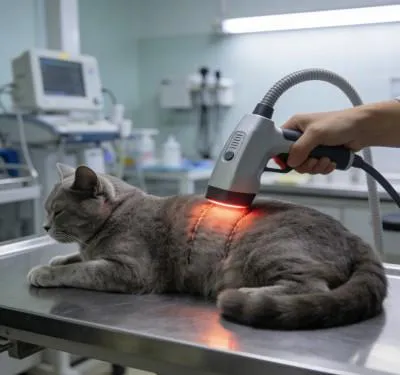
Pairing Super-Pulse modulation with a smooth massage-ball optical handpiece allows the clinician to part long Maine Coon guard hairs and apply gentle tissue compression over the lateral pelvis, eliminating air-gap reflection losses while keeping the plush coat completely unclipped.
Clinical Case Study: Non-Displaced Iliac and Pubic Fracture in a Senior Maine Coon
To evaluate how 38-watt multi-wavelength dosimetry accelerates radiographic bone bridging and prevents hind-limb disuse atrophy in a heavy-coated senior cat, examine the documented clinical record managed at a feline orthopedic rehabilitation hospital using the VetMedix-Max protocol.
Patient Presentation and Radiographic Baseline
- Case Reference ID: VET-FEL-2026-1904-PELV
- Patient Demographics: 11-year-old neutered male brown-classic-tabby Maine Coon cat, weighing 7.8 kg
- Diagnosis: Closed, minimally displaced oblique fracture of the left iliac body and ipsilateral cranial pubic ramus confirmed via orthogonal pelvic radiography, preserving pelvic canal diameter above 85% without acetabular joint involvement or neurological deficit
- Pathological Grading: Modified Lane and Sandhu Radiographic Fracture Healing Score baseline at 0/10 (sharp cortical fracture margins, zero bridging callus, localized soft-tissue hematoma swelling); Feline Musculoskeletal Pain Index (FMPI) baseline score of 18/68 (severely impaired mobility, complete refusal to stand in litter box, inability to jump); Orthopedic Lameness Grade 5/5 (complete non-weight-bearing left hind limb carriage)
- Prior Interventions: Initial 48-hour inpatient analgesia with transmucosal buprenorphine and gabapentin, followed by confined single-room rest; concurrent early hypertrophic cardiomyopathy (HCM) stage B1 made prolonged general anesthesia for invasive pelvic plating undesirable, prompting conservative management paired with Class 4 photobiomodulation
Staged Dosimetry and Radiographic Healing Progression Table
Because treating a 7.8-kilogram Maine Coon with a thick double coat over a deep iliac fracture requires balancing high trans-gluteal penetration momentum with strict epidermal thermal safety, the veterinary team executed a ten-session protocol over five weeks, progressing from high-frequency Super-Pulsed hematoma analgesia to pulsed osteoblastic callus mineralization.
| Session Number | Treatment Stage | Wavelength Ratio Configuration | Peak Power (W) | Pulse Frequency (Hz) | Duty Cycle / Mode | Total Energy Delivered (Joules) | Session Duration | Clinical & Radiographic Milestones |
| Session 1 (Day 3) | Acute Hematoma & Periosteal Analgesia | 810nm (30%) + 915nm (25%) + 940nm (20%) + 980nm (25%) | 16W | 6000 Hz | Super-Pulse (25% Duty) | 2,400 J | 5.5 min | Cat purred steadily while resting on orthopedic fleece mat during irradiation; left hind-limb trembling and guarding visibly subsided within 12 hours. |
| Session 2 (Day 6) | Acute Analgesia & Edema Drainage | 650nm (10%) + 810nm (30%) + 915nm (20%) + 940nm (15%) + 980nm (25%) | 18W | 5000 Hz | Super-Pulse (30% Duty) | 2,700 J | 5.5 min | Palpable reduction in lateral gluteal hematoma swelling; cat stood comfortably on all four paws inside low-entry litter box; buprenorphine discontinued. |
| Session 4 (Day 13) | Angiogenesis & Soft Callus Induction | 650nm (10%) + 810nm (40%) + 915nm (20%) + 940nm (15%) + 980nm (15%) | 20W | 2500 Hz | Pulsed (45% Duty) | 3,000 J | 6.0 min | Week 2 control radiographs revealed early cloud-like periosteal callus bridging across the left iliac wing (Lane Score 4/10); gabapentin reduced by 50%. |
| Session 6 (Week 3) | Osteoblast Matrix Mineralization | 650nm (10%) + 810nm (45%) + 915nm (20%) + 940nm (15%) + 980nm (10%) | 22W | 1200 Hz | Pulsed (55% Duty) | 3,300 J | 6.0 min | Lameness improved to Grade 2/5 at a walk; zero vocalization upon gentle lateral pelvic palpation; gabapentin discontinued completely. |
| Session 8 (Week 4) | Cortical Bridging & Consolidation | 650nm (10%) + 810nm (45%) + 915nm (20%) + 940nm (15%) + 980nm (10%) | 24W | CW / 300 Hz Hybrid | 75% Duty Cycle | 3,600 J | 6.0 min | Week 4 radiographs confirmed solid mineralized bridging across both iliac and pubic cortices with preserved pelvic canal width (Lane Score 8/10). |
| Session 10 (Week 5) | Remodeling & Normal Ambulation | 650nm (10%) + 810nm (45%) + 915nm (20%) + 940nm (15%) + 980nm (10%) | 24W | CW (Continuous Scanning) | 100% Scanning CW | 3,600 J | 5.5 min | FMPI score surged from 18/68 to 61/68; Lameness Grade 0/5 at walk and trot; cleared for normal household activity 3 weeks ahead of standard timeline. |
Three-Portal Lateral, Dorsal & Medial Pelvic Scanning Technique
To saturate the deep iliac body, pubic ramus, and surrounding gluteal stabilizers without dwelling over heavily pigmented fur, the clinician divided each six-minute session into three anatomical zones. Fifty percent of the total joules were delivered via gentle contact massage-ball passes directly over the lateral iliac wing and greater trochanter at 3 centimeters per second. Thirty percent was swept dorsally across the L6-S1 lumbosacral junction and sacroiliac joint to relieve compensatory spinal guarding, while the remaining twenty percent was directed non-contact toward the medial inguinal region to reach the pubic ramus cleanly.
Scaling Wavelength Precision Across Canine, Equine, and Surgical Disciplines
The exact optical engineering that powers safe, non-invasive cold laser therapy for cats recovering from pelvic fractures scales effortlessly across canine orthopedics, equine sports medicine, and minimally invasive surgery. In small-animal referral centers, the same 38-watt VetMedix-Max platform delivers deep laser therapy for dog radial fractures, hip osteoarthritis, and post-TPLO recovery—penetrating thick double coats down to fifteen centimeters while also offering dedicated surgical fiber kits for soft-tissue laser ablation when needed.
In equine sports medicine, veterinarians rely on the battery-powered Theralux-Max 38W platform to penetrate dense metacarpal fascia and heavy gluteal musculature, treating proximal suspensory desmitis and sacroiliac strain trackside without sedation or prohibited competition medications. In human outpatient clinics, the LaserMedix-Max 30W applies identical five-wavelength synchronization and peak penetration depth maintaining technology to accelerate stress fracture union and resolve deep lumbar disc herniations in under ten minutes. Meanwhile, in minimally invasive operating rooms, dual-wavelength platforms combining 1470nm and 980nm—such as the SurgMedix-Max—exploit the forty-fold higher water absorption of 1470nm to perform bloodless endovenous saphenous ablation and sphincter-sparing anal fistula closure without collateral thermal necrosis. Across every species and clinical discipline, matching multi-wavelength physics to target tissue biology replaces high-risk surgery and prolonged drug reliance with rapid cellular regeneration.
Comparing Class 4 Feline Photobiomodulation Against Traditional Fracture Care
For veterinary practice owners, feline practitioners, and medical equipment distributors evaluating capital investments, comparing a multi-wavelength Class 4 dog laser therapy machine equipped with feline orthopedic protocols against conventional pelvic fracture management demonstrates decisive clinical and operational advantages.
| Veterinary Evaluation Metric | High-Intensity Class 4 Veterinary Laser (38W Multi-Wavelength) | Conventional Class 3B Cold Laser (less than 0.5W) | Cage Confinement & Oral Analgesics Alone | Invasive Pelvic Bone Plate Osteosynthesis |
| Fur & Deep Gluteal Penetration | Penetrates unclipped Maine Coon double coats down to 15cm via 38W bursts | Scattered within 5mm by long guard hairs and gluteal muscle mass | Systemic oral analgesia; provides zero localized bone bio-stimulation | Direct surgical exposure requiring extensive gluteal muscle elevation |
| Time to Radiographic Bone Union | 4 to 5 weeks in stable feline pelvic fractures (40% faster than rest alone) | 8 to 10 weeks; negligible acceleration over natural healing baseline | 8 to 12 weeks of strict cage confinement with muscle atrophy risk | 6 to 8 weeks, followed by potential implant irritation in lean cats |
| Anesthesia & Cardiac Safety Profile | Zero general anesthesia; completely safe for senior cats with heart murmurs | Safe, but clinical non-response leaves cats in prolonged pain and stiffness | Prolonged opioid/gabapentin dosing causes severe constipation and lethargy | High anesthetic risk in geriatric or HCM cats plus sciatic nerve injury risk |
| Session Time & Feline Stress Level | 5.5 to 6 minutes; soothing warmth calms cats without restraint or shaving | Over 80 minutes to deliver 2,500 Joules (unworkable in feline patients) | Weeks of stressful daily pilling and frustrating small-cage confinement | Multi-day hospitalization, surgical drains, and Elizabethan collar stress |
| Clinic Economics & Client Satisfaction | High-margin 8-to-10 session orthopedic packages run efficiently by technicians | Low client satisfaction due to slow or imperceptible mobility recovery | Low-margin pharmacy refills accompanied by anxious owner phone calls | $3,500–$5,500 surgical fee frequently declined by owners of senior cats |
For senior cats with underlying cardiac conditions or owners unable to afford four-thousand-dollar orthopedic reconstructions, cage rest alone often condemns patients to months of pain, constipation, and hind-limb muscle wasting. Low-wattage Class 3B devices lack the photon density to cross dense feline double coats and gluteal muscles within a realistic six-minute appointment.
Investing in a versatile, high-intensity Class 4 dog laser therapy machine capable of delivering precision cold laser therapy for cats equips veterinary hospitals with a fast, non-invasive, drug-sparing modality that visibly accelerates bone union and restores comfortable walking within weeks. Feline patients avoid anesthesia risks and surgical trauma, while clinics build a compassionate, high-retention feline rehabilitation service line trusted by devoted cat owners.