 FotonMedix











Trans-Cheek Feline Stomatitis Relief Without Full-Mouth Extractions
Synchronized five-wavelength beams penetrate feline buccal cheeks, 810nm energy calms mucosal T-cell inflammation, and super-pulsed gating prevents skin overheating.
Walk into any feline-friendly veterinary clinic on a Tuesday morning, and you will see an owner in tears over a cat that refuses to eat despite being visibly hungry. An eight-year-old domestic shorthair sits hunched beside its food bowl, drooling thick, blood-tinged saliva and pawing frantically at its mouth due to severe feline chronic gingivostomatitis (FCGS). Standard medical management traps cats in endless cycles of long-acting corticosteroid injections that trigger feline diabetes mellitus, while radical full-mouth tooth extraction leaves up to thirty percent of refractory patients still suffering from agonizing caudal oral mucositis. Attempting to treat a fractious, painful cat inside the mouth requires repeated general anesthesia, low-wattage therapy devices scatter harmlessly off dense facial fur without reaching the inflamed palatoglossal folds, and continuous high-wattage single-wavelength beams risk burning thin feline cheek skin within seconds.
When companion-animal hospitals adopt high-intensity Class 4 cold laser therapy for cats—upgrading from weak sub-watt units to modern multi-wavelength photobiomodulation—clinicians can deliver therapeutic energy transcutaneously right through the external cheek without forcing open a painful jaw. Operating a versatile dog laser therapy machine engineered with dedicated feline protocols and dual hot-and-cold emission modes allows veterinarians to target deep oral mucosal inflammation non-invasively. Deploying a 38-watt clinical platform like the VetMedix-Max enables veterinary teams to suppress neurogenic oral pain, shrink proliferative buccal ulcers, and restore comfortable chewing in under five minutes per visit without sedating the cat or scorching delicate facial fur.
Feline Buccal Tissue Attenuation Curves and Mucosal Chromophore Targets
Treating feline chronic gingivostomatitis transcutaneously requires navigating a compact yet optically dense anatomical corridor. Between the external whisker pad and the inflamed caudal oral mucosa lie dense facial guard hairs, pigmented epidermis, subcutaneous adipose pads, the buccinator and masseter muscles, and thick salivary gland tissue. According to Monte Carlo optical transport modeling in small-mammal facial tissues, fine, dense feline fur scatters and reflects up to sixty-five percent of incident photons before light reaches the stratum corneum. Once inside the cheek wall, capillary hemoglobin, melanin, and interstitial fluid create an exponential energy decay curve governed by the Beer-Lambert law. A conventional low-wattage unit emitting less than half a watt loses virtually all photon flux within the outer dermis—never approaching the deep palatoglossal arches and sublingual mucosa where lymphoplasmacytic inflammation thrives.
Whether delivering targeted laser therapy for dog orthopedic joints or trans-cheek feline oral protocols, overcoming tissue scattering demands synchronizing five distinct wavelengths (650nm, 810nm, 915nm, 940nm, and 980nm) at peak outputs up to 38 watts to engage specific cellular photoacceptors across every anatomical depth:
- 650nm (Perioral & Lip-Margin Epithelial Priming): Absorbed within upper epidermal layers around the commissures of the lips, accelerating closure of saliva-scalded dermal erosions without adding deep thermal load.
- 810nm (Mitochondrial Cytochrome C Oxidase & Mucosal Immunomodulation): Hits the exact absorption peak of cytochrome c oxidase inside mucosal epithelial cells, fibroblasts, and infiltrating lymphocytes. Photons at 810nm displace inhibitory nitric oxide from the mitochondrial respiratory chain, restoring electron transport and surging adenosine triphosphate (ATP) production required to downregulate pro-inflammatory cytokines and regenerate ulcerated oral epithelium.
- 915nm and 940nm (Facial Coat Bypass & Hemoglobin Oxygen Offloading): Positioned beyond the steepest epidermal melanin absorption slope, these wavelengths traverse dense cheek fur and masseter fibers cleanly while promoting oxygen dissociation from oxyhemoglobin into ischemic, friable mucosal lesions.
- 980nm (Submucosal Edema Drainage & Trigeminal Nociceptor Analgesia): Exhibits targeted affinity for interstitial water molecules, establishing gentle micro-thermal gradients that lower inflammatory fluid viscosity, stimulate lymphatic drainage of buccal swelling, and slow acute nociceptive signaling along irritated maxillary and mandibular trigeminal nerve branches.
Peer-reviewed clinical investigations published in the Journal of Feline Medicine and Surgery and Veterinary Dentistry confirm that high-fluence near-infrared photobiomodulation significantly reduces oral ulceration severity scores, decreases lymphocytic-plasmacytic mucosal infiltration, and restores voluntary food intake in cats suffering from refractory caudal stomatitis.
“For six months after his full-mouth dental extractions, Oliver still screamed whenever he tried to swallow soft pate, lost nearly three pounds, and hid under the bed all day because steroid shots had stopped working,” shares Sophia Lindqvist, owner of an eight-year-old domestic shorthair treated for refractory feline gingivostomatitis. “After just three quick trans-cheek sessions on the high-power dog laser therapy machine, the thick drooling stopped and he walked straight over to his bowl to eat without flinching—within a month he had gained back his weight and started purring again without needing a single steroid injection.”
Super-Pulsed Duty Cycle Gating Over Thin Feline Cheek Skin
Transmitting thirty-eight watts of optical power across a cat’s cheek—where thin, delicate skin stretches tightly over the masseter muscle and zygomatic arch with minimal subcutaneous fat—requires exact thermal discipline. Holding an uninterrupted continuous 38W beam stationary over dark tabby fur or sensitive facial skin would rapidly elevate local temperatures past the forty-three-degree Celsius thermal pain threshold, causing immediate head withdrawal and feline stress. Experienced veterinary clinicians eliminate this hazard not by dialing down peak power—which would collapse penetration through the cheek wall into the oral cavity—but by regulating pulse frequency, duty cycle, and gentle circular scanning.
During a structured Class 4 trans-cheek photobiomodulation protocol, Super-Pulse gating fires ultra-short, high-intensity bursts at 38W peak output—providing the photon momentum required to reach deep caudal oral lesions—separated by calibrated millisecond dark intervals matching the thermal relaxation time of thin feline epidermis.
| Emission Mode | Peak Power Output | Duty Cycle & Thermal Dynamics | Primary Physiological Mechanism | Target Feline Oral & Soft-Tissue Stage |
| Super-Pulse Mode | Up to 38W peak | Low average thermal load (25%–35% duty) | Deep trans-cheek penetration and trigeminal analgesia without skin heating | Acute ulcerative feline stomatitis, severe ptyalism, post-extraction oral pain |
| Pulsed Mode | 12W – 20W | Balanced on/off gating (50% duty) | Mucosal fibroblast ATP acceleration, angiogenesis, and submucosal drainage | Sub-acute proliferative gingivostomatitis, lingual ulcers, sialocele edema |
| Continuous Wave (CW) | 8W – 14W | Steady emission (100% duty with brisk scanning) | Superficial lip-commissure healing and masseter muscle spasm relaxation | Late-stage mucosal consolidation, chronic jaw-guarding myofascial tension |
Pairing Super-Pulse modulation with a non-contact open-beam handpiece held two centimeters from the external cheek eliminates mechanical pressure over painful facial tissues while delivering soothing warmth that calms anxious cats without physical restraint.
Clinical Case Study: Refractory Caudal Gingivostomatitis in an Adult Cat
To evaluate how 38-watt multi-wavelength dosimetry resolves painful oral ulcers and eliminates steroid dependency in a refractory feline patient, examine the documented clinical record managed at a feline specialty hospital using the VetMedix-Max protocol.
Patient Presentation and Oral Baseline
- Case Reference ID: VET-FEL-2026-1812-FCGS
- Patient Demographics: 8-year-old neutered male brown-tabby Domestic Shorthair cat, weighing 4.1 kg (down from 5.4 kg baseline)
- Diagnosis: Severe refractory feline chronic gingivostomatitis (FCGS) persisting six months post-full-mouth dental extraction, characterized by bilateral cobblestone proliferative ulceration of the palatoglossal folds, buccal mucosa, and lateral pharyngeal arches, accompanied by thick ropy ptyalism and halitosis
- Pathological Grading: Stomatitis Disease Activity Index (SDAI) Score of 24/30 (severe oral inflammation, spontaneous mucosal bleeding, complete refusal of dry kibble, and marked reluctance to groom); Owner Oral Pain Visual Analog Scale (VAS) at 8.9/10; severe vocalization and head-pulling upon gentle external palpation of the caudal cheeks
- Prior Interventions: Complete full-mouth extraction confirmed free of retained root tips via dental radiography, followed by three repositol methylprednisolone injections, oral cyclosporine, and buprenorphine; patient developed early steroid-induced hyperglycemia (blood glucose 245 mg/dL) and severe nausea from oral cyclosporine, forcing cessation of immunosuppressive drugs
Staged Dosimetry and Mucosal Recovery Table
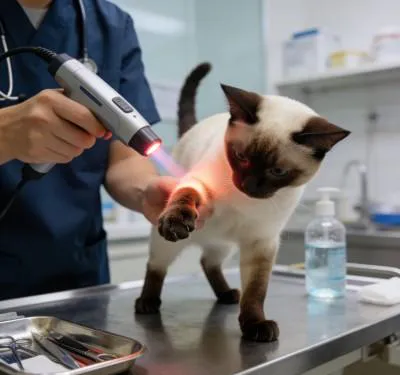
Because treating a thin-skinned feline cheek with heavily pigmented tabby stripes requires balancing trans-buccal penetration momentum with strict epidermal thermal safety, the veterinary team executed a ten-session protocol over five weeks, progressing from high-frequency Super-Pulsed trigeminal analgesia to pulsed mucosal epithelial remodeling.
| Session Number | Treatment Stage | Wavelength Ratio Configuration | Peak Power (W) | Pulse Frequency (Hz) | Duty Cycle / Mode | Total Energy Delivered (Joules) | Session Duration | Clinical & Oral Healing Milestones |
| Session 1 | Acute Trigeminal Analgesia | 810nm (30%) + 915nm (25%) + 940nm (20%) + 980nm (25%) | 12W | 6000 Hz | Super-Pulse (25% Duty) | 1,200 J (600 J/side) | 4.5 min | Cat purred softly while resting in owner’s towel wrap during non-contact trans-cheek irradiation; blood-tinged drooling stopped within 24 hours. |
| Session 2 | Acute Analgesia & Edema Drainage | 650nm (10%) + 810nm (30%) + 915nm (20%) + 940nm (15%) + 980nm (25%) | 14W | 5000 Hz | Super-Pulse (30% Duty) | 1,400 J (700 J/side) | 4.5 min | Owner Oral Pain VAS score dropped from 8.9 to 4.8/10; cat voluntarily ate two full cans of warmed wet food without pawing at mouth. |
| Session 4 | Mucosal Ulcer Contraction | 650nm (15%) + 810nm (35%) + 915nm (20%) + 940nm (15%) + 980nm (15%) | 16W | 2500 Hz | Pulsed (45% Duty) | 1,600 J (800 J/side) | 5.0 min | Visual oral exam showed 50% flattening of proliferative palatoglossal lesions and cessation of spontaneous mucosal bleeding; buprenorphine discontinued. |
| Session 6 | Epithelial Bridging & Grooming Return | 650nm (15%) + 810nm (40%) + 915nm (15%) + 940nm (15%) + 980nm (15%) | 18W | 1200 Hz | Pulsed (55% Duty) | 1,800 J (900 J/side) | 5.0 min | Cat resumed normal self-grooming of forepaws and chest; blood glucose normalized to 112 mg/dL off steroids; weight increased to 4.5 kg. |
| Session 8 | Submucosal Fibroblast Remodeling | 650nm (20%) + 810nm (40%) + 915nm (15%) + 940nm (15%) + 980nm (10%) | 20W | CW / 300 Hz Hybrid | 75% Duty Cycle | 2,000 J (1,000 J/side) | 5.0 min | Caudal buccal and palatoglossal mucosa smooth and pale pink with over 85% ulcer resolution; cat began crunching small dry kibble pieces comfortably. |
| Session 10 | Functional Consolidation | 650nm (20%) + 810nm (40%) + 915nm (15%) + 940nm (15%) + 980nm (10%) | 20W | CW (Continuous Scanning) | 100% Scanning CW | 2,000 J (1,000 J/side) | 4.5 min | SDAI score fell from 24/30 to 3/30; Oral Pain VAS score at 0.4/10; body weight restored to 5.1 kg; transitioned to single monthly maintenance visits. |
Bilateral Trans-Cheek & Submandibular Scanning Technique
To bathe both the caudal palatoglossal arches and the submandibular lymph nodes without opening the cat’s sore mouth or overheating dark tabby cheek stripes, the clinician divided each session across two external anatomical zones per side. Seventy percent of the total joules were delivered via non-contact circular scanning passes held two centimeters from the lateral cheek—extending from the lip commissure caudally to the temporomandibular joint—at 3 centimeters per second. The remaining thirty percent was swept gently along the ventral submandibular and retropharyngeal lymph node region to accelerate lymphatic drainage of oral inflammatory mediators and relax masseter muscle guarding.
Scaling Wavelength Precision Across Canine, Equine, and Surgical Disciplines
The exact optical engineering that powers safe trans-cheek cold laser therapy for cats scales effortlessly across canine orthopedics, equine sports medicine, and minimally invasive surgery. In small-animal hospitals, the same 38-watt VetMedix-Max platform delivers deep laser therapy for dog hip osteoarthritis, cranial cruciate ligament tears, and post-TPLO bone healing—penetrating thick double coats down to fifteen centimeters while also offering dedicated surgical fiber kits for intraoral laser ablation when required.
In equine sports medicine, veterinarians rely on the battery-powered Theralux-Max 38W platform to penetrate dense metacarpal fascia and heavy gluteal musculature, treating proximal suspensory desmitis and sacroiliac strain trackside without sedation or prohibited competition medications. In human outpatient clinics, the LaserMedix-Max 30W applies identical five-wavelength synchronization and peak penetration depth maintaining technology to resolve deep lumbar disc herniations and temporomandibular joint dysfunction in under ten minutes. Meanwhile, in minimally invasive operating rooms, dual-wavelength platforms combining 1470nm and 980nm—such as the SurgMedix-Max—exploit the forty-fold higher water absorption of 1470nm to perform bloodless endovenous saphenous ablation and sphincter-sparing anal fistula closure without collateral thermal necrosis. Across every species and clinical discipline, matching multi-wavelength physics to target tissue biology replaces toxic systemic medications and repeated anesthesia with rapid cellular regeneration.
Comparing Class 4 Trans-Cheek Photobiomodulation Against Traditional Stomatitis Care
For veterinary practice owners, feline practitioners, and medical equipment distributors evaluating capital investments, comparing a multi-wavelength Class 4 dog laser therapy machine equipped with feline protocols against conventional stomatitis treatments demonstrates decisive clinical and operational advantages.
| Veterinary Evaluation Metric | High-Intensity Class 4 Veterinary Laser (38W Multi-Wavelength) | Conventional Class 3B Cold Laser (less than 0.5W) | Long-Acting Corticosteroid Injections | Oral Cyclosporine & Opioid Analgesics |
| Trans-Cheek Penetration & Patient Comfort | Crosses external cheek fur and muscle via 38W super-pulsed bursts; no jaw opening | Scattered within 4mm by facial fur and cheek muscle; fails to reach oral folds | Systemic injection; requires repeated stressful clinic restraint | Daily oral liquid/capsules extremely difficult to administer into a painful mouth |
| Session Time & Restraint Requirement | 4.5 to 5 minutes; non-contact warmth calms cats inside owner towel wrap | Over 60 minutes to deliver 1,500 Joules (impossible in awake feline patients) | 10-minute nurse visit, but efficacy diminishes rapidly with repeated doses | Daily owner struggle causing hypersalivation, vomiting, and loss of trust |
| Impact on Mucosal Healing & Appetite | Accelerates epithelial bridging, reduces T-cell inflammation, restores eating fast | Negligible deep palatoglossal stimulation within realistic appointment times | Temporarily masks inflammation, but thins mucosa and delays tissue repair | Suppresses immune response slowly over 4–6 weeks; frequent GI intolerance |
| Metabolic & Organ Safety Profile | Zero diabetic, renal, or hepatic toxicity; thermal safety via Super-Pulse gating | Safe, but high rate of clinical non-response leaves cats malnourished | High risk of iatrogenic diabetes mellitus, skin fragility, and heart failure | Risk of severe nausea, anorexia, hepatic stress, and opportunistic infections |
| Clinic Workflow & Client Loyalty | High-margin 8-to-10 session feline oral care packages run by technicians | Low client satisfaction due to slow or imperceptible pain relief | Low-margin steroid shots accompanied by frustrated emergency rechecks | High owner abandonment rate due to pilling stress and medication cost |
Repeated corticosteroid injections place middle-aged and senior cats at severe risk of developing insulin-dependent diabetes mellitus, while forcing bitter liquid medications into an ulcerated feline mouth destroys the human-animal bond. Low-wattage Class 3B devices lack the photon density to traverse the cheek wall within a realistic five-minute feline appointment window.
Investing in a versatile, high-intensity Class 4 dog laser therapy machine capable of delivering precision cold laser therapy for cats equips veterinary hospitals with a gentle, drug-sparing modality that restores comfortable eating and purring within days. Feline patients avoid repeated anesthesia and metabolic drug toxicity, while clinics build a compassionate, high-retention feline medicine service line trusted by devoted cat owners.