 FotonMedix











Overcoming Deep Nerve Fibrosis in Piriformis Syndrome
Dual-action hemoglobin oxygenation, deep water resonance, and modulated thermal duty gating resolve sciatic nerve entrapment across dense gluteal musculature.
Physical therapy practices frequently see sciatic rehabilitation stall when managing chronic piriformis syndrome accompanied by deep intraneural fibrosis. Patients endure sharp radiating buttock pain, posterior thigh paresthesia, and burning dysesthesia down to the foot that fail to resolve after manual release, dry needling, and lumbar traction. Clinicians attempting treatment with a standard medical grade cold laser therapy device run directly into an anatomical impasse: low-milliwatt beams scatter entirely within the massive gluteus maximus, thick subcutaneous adipose sheaths, and deep sacrospinous ligaments. At depths past twenty millimeters, optical irradiance falls well beneath biological activation levels, leaving the compressed sciatic sheath completely untreated. When practitioners attempt to compensate by blasting high-power units in unmodulated continuous mode, rapid dermal thermal buildup forces them to stop before achieving deep photon saturation. Resolving this deep-seated nerve compression requires deploying a high-intensity therapy laser that pairs targeted 980 nm and 1470 nm chromophore absorption with precision duty-cycle gating to bypass superficial thermal barriers.
Photonic Transmission Across Dense Gluteal Musculoskeletal Layers
Delivering an effective photobiomodulation dose to the infrapiriform foramen requires penetrating through some of the thickest soft-tissue barriers in the human body: epidermis, dense gluteal adipose cushions, thick gluteal aponeurotic fascia, and the bulky, contracted muscle fibers of the gluteus maximus. Photons traveling through this layered anatomical volume encounter extreme forward and lateral scattering alongside substantial bulk absorption, as modeled in tissue optics principles established by researchers like Steven Jacques and Lihong Wang.
In coarse skeletal muscle tissue, structural striations and heavy intracellular myoglobin act as substantial optical dispersers and absorbers. Low-power units lose clinical viability because their photon flux drops below the biostimulation threshold of 0.01 W per square centimeter long before clearing the outer third of the gluteal mass. To reach the impinged sciatic nerve trunk resting 40 to 60 millimeters beneath the posterior skin surface, clinics must employ a high-power Class IV laser therapy device. High initial radiant power delivers enough coherent photon flux through intervening tissue beds so that the remaining unattenuated photon density arriving at the deep nerve bed is sufficient to drive metabolic and microvascular repair.
Synergistic Chromophore Targeting: Perineural Microcirculation and Hydrated Fascial Bands
Treating persistent sciatic nerve entrapment requires simultaneously addressing deep vascular ischemia and dense perineural scar tissue. Using a multi-wavelength emission system handles both pathological drivers through distinct cellular targets:
The 980 nm wavelength interacts strongly with tissue hemoglobin, targeting the microcirculatory bed of the vasa nervorum that nourishes the sciatic nerve trunk. Chronic piriformis muscle spasm subjects the sciatic nerve to mechanical compression, leading to capillary collapse, local hypoxia, and the buildup of acidic inflammatory metabolites that provoke spontaneous axonal firing. Exposure to 980 nm light triggers the photodissociation of nitric oxide from cytochrome c oxidase in cellular mitochondria. This biological event causes immediate local vasodilation, restores microvascular perfusion to ischemic nerve fibers, flushes neuro-inflammatory debris, and replenishes adenosine triphosphate pools to stabilize irritable neural membranes.
The 1470 nm wavelength corresponds directly to a prominent resonance absorption band in interstitial water, which comprises the primary matrix of the perineural sheath, loose intermuscular sliding planes, and inflammatory fluid collections. Chronic piriformis contracture thickens surrounding connective tissue and creates dense collagenous cross-links that lock the nerve trunk in place. Delivering 1470 nm radiation introduces controlled, non-destructive photothermal warming directly into bound water molecules. This localized action softens rigid fibrillar adhesions, enhances tissue elasticity, and frees the tethered sciatic nerve without damaging structural proteins or triggering thermal coagulation. Sourcing equipment from a dedicated medical laser equipment supplier ensures calibrated multi-wavelength output, enabling operators to deliver precise optical dosing to deep musculoskeletal structures.
Thermal Dissipation Control Through Gated Duty Cycles
Directing high continuous wattage into deep gluteal layers risks thermal stacking in superficial dermal and subcutaneous fat tissues. Protecting skin integrity while delivering deep energy saturation requires respecting the thermal relaxation time of human skin and adipose layers, which ranges between 20 and 45 milliseconds.
Pulsed duty-cycle gating eliminates this thermal bottleneck. By pulsing high peak power in tight microsecond bursts followed by calibrated rest periods, superficial capillary networks and dermis conduct accumulated heat away into adjacent tissue beds. Meanwhile, penetrating photon packets continue propagating into deep connective and neural zones. Modulating duty cycles between 25% and 45% allows clinical teams to project sufficient energy densities into the infrapiriform space while keeping surface temperatures well below thermal pain thresholds.
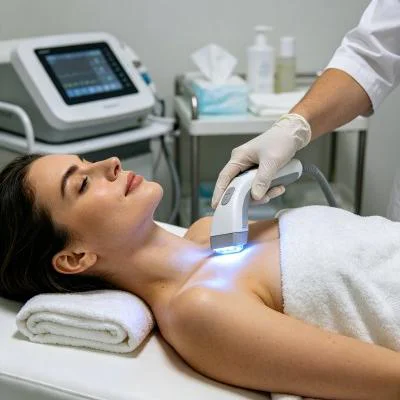
Clinical Protocol: Multi-Wavelength Class IV Laser Therapy in Refractory Piriformis Syndrome
The following clinical data represents an outpatient rehabilitation protocol for a patient suffering from long-standing piriformis syndrome with secondary sciatic entrapment.
Patient Profile and Clinical Baseline
- Case Identifier: FTM-NEURO-2026-1408
- Patient Age: 44
- Sex: Female
- Primary Diagnosis: Chronic left piriformis syndrome with entrapment of the main sciatic nerve trunk and secondary gluteal myofascial pain syndrome, symptom duration 10 months
- Prior Treatments: Oral NSAIDs, skeletal muscle relaxants, two local piriformis corticosteroid/anesthetic injections (transient numbness followed by full recurrence), six weeks of targeted physical therapy, and dry needling
- Baseline Diagnostics: High-resolution neuromuscular ultrasound and pelvis MRI confirmed left piriformis muscle hypertrophy (thickness 18.6 mm vs. 12.2 mm on the unaffected contralateral side) with focal compression, flattening, and hypoechoic perineural edema of the underlying sciatic nerve trunk at the infrapiriform foramen. The patient demonstrated positive FAIR (flexion, adduction, internal rotation) and Beatty tests, marked antalgic gait, and radiating pain into the posterior thigh and lateral calf. Baseline Visual Analog Scale (VAS) pain score stood at 8.4/10 during sitting longer than 15 minutes. Oswestry Disability Index (ODI) score measured 62.0%.
Treatment Parameters and Technical Dosing Schedule
The patient completed a four-week clinical protocol consisting of twelve therapy sessions delivered three times per week. Treatments utilized deep-contact compression scanning along the gluteal course of the piriformis muscle to displace superficial venous blood, combined with continuous-wave linear passes targeting the sciatic pathway toward the ischial tuberosity.
| Session Range | Optical Wavelength Ratio | Peak Power Output | Pulse Gating Frequency | Effective Duty Cycle | Session Duration | Applied Radiant Exposure | Total Energy Delivered |
| Sessions 1–3 | 75% 980 nm, 25% 1470 nm | 10.0 W | 20 Hz | 30% | 600 s | 18.0 J/cm² | 1,800 J |
| Sessions 4–6 | 65% 980 nm, 35% 1470 nm | 12.0 W | 40 Hz | 35% | 540 s | 25.0 J/cm² | 2,268 J |
| Sessions 7–9 | 55% 980 nm, 45% 1470 nm | 14.0 W | 80 Hz | 40% | 480 s | 32.0 J/cm² | 2,688 J |
| Sessions 10–12 | 50% 980 nm, 50% 1470 nm | 15.0 W | 100 Hz / Continuous alternating | 55% | 420 s | 38.0 J/cm² | 3,465 J |
Objective Clinical Progression Metrics
Sessions proceeded without local anesthetic injections or cutaneous cooling gels. Epidermal temperature was tracked continuously using integrated thermal sensors, maintaining surface levels below 41.5 degrees Celsius throughout each application.
| Clinical Parameter | Baseline Evaluation | Post-Session 3 | Post-Session 6 | Post-Session 9 | Completion (Session 12) | 90-Day Follow-Up |
| Sitting Pain (VAS 0–10) | 8.4 | 5.8 | 3.2 | 1.5 | 0.3 | 0.0 |
| Oswestry Disability Index (%) | 62.0% | 46.5% | 31.0% | 16.5% | 6.0% | 4.0% |
| Straight Leg Raise (SLR Deg) | 38° | 48° | 62° | 76° | 84° | 86° |
| Piriformis Muscle Thickness (mm) | 18.6 | 18.0 | 16.2 | 14.4 | 13.0 | 12.5 |
| FAIR Test Reproducibility | Severe Pain | Moderate | Mild | Negative | Negative | Negative |
| Distal Neuropathic Dysesthesia | Continuous | Intermittent | Mild Occasional | Trace | Fully Resolved | Fully Resolved |
Tissue Recovery and Neurological Restoration Progression
Initial sessions focused on 980 nm to stimulate the congested vasa nervorum, quiet axonal hyperexcitability, and break the ischemia-pain-spasm cycle in the piriformis muscle. By the end of week one, the patient’s sitting pain dropped from 8.4 to 5.8 on the VAS scale, and tolerance for seated activities increased from 15 to 45 minutes.
During the second and third weeks, increasing the 1470 nm ratio delivered localized photothermal energy into the dense fibrous matrix surrounding the compressed nerve trunk. This interaction softened tight collagen bonds and relaxed chronic muscular contracture, allowing the piriformis belly to thin from 18.6 mm toward normal baseline values. By session nine, radiating sensory dysesthesia along the posterior thigh had cleared, and the straight leg raise improved from 38 to 76 degrees without radicular reproduction. At the 90-day follow-up, repeat ultrasound confirmed normal sciatic nerve morphology without flattening or surrounding fluid, and the patient returned to full occupational seated tasks without pain or functional limitations.
High-Power Laser Therapy Compared to Conventional Clinical Pathways
Managing deep piriformis-induced sciatic neuropathy through conventional medical pathways presents clear clinical limitations. Oral narcotics, gabapentinoids, and muscle relaxants provide short-term symptom dampening while causing persistent drowsiness, mental fog, and gastrointestinal complications.
Local corticosteroid injections deliver temporary anti-inflammatory relief, but repeated injections can weaken surrounding gluteal tendons, cause subcutaneous fat atrophy, and increase the likelihood of structural muscle degeneration. Open or endoscopic surgical release of the piriformis muscle mechanically decompresses the sciatic nerve, but surgery brings risks of deep scar tissue formation, pelvic instability, prolonged physical rehabilitation, and surgical wound infections.
High-intensity Class IV laser therapy offers a powerful, non-invasive therapeutic path. Combining targeted 980 nm and 1470 nm wavelengths with thermal relaxation duty gating allows clinicians to project therapeutic photon density through thick gluteal layers directly to the trapped sciatic trunk. Practitioners can resolve perineural edema, restore microvascular circulation, and release muscular contractures without surgical risks, systemic pharmaceutical reliance, or prolonged patient downtime. Modern optical therapy platforms deliver reliable, long-term functional recovery for patients facing complex deep-nerve compression disorders.