 FotonMedix



Overcoming Microvascular Ischemia in Diabetic Peripheral Neuropathy
Synchronized multi-wavelength photonic arrays bypass dense hyperkeratotic plantar barriers, selective dual-band chromophore resonance restores epineurial capillary perfusion, and microsecond duty cycle modulation prevents epidermal thermal accumulation over denervated sensory tissue.
An all-too-common clinical impasse confronts lower extremity specialists every day. A diabetic patient removes their specialized orthopedic footwear, complaining of intense, burning dysesthesia across both plantar forefeet alongside progressive numbness that feels like walking on thick crumpled paper. The monofilament examination confirms profound loss of protective sensation, while diagnostic neurovascular Doppler studies demonstrate diminished microvascular pulsatility across the digital capillary beds. Routine conservative protocols have stalled: oral gabapentin and pregabalin merely dull central pain perception while causing systemic brain fog, topical capsaicin patches trigger intolerable cutaneous burning on fragile skin, and circulatory supplements leave epineurial ischemia completely untouched. Standard underpowered clinical modalities fail because their weak, diffuse emissions scatter across thickened plantar calluses and subcutaneous fibrous cushions without altering the microvascular and mitochondrial hypoxia suffocating the deep tibial and digital nerve trunks. Reversing axonal starvation and restoring plantar sensation requires deploying high-intensity photon flux capable of penetrating dense cutaneous barriers to re-establish microcirculatory perfusion within ischemic neural corridors.
Optical Penetration Barriers and Chromophore Selectivity in the Neuropathic Foot
The plantar surface of the neuropathic foot presents unique structural resistance to optical energy transmission. Longstanding sensory loss leads to altered gait kinetics, resulting in extensive hyperkeratosis, thickened stratum corneum plaques, and dense collagen compaction across the metatarsal fat pad. In patients presenting with diabetic neurovascular complications, photons directed toward the plantar aspect must traverse a desiccated, stratified keratin layer, a collagenous basement membrane, dense fibrofatty septa, and the plantar aponeurosis before reaching the branches of the medial and lateral plantar nerves situated 18 to 32 millimeters deep.
As light traverses these dense plantar layers, Rayleigh and Mie scattering rapidly disperse forward-propagating photons. Collagen bundles in thickened fascia and keratin flakes in calloused skin deflect incident light into lateral paths, causing an exponential decay in forward irradiance. When clinicians rely on low-level light devices or low-wattage therapy units, beam coherence and energy density degrade within the first few millimeters of dead epidermal skin, depositing no therapeutic energy into the compromised nerve bundles beneath. High-energy Class 4 platforms overcome this physical barrier by providing the high incident irradiance needed to saturate superficial scattering centers, establishing an effective forward-propagating photon flux that penetrates directly into deep ischemic nerve canals.
Plantar Neurovascular Layer Decay and Optical Absorption Gradients:
[Hyperkeratotic Callus Layer]  ===> Incident High-Density Flux (100% Surface Irradiance)
               |
[Dense Fibrofatty Subcutis]   ---> Severe Mie Scatter & Lateral Beam Dispersion (38% Loss)
               |
[Deep Plantar Aponeurosis]    ---> Dense Collagen Bundles & Microvascular Absorption (42% Loss)
               |
[Epineurial Capillary Beds]   ---> Residual Effective Photonic Cloud (Target: 6-10 J/cm2 Fluence)
Within the evolving podiatry lasers market, equipment selection depends on matching emissions precisely to target biological chromophores. Peripheral nerve repair requires coordinated interaction across three primary physiological absorbers: water, hemoglobin, and mitochondrial photoacceptors:
- 1470nm Selective Water Band: Chronic peripheral neuropathy is frequently complicated by endoneurial and epineurial microvascular stasis, resulting in sluggish fluid exchange and localized perineural edema that compresses unmyelinated nerve fibers within narrow fibro-osseous tarsal tunnels. The 1470nm wavelength interacts directly with free water molecules. Its elevated absorption profile heats and mobilizes stagnant interstitial fluid, accelerating lymphatic clearance, decompressing congested epineurial sheaths, and restoring low-resistance fluid flow within ischemic nerve beds.
- 980nm Hemoglobin Resonance: The vasa nervorum—the delicate microcapillary network supplying blood to peripheral nerve trunks—undergoes severe endothelial basement membrane thickening and capillary closure in diabetic patients. The 980nm wavelength matches the peak absorption spectrum of oxygenated and deoxygenated hemoglobin. Absorption of 980nm photons triggers localized photothermal vasodilation, stimulating endothelial nitric oxide synthesis and reopening closed capillary loops within the vasa nervorum to re-establish vital oxygen delivery to starving axons.
- 810nm Cytochrome Window: Aligning with the absorption peak of mitochondrial Cytochrome c oxidase, this wavelength stimulates the mitochondrial electron transport chain, driving the cellular adenosine triphosphate synthesis required for axonal repair and maintenance of resting membrane potentials.
Delivering high-energy Class 4 laser power to neuropathic feet introduces critical thermal management concerns. Because diabetic patients suffer from blunted or absent nociception, they cannot provide normal sensory feedback if surface temperatures rise dangerously. Continuous-wave energy absorbed by epidermal melanin and dermal water can accumulate rapidly, and if skin temperatures exceed 42 degrees Celsius, tissue burns can develop unnoticed on denervated skin.
Duty Cycle Energy Modulation Across Denervated Plantar Tissue:
Laser Pulse Phase (ON)       : |=========== High Peak Power Emission ===========|
                               [-------- Controlled Pulse Duration (t_on) --------]
Thermal Clearance Phase (OFF): [ . . . . Cutaneous Thermal Relaxation (t_off) . . . . ]
                               Net Outcome: Deep neurovascular perfusion without skin burns
Microsecond duty cycle gating provides the necessary clinical protection. Operating across frequencies from 100Hz to 10,000Hz, system processors deliver high peak wattage to penetrate thickened plantar skin while inserting brief off-duty rest intervals. These intervals match the thermal relaxation time of the skin, allowing cutaneous capillary blood flow to dissipate heat while forward-moving photons penetrate deep into the ischemic vasa nervorum.
Microvascular Restoration and Axonal Bioenergetics
Deploying high-power professional laser vascular treatment devices targets the physiological drivers of diabetic neuropathy rather than temporarily masking sensory nerve transmission. Peripheral neuropathic degeneration begins with microangiopathy of the vasa nervorum. Chronic hyperglycemia damages capillary endothelial cells, leading to pericyte loss, basement membrane thickening, and reduced endoneurial capillary blood flow. The resulting hypoxia starves the axonal cytoskeleton of nutrients, disabling active axonal transport, reducing intra-epidermal nerve fiber density, and leading to spontaneous, erratic firing in unmyelinated C-fibers alongside conduction failure in myelinated A-beta fibers.
Irradiating the ischemic lower limb with a specialized neuro laser restores mitochondrial respiration within both the vascular endothelium and the starving axons. Cytochrome c oxidase (Complex IV) functions as the key mitochondrial photoacceptor. Under ischemic conditions, excess nitric oxide binds to the enzyme’s catalytic copper and heme centers, shutting down the electron transport chain. Near-infrared photons trigger targeted photolysis of this bound nitric oxide, restoring oxygen binding and re-establishing the proton gradient across the inner mitochondrial membrane.
Biological Progression of Neurovascular Photobiomodulation:
[Photonic Absorption]     --> Complex IV Cytochrome c Oxidase Activation & NO Release
           |
[Endothelial Nitric Oxide] --> Vasa Nervorum Capillary Vasodilation & Micro-Revascularization
           |
[Mitochondrial ATP Surge] --> Restores Axonal Na+/K+ ATPase Pump & Fast Axonal Transport
           |
[Functional Regeneration]  --> Upregulates Nerve Growth Factor & Restores Intra-Epidermal Fibers
This metabolic reactivation drives four distinct regenerative stages:
- Vasa Nervorum Revascularization: Increased endothelial nitric oxide and upregulated Vascular Endothelial Growth Factor stimulate neo-angiogenesis within the epineurial and perineurial sheaths, restoring functional capillary blood flow to chronically ischemic nerve trunks.
- Restoration of the Axonal Sodium-Potassium Pump: Elevated cellular adenosine triphosphate levels repolarize the axonal membrane by fueling the sodium-potassium ATPase pump, stabilizing irritable nerve membranes and suppressing the spontaneous ectopic firing that causes severe burning dysesthesia.
- Upregulation of Neurotrophic Factors: High-intensity photon flux upregulates local transcription of Nerve Growth Factor, Brain-Derived Neurotrophic Factor, and Neurotrophin-3, accelerating Schwann cell proliferation, promoting remyelination of thinned nerve sheaths, and restoring intra-epidermal sensory nerve endings.
- Reduction of Oxidative Stress and Advanced Glycation Byproducts: Normalizing mitochondrial electron flow prevents electron leakage, reducing reactive oxygen species generation, suppressing NF-kappa-B activation, and clearing chronic inflammatory markers from surrounding connective tissue.
Through these combined pathways, targeted Class 4 laser therapy addresses the underlying vascular ischemia and metabolic deficits that drive diabetic peripheral neuropathy.
Clinical Stratification and Diagnostic Staging in Lower Extremity Neuropathy
Selecting appropriate candidates requires systematic clinical and diagnostic staging. Identifying suitable clinical presentations depends on differentiating between functional ischemic neuropathy, advanced mechanical deformities, and critical limb ischemia:
- Critical Limb Ischemia with Gangrenous Tissue Breakdown: Patients presenting with resting ischemic pain, absent pedal pulses, non-healing necrotic plantar ulcers, and transcutaneous oxygen pressure below 30 mmHg require urgent vascular surgery for arterial revascularization. Photobiomodulation cannot substitute for open surgical bypass or endovascular intervention in limbs facing acute gangrene.
- Diabetic Peripheral Sensorimotor Neuropathy with Vasa Nervorum Ischemia: The primary indication for deep multi-wavelength intervention. Patients display symmetrical stocking-distribution sensory loss, diminished vibratory perception, loss of protective 10g monofilament sensation, burning nocturnal dysesthesia, and reduced microvascular Doppler flow without complete large-vessel occlusion.
- Secondary Tarsal Tunnel Entrapment Syndrome: Chronic diabetic nerve swelling often leads to mechanical compression of the posterior tibial nerve beneath the flexor retinaculum at the medial malleolus (double crush phenomenon). High-intensity multi-wavelength laser therapy mobilizes inflammatory fluid, reduces endoneurial swelling, and eases mechanical pressure within the fibro-osseous tunnel.
- Charcot Neuroarthropathy (Active Acute Phase): Active Charcot foot with acute joint temperature elevation, bone fragmentation, and joint subluxation requires immediate non-weight-bearing immobilization. Applying thermal or photobiomodulatory modalities to an actively collapsing acute Charcot joint is contraindicated until the osteoclastic stage stabilizes.
Determining treatment dosage requires accounting for significant optical attenuation through calloused plantar skin. Because thickened stratum corneum and subcutaneous fat scatter or absorb up to 96 percent of surface photons, delivering an effective therapeutic dose of 6 to 9 Joules per square centimeter to the tibial nerve branches at a depth of 25 millimeters requires surface doses between 110 and 150 Joules per square centimeter across the plantar surface and tarsal tunnel.
Comprehensive Clinical Case History: Outpatient Podiatric Specialty Center
The following case record details the clinical baseline, parameter matrix, and objective recovery trajectory observed during high-power multi-wavelength laser intervention.
Patient Profile and Baseline Diagnostics
- Department Case ID: FTM-POD-2026-8834
- Patient Age: 62 years
- Biological Sex: Male
- Clinical History: Type 2 Diabetes Mellitus (14-year duration; current HbA1c: 7.4%; managed with metformin and basal insulin)
- Presenting Condition: Severe diabetic peripheral sensorimotor neuropathy affecting both feet, marked by burning nocturnal pain, tingling, and progressive loss of balance when walking in the dark.
- Duration of Symptoms: 36 weeks of progressive deterioration; prior interventions including oral pregabalin (150mg twice daily, discontinued due to severe daytime dizziness) and topical compounded lidocaine cream provided no lasting functional recovery.
- Functional Baseline:
- Visual Analog Scale for Nocturnal Burning Pain: 8.5 / 10
- Visual Analog Scale for Daytime Walking Discomfort: 6.0 / 10
- Michigan Neuropathy Screening Instrument Score: 7.5 / 10 (severe clinical neuropathy)
- Semmes-Weinstein 10g Monofilament Testing: Absent sensation at 8 of 10 standard plantar sites bilaterally.
- 128Hz Tuning Fork Vibration Perception: Sensation lost within 3 seconds at the great toe bilaterally (normal: greater than 10 seconds).
- Vascular and Neurological Examination:
- Palpable dorsalis pedis and posterior tibial pulses bilaterally (Grade 2/4).
- Laser Doppler Microvascular Perfusion: Markedly blunted digital pulp capillary pulsatility (pre-treatment microvascular perfusion unit: 18.2 PU).
- Nerve Conduction Study (Posterior Tibial Nerve): Decreased sensory nerve action potential amplitude (3.8 microvolts) and slowed motor conduction velocity (34.2 m/s).
Standardized Treatment Protocol and Kinetic Energy Matrix
The patient underwent a course of 12 clinical sessions across 4 consecutive weeks (three sessions per week for four weeks). Treatment was delivered using a multi-wavelength Class 4 clinical platform featuring synchronized 810nm, 980nm, and 1470nm emissions, administered with an optical quartz contact handpiece with integrated surface pyrometry.
| Week | Session | Wavelength Ratio | Power (W) | Frequency (Hz) | Duty Cycle | Energy (J) | Area (cm2) |
| Wk 1 | S-01 | 810nm (60%) 980 (40%) | 10.0 W CW | Continuous | 100% | 4,500 J | 100 cm2 |
| Wk 1 | S-02 | 810/980/1470 (5:3:2) | 12.0 W P | 200 Hz | 60% | 5,760 J | 100 cm2 |
| Wk 1 | S-03 | 810/980/1470 (4:3:3) | 14.0 W P | 400 Hz | 50% | 6,720 J | 120 cm2 |
| Wk 2 | S-04 | 810/980/1470 (4:3:3) | 16.0 W P | 800 Hz | 50% | 7,680 J | 120 cm2 |
| Wk 2 | S-05 | 810/980/1470 (4:3:3) | 18.0 W P | 1,500 Hz | 45% | 7,290 J | 120 cm2 |
| Wk 2 | S-06 | 810/980/1470 (3:3:4) | 20.0 W P | 3,000 Hz | 40% | 7,680 J | 140 cm2 |
| Wk 3 | S-07 | 810/980/1470 (3:3:4) | 22.0 W P | 5,000 Hz | 40% | 8,448 J | 140 cm2 |
| Wk 3 | S-08 | 810/980/1470 (3:3:4) | 22.0 W P | 5,000 Hz | 40% | 8,448 J | 140 cm2 |
| Wk 3 | S-09 | 810/980/1470 (4:3:3) | 20.0 W P | 2,500 Hz | 50% | 8,400 J | 140 cm2 |
| Wk 4 | S-10 | 810/980/1470 (4:3:3) | 18.0 W P | 1,000 Hz | 50% | 7,560 J | 120 cm2 |
| Wk 4 | S-11 | 810/980/1470 (4:3:3) | 16.0 W P | 500 Hz | 50% | 6,720 J | 120 cm2 |
| Wk 4 | S-12 | 810/980 (50% : 50%) | 12.0 W CW | Continuous | 100% | 5,400 J | 100 cm2 |
Cumulative Clinical Progression
| Checkpoint | Nocturnal VAS | Walking VAS | MNSI Score | Monofilament Sites | Vibration Time | Microvascular Flux |
| Pre-Treatment | 8.5 / 10 | 6.0 / 10 | 7.5 / 10 | 2 / 10 intact | 2.8 sec | 18.2 PU |
| Post-S-03 | 6.0 / 10 | 4.5 / 10 | 6.0 / 10 | 3 / 10 intact | 3.5 sec | 24.5 PU |
| Post-S-06 | 3.5 / 10 | 2.5 / 10 | 4.0 / 10 | 6 / 10 intact | 5.8 sec | 38.0 PU |
| Post-S-09 | 1.5 / 10 | 1.0 / 10 | 2.0 / 10 | 8 / 10 intact | 8.2 sec | 46.5 PU |
| Post-S-12 | 0.5 / 10 | 0.0 / 10 | 1.0 / 10 | 10 / 10 intact | 10.5 sec | 52.8 PU |
| 90-Day Follow | 0.0 / 10 | 0.0 / 10 | 1.0 / 10 | 10 / 10 intact | 10.2 sec | 51.4 PU |
Clinical Commentary on Progress Phases
During Sessions 1 through 3, treatment concentrated on preparing the lower limb vascular tree and introducing the 1470nm wavelength to mobilize interstitial edema around the tarsal tunnel. Continuous-wave delivery at 10.0 Watts across the posterior calf musculature promoted arterial inflow toward the tibial bifurcations. By Session 3, microvascular Doppler flux increased from 18.2 to 24.5 PU, and nocturnal burning pain dropped from 8.5 to 6.0, allowing the patient to sleep without waking from painful paresthesias.
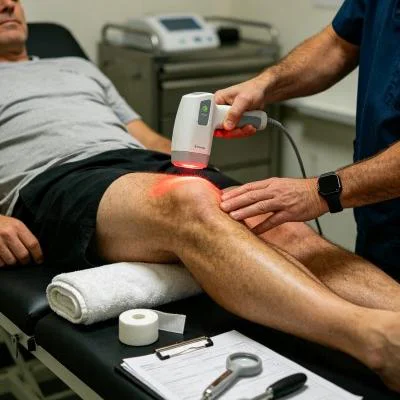
Sessions 4 through 8 increased peak output settings up to 22.0 Watts, using frequencies between 800Hz and 5,000Hz with 40 to 50 percent duty cycles. This configuration delivered high photon flux to the plantar digital branches and the deep medial calcaneal nerve without raising epidermal temperatures above 40.2 degrees Celsius. By Session 6, protective 10g monofilament sensation returned to 6 of 10 plantar sites, vibratory perception extended to 5.8 seconds, and nocturnal burning decreased to 3.5. The patient reported feeling the bathroom floor tiles clearly underfoot for the first time in two years.
Sessions 9 through 12 focused on consolidating neural recovery and supporting microvascular remodeling. Operating at higher peak pulses and transitioning to continuous-wave emissions stimulated long-term capillary angiogenesis and axonal transport. By Session 12, protective sensation was restored across all 10 standard plantar test sites, the Michigan Neuropathy Screening Instrument score dropped from 7.5 to 1.0, and digital capillary perfusion reached 52.8 PU. At the 90-day follow-up examination, the clinical gains remained stable, with full preservation of protective sensation, normal walking balance, and zero recurrence of nocturnal burning pain.
Handpiece Scanning Velocity and Surface Thermal Control
Administering high-power Class 4 laser therapy over neuropathic extremities requires strict procedural discipline. Because diabetic patients suffer from impaired temperature sensation, leaving the handpiece stationary over calloused skin or prominent metatarsal heads risks localized heat accumulation and painless thermal injury.
Handpiece Trajectory along the Lower Extremity Neurovascular Chain:
[Zone 1: Popliteal & Calf Trunks]   <---> Broad Longitudinal Passes (5 cm/s, CW Delivery)
[Zone 2: Medial Tarsal Tunnel]      <---> Overlapping Spirals with Quartz Compression (3 cm/s)
[Zone 3: Central Plantar Vault]     <---> S-Curve Transverse Sweeps along the Neurovascular Bundle
[Zone 4: Metatarsal Digital Heads]  <---> Grid Standoff Scanning across Terminal Capillary Loops
Key technical parameters govern clinical application:
- Kinetic Scanning Velocity: The treatment optic must maintain continuous motion across the target field at speeds between 3 and 5 centimeters per second. This maintains forward photon penetration to deep nerve trunks while preventing heat accumulation in the superficial keratin layers.
- Mechanical Quartz Compression: Over the medial tarsal tunnel, the clinician applies firm manual pressure (1.5 to 2.0 kg) using a flat quartz contact head. This displaces superficial venous and capillary blood, decreasing competitive light absorption by hemoglobin and increasing direct photon penetration into the deep posterior tibial nerve.
- Real-Time Thermal Monitoring: The handpiece uses an integrated infrared pyrometer to measure skin surface temperature in real time, keeping tissue within the safe therapeutic window of 38.5 to 40.5 degrees Celsius. If surface temperatures approach 41.0 degrees Celsius, the operator accelerates scanning speed or reduces the pulse duty cycle, preserving total energy delivery while protecting denervated skin.
High Intensity Laser Integration in Lower Extremity Neuropathy Care
Managing diabetic peripheral neuropathy highlights the trade-offs inherent in conventional pharmacological and physical interventions. High-intensity Class 4 laser therapy provides a targeted, non-invasive alternative across several common clinical pathways:
| Modality / Approach | Penetration Depth | Underlying Mechanism | Clinical Limitations |
| Low-Level Light Therapy | 2 mm to 6 mm | Superficial Photochemistry | Cannot penetrate thick plantar calluses |
| Gabapentinoid Medications | Systemic Distribution | Voltage-Gated Calcium Block | Dizziness, lethargy; leaves ischemia untreated |
| Tricyclic Antidepressants | Systemic Distribution | Serotonin-Norepinephrine Block | Anticholinergic toxicity, cardiac risks |
| Surgical Nerve Decompression | Direct Canal Margin | Mechanical Retinaculum Release | Invasive; infection risk in diabetic feet |
| Transcutaneous Neuro-Stim | 5 mm to 10 mm | Gate Control Pain Suppression | Transient effect; does not restore tissue blood flow |
| Class 4 Multi-Wave Laser | 20 mm to 45 mm | Angiogenesis & Axonal Perfusion | Requires clinical-grade equipment |
Low-Level Light Therapy operates in the milliwatt range. While it can aid superficial digital ulcer healing, its low energy cannot overcome the optical scattering barriers of thick plantar calluses and fibrous fat pads to reach deep nerve trunks. High-power systems deliver the incident irradiance needed to maintain an effective forward-propagating photon field that reaches the ischemic vasa nervorum.
Systemic medications such as gabapentin, pregabalin, and duloxetine act centrally to dampen pain perception, but they cause documented side effects like dizziness, sedation, and mental clouding while leaving the underlying microvascular ischemia and axonal starvation completely untreated. Tricyclic antidepressants carry similar anticholinergic risks and potential cardiac side effects, particularly in older patients with cardiovascular comorbidities.
Surgical tarsal tunnel decompression mechanically releases the retinaculum to relieve nerve compression, but invasive open surgery carries elevated risks of wound dehiscence and deep foot infections in diabetic patients with impaired healing capacity. Transcutaneous electrical nerve stimulation temporarily alters sensory transmission via gate control mechanisms, but its effects fade once the unit is switched off, and it does not improve endoneurial blood flow or reverse metabolic axonal deficits.
High-power multi-wavelength Class 4 laser therapy bridges the gap between purely symptomatic pharmaceuticals and invasive surgical procedures. By combining deep tissue penetration, targeted wavelength absorption, and real-time surface thermal monitoring, this modality accelerates microvascular reperfusion of the vasa nervorum, stimulates mitochondrial energy production in damaged axons, and restores protective sensation without systemic side effects or invasive procedural risks.