 FotonMedix



Overcoming Spinal Compression Stagnation in Canines
Pulsed multi-wavelength delivery penetrates deep paraspinal epaxial musculature, selectively desensitizes compressed dorsal nerve roots, and stimulates subacute myelin repair via duty cycle thermal mitigation.
A 5-year-old French Bulldog drags both pelvic limbs across the tile floor, vocalizing in sharp agony whenever the thoracolumbar junction is palpated. The MRI reports Hansen Type I intervertebral disc extrusion at T13-L1 with thirty-five percent spinal canal compromise, producing severe proprioceptive loss, bilateral pelvic limb paresis, and absent voluntary urination. The owners sit across the exam table, paralyzed between a ten-thousand-dollar spinal hemilaminectomy quote they cannot afford and the grim specter of euthanasia. Your clinic initiates emergency cage rest and high-dose systemic corticosteroids, but after forty-eight hours, the dog remains completely non-ambulatory, urinary catheter dependent, and plagued by excruciating neuropathic muscle spasm.
Traditional low-output therapeutic modalities offer zero clinical leverage in this acute neurological crisis. Millivolt units and underpowered handheld veterinary cold laser equipment cannot breach the physical barrier: four centimeters of dense, hypertonic longissimus dorsi muscle, heavy fascial sheaths, and the thick dorsal cortical lamina of the vertebral arch. The incident photons from low-wattage devices scatter completely within the dermal layer, converting into meaningless epidermal warmth long before touching ischemic spinal cord parenchyma. Overcoming compressive spinal cord deficits requires migrating beyond superficial gear to a genuine, deep-penetrating class 4 veterinary laser capable of projecting high photon densities straight into the hypoxic, compressed neural canal.
Photonic Attenuation Across Paraspinal Layers and Neural Photobiology
When photons enter biological tissue, their forward path degrades exponentially through the combined effects of optical scattering and endogenous chromophore absorption. Across the canine paraspinal tract, epaxial muscle fibers contain extraordinarily dense concentrations of myoglobin, while dense overlying fascia and pigmented skin form a major optical filter. Under standard Beer-Lambert attenuation dynamics, over ninety percent of superficial, low-irradiance light dissipates before achieving two centimeters of tissue depth.
To trigger genuine mitochondrial activation inside ischemic anterior horn motor neurons and inflamed dorsal spinal nerve roots, delivered light must exploit specialized optical windows:
- 980 nm Hemodynamic Microcirculation Re-establishment: Mechanical disc extrusion compresses local venous sinuses, creating acute microcirculatory stasis, parenchymal edema, and localized tissue hypoxia. Photons at 980 nm match the local absorption signature of deoxygenated and oxygenated hemoglobin, producing mild, localized photothermal expansion within spastic microcapillaries. This reaction flushes out trapped neuroinflammatory metabolites, breaks the ischemic-hypoxic loop, and accelerates retrograde lymphatic drain from the spinal canal.
- 1064 nm Deep Lamina Penetration and Myelin Protection: Moving deeper into the near-infrared spectrum, optical scattering coefficients drop significantly. Photons at 1064 nm bypass dense muscular myofibrils and thick vertebral bone plates, depositing adequate fluence directly into injured Schwann cells and surrounding glial tissue to protect axonal integrity.
- 1470 nm High Water Affinity for Perispinal Edema Clearance: Extruded disc material triggers extensive epidural and subarachnoid edema, raising localized mechanical pressure on sensory nociceptors. Light at 1470 nm targets free and bound interstitial water molecules, mobilizing stagnant interstitial fluid pockets and rapidly relieving direct mechanical compression against the dura mater.
Delivering this broad photonic saturation cannot be achieved with low-energy emitters without requiring hours of manual scanning. Utilizing a high-output class 4 laser veterinary system enables clinicians to flood the entire spinal segment and corresponding peripheral nerve pathways with targeted energy in an eight-minute workflow, shifting compressed neurons from necrotic apoptosis toward mitochondrial adenosine triphosphate regeneration.
Duty Cycle Modulation to Safeguard Neurological Tissues
Delivering thirty to forty watts of raw optical power into an animal presenting with spinal cord damage carries an inherent clinical contradiction: deep tissue repair requires massive energy deposition, yet delicate, ischemic neural tracts cannot endure excessive heat accumulation. Continuous-wave high-wattage exposure over pigmented, double-coated canine skin quickly spikes dermal temperatures, threatening cutaneous burns and thermal aggravation of already hyperactive spinal nociceptors.
The solution rests within microsecond pulse regulation and active duty cycle management. By breaking continuous photonic delivery into calculated bursts, the target tissue undergoes controlled thermal relaxation during the unlit intervals.
Continuous Wave: [================ Continuous Heat Accumulation ================] -> Epidermal Burn Risk
50% Duty Cycle:  [=== Pulse ON ===] [ Thermal Vent ] [=== Pulse ON ===] [ Vent ]  -> Deep Neural Saturation
During the active pulse, peak power drives photons deep past dense paraspinal musculature and the spinal lamina. During the brief inactive pulse phase, the extensive capillary network within the overlying dermis vents surface thermal energy. Because the deep neurological canal dissipates heat much slower than superficial vascular beds, therapeutic photon fluence accumulates safely around the nerve root without any epidermal burn risk.
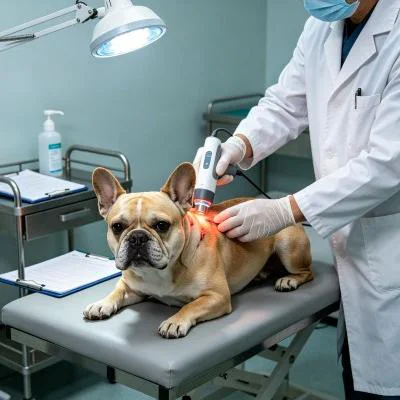
Clinicians can sweep between high-frequency superpulsing for instantaneous blockade of pain impulses along unmyelinated C-fibers, and low-frequency pulses designed to stimulate neurotrophic factor synthesis, ensuring comfortable, safe, and effective Class IV treatments.
Evidence-Based Clinical Case and Functional Recovery Metrics
According to the neural photobiomodulation framework established by Rochkind and validated through clinical canine neuro-rehabilitation trials published in the Journal of the American Veterinary Medical Association, targeted high-power near-infrared light upregulates neural growth factors, reduces glial scar formation, and accelerates axonal sprouting across compressed spinal segments.
The following case document highlights the multi-wavelength protocol utilized in a severe case of acute spinal cord compression managed without surgical decompression.
Case Record: Acute Canine Thoracolumbar Intervertebral Disc Disease
- Case Identifier: NEURO-2026-CANINE-1104
- Patient Profile: 5-year-old male neutered French Bulldog
- Body Mass: 13.8 kg
- Diagnosis: Hansen Type I Intervertebral Disc Extrusion at T13-L1, Grade 3 Modified Frankel Scale (non-ambulatory paraparesis, intact deep pain perception, severe epaxial muscle spasms, loss of voluntary micturition)
- Prior Conservative Therapy: Dexamethasone at 0.15 mg/kg once daily for two days, Gabapentin at 15 mg/kg every 8 hours, Methocarbamol at 20 mg/kg every 8 hours; minimal pain relief, patient unable to stand, persistent hindlimb dragging with knuckling on both rear paws
Comprehensive Treatment Protocol Parameters
| Session Number | Phase of Neurological Care | Output Power (W) | Operating Mode & Duty Cycle | Targeted Spectral Distribution | Frequency (Hz) | Total Energy (Joules) | Fluence (J/cm²) |
| 01 | Acute Neural Desensitization | 12.0 W | Pulsed (40% Duty Cycle) | High 980 nm / Microvascular Focus | 3,500 Hz | 3,200 J | 8.0 J/cm² |
| 02 | Edema & Fluid Mobilization | 15.0 W | Pulsed (45% Duty Cycle) | High 1470 nm / Interstitial Water Focus | 2,000 Hz | 4,500 J | 11.2 J/cm² |
| 03 | Epaxial Myofascial Release | 18.0 W | Pulsed (50% Duty Cycle) | Balanced 980 nm / 1064 nm Mix | 1,000 Hz | 5,400 J | 13.5 J/cm² |
| 04 | Parenchymal ATP Saturation | 20.0 W | Superpulsed (50% Duty Cycle) | Deep Penetration Dominant (1064 nm) | 500 Hz | 6,000 J | 15.0 J/cm² |
| 05 | Axonal Regeneration Induction | 22.0 W | Pulsed (50% Duty Cycle) | Balanced Multi-spectral Array | 250 Hz | 6,600 J | 16.5 J/cm² |
| 06 | Motor Nerve Sprouting Phase | 24.0 W | Pulsed (50% Duty Cycle) | Deep Axonal Matrix Focus | 100 Hz | 7,200 J | 18.0 J/cm² |
| 07 | Functional Consolidation | 20.0 W | Pulsed (50% Duty Cycle) | Mixed Neurological Bands | 50 Hz | 6,000 J | 15.0 J/cm² |
| 08 | Neuromuscular Re-education | 16.0 W | Continuous Dynamic Sweep | Broad Spectrum Regenerative Mix | CW / Dynamic | 5,000 J | 12.5 J/cm² |
Longitudinal Neurological Recovery Milestones
Texas Spinal Cord Injury Score (0-11 Scale, Lower Score = Severe Deficit):
Pre-Treatment: [==] 2 (Non-ambulatory paraparesis)
Session 03:    [====] 4 (Voluntary micturition restored)
Session 05:    [=======] 7 (Assisted standing, reduced knuckling)
Session 08:    [==========] 10 (Independent ambulation, mild ataxia)

Conscious Proprioception Deficit Score (0 = Normal, 3 = Completely Absent):
Pre-Treatment: [==============================] 3.0 (Severe bilateral knuckling)
Session 03:    [====================] 2.0 (Delayed correction)
Session 05:    [==========] 1.0 (Mild latency on right rear limb)
Session 08:    [] 0.0 (Immediate physiological paw replacement)
Following the third session, severe epaxial muscle tremors ceased, allowing catheter removal as normal voluntary bladder emptying resumed. By the fifth session, assisted weight-bearing posture was restored without back arching. At the end of the eight-session course, the dog walked into the clinic independently with complete conscious proprioception across both rear paws, requiring no further systemic steroidal administration.
Transforming Clinic Workflows and Client Retention
Veterinarians managing acute disc disease and degenerative myelopathies routinely face immense client heartbreak. Major neurosurgery costs thousands of dollars and demands specialized surgical suites, placing it beyond reach for many pet owners. Conversely, relying strictly on crate rest and corticosteroids leaves owners anxiously watching their pets deteriorate over weeks, often leading to secondary pressure sores, severe gastrointestinal ulcerations, and premature euthanasia decisions.
Deploying high-power Class IV technology changes clinic viability across multiple fronts:
1. Direct Non-Surgical Alternative
Providing a non-invasive, drug-sparing clinical solution gives pet owners an effective alternative when surgery is financially or medically impossible. Instead of sending desperate clients away, the clinic offers an immediate protocol that preserves patient mobility and deepens client trust.
2. Radical Reduction in Staff Fatigue
Low-power equipment forces staff to spend half an hour per patient managing tiny, underpowered probes with questionable results. A high-wattage platform delivers massive, therapeutic energy across broad treatment areas in five to eight minutes, allowing one veterinary assistant to treat multiple acute rehabilitation cases each hour.
3. Rapid Visible Improvement for Pet Owners
Neurological recoveries managed with medication alone can take weeks of nerve-wracking uncertainty. With high-intensity photonic protocols, muscle relaxation and partial reflex recovery often appear within the first seventy-two hours. Seeing immediate functional improvement keeps owners fully compliant with rest regimens and long-term care plans.
Class IV photomedicine is an essential clinical workhorse for modern veterinary practices. Overcoming severe paraspinal attenuation through targeted multi-wavelength delivery turns challenging, paralyzing neurological emergencies into reliable non-surgical victories that restore mobility and keep patients walking.