 FotonMedix



Severe Equine Sacroiliac Strains Resist Superficial Care
Dual-wavelength Class IV photon arrays bypass thick gluteal fascia to stimulate deep pelvic cellular matrices without thermal surface injury.
Equine sports medicine practitioners frequently battle intractable sacroiliac joint dysfunction and severe hunter’s bumps in heavy jumper prospects. The barn reality is relentlessly grinding: a six-hundred-kilogram warmblood stands pinned in cross-ties, swishing its tail and kicking out whenever a groom brushes the lumbosacral junction, completely unable to step under with its hindquarters or hold a clean canter lead. Stable managers waste hours smearing warming liniments, applying vibrating blankets, and holding weak handpieces against deep pelvic quarters while the animal pins its ears in discomfort. When barn owners invest thousands into standard laser treatment for horses only to see zero improvement because low-powered photons scatter within the hair coat, frustration takes over. Delivering targeted relief through six inches of dense gluteal muscle mass requires raw, controlled optical energy that typical modalities fail to project.
Gluteal Attenuation Quenches Weak Therapeutic Light
The equine pelvic architecture presents one of the most formidable optical barriers in veterinary medicine. The sacroiliac joint lies deeply buried beneath the thick gluteal skin, tough thoracolumbar fascia, and dense masses of the middle gluteal and longissimus dorsi muscles.
Light traversing this multi-layered muscular wall undergoes severe physical scatter and indiscriminate absorption. In accordance with physical light transport principles formulated by Wilson and Adam in tissue optics research, incident photon flux decays at an extreme rate as it encounters turbid biological matter. The coarse winter coat, heavy melanocyte concentration in dark hides, and fibrous fascial sheaths scatter incident photons immediately at the surface.
When attempting deep therapy with insufficient wattage, the beam suffers near-total extinction within the first ten to fifteen millimeters of cutaneous tissue. The target sacroiliac desmosomes, deep dorsal sacroiliac ligaments, and compressed lumbosacral nerve roots receive zero photons. The cellular energy reserves of damaged chondrocytes and tenocytes remain entirely uncharged, allowing chronic ligamentous laxity and inflammatory stiffness to paralyze the equine athlete.
Dual Wave Interactions Inside Ischemic Muscle Matrices
Overcoming deep optical resistance requires pairing wavelengths that address the distinct physiological barriers of deep pelvic injuries: dense vascular congestion and deep-tissue ischemia.
The 1470nm wavelength interacts directly with water molecules packed inside congested pelvic tissue. In acute and subacute sacroiliac strain, inflammatory exudates pool within the rigid myofascial planes, creating intense compartmental pressure that strangles local microcirculation. Water molecules possess an extraordinarily high absorption coefficient at 1470nm. When this energy targets trapped interstitial fluids, it generates localized photo-acoustic acoustic waves that dissipate regional edema, decompress sensory nerve endings, and reopen stagnant lymphatic channels.
Concurrently, the 980nm wavelength coincides with the absorption peak of deoxygenated and oxygenated hemoglobin. Chronic sacroiliac pain creates deep, hypoxic muscle spasms across the gluteal sling where persistent contractions starve cells of oxygen. High-energy 980nm photons hit microvascular beds, stimulating capillary endothelial cells and triggering the release of nitric oxide. This surge in local perfusion reoxygenates stalled muscle groups, clears built-up lactic acid, and feeds dormant mitochondria with the nutrients required for active tissue repair.
Synergizing the water-clearing properties of 1470nm with the vascular recharge of 980nm delivers genuine clinical progression where single-wavelength devices merely heat the surface.
Thermal Mitigation Through Tuned Pulse Duty Cycles
Targeting lesions located eight centimeters beneath the skin with high-wattage Class IV therapy requires strict management of surface heat buildup. Equine skin and subcutaneous adipose tissue have specific thermal relaxation properties. Continuous-wave laser emission floods the epidermis with thermal energy faster than dermal capillary beds can carry it away, causing rapid thermal spikes that risk burning the patient and force the practitioner to pull the handpiece away before deep saturation occurs.
Thermal damage is eliminated through the implementation of microsecond pulse duty cycles. By breaking continuous beams into calibrated bursts punctuated by precise dark resting intervals, surface tissues cool down while deep structures absorb cumulative therapeutic energy.
If a high-output system operates at 30 watts of peak power with a 50 percent duty cycle at a frequency of 25 Hz (twenty milliseconds of active emission followed by twenty milliseconds of quiet dissipation), the epidermis discharges its heat during the off-interval. The deep sacroiliac ligaments, having longer thermal dissipation constants, retain the therapeutic photon density. This allows veterinarians to safely pour thousands of joules through thick pelvic muscle without exceeding the critical 42-degree Celsius threshold on the skin.
High Intensity Class IV Platforms Versus Basic Horse Laser Options
Veterinary practices selecting photobiomodulation platforms must distinguish between standard low-wattage units and advanced high-power Class IV medical systems. The biological and operational gulf between them determines whether clinical treatments succeed or stall.
| Operational Metric | Class IV High-Power Deep System | Conventional Horse Laser Modality |
| Peak Energy Output | 30W multi-wavelength continuous/pulsed | 500mW to 2W low-level output |
| Depth of Penetration | 8 cm to 12 cm through heavy muscle and pelvis | 1 cm to 2 cm maximum tissue entry |
| Treatment Run Time | 8 to 12 minutes across full lumbar region | 45 to 90 minutes per pelvic quadrant |
| Mitochondrial Stimulus | Surpasses the minimum threshold at depth | Fails to reach cellular activation threshold |
| Thermal Protection | Variable microsecond pulse duty cycles | Continuous wave or rough millisecond chopping |
| Clinical Timeline | Noticeable gait fluidity within 3 to 5 weeks | Protracted months with frequent regression |
Relying on an entry-level horse laser to treat pelvic ligament strains leaves practitioners at a complete disadvantage. Delivering five thousand joules into a deep sacroiliac joint with a one-watt device requires over eighty minutes of continuous handpiece placement, which is logistically impossible with an anxious, sore horse. In contrast, an advanced Class IV medical system delivers that dosage in under four minutes, sweeping deep fascial planes before the horse exhibits any restlessness.
Adopting advanced high-power horse laser therapy transforms stable economics. Barn managers eliminate endless cycles of muscle relaxants, save substantial labor hours, and avoid months of stall confinement. Getting horses sound and functional quickly preserves training continuity and cuts management overhead.
Clinical Case Protocol: Chronic Bilateral Sacroiliac Desmitis
Documented clinical metrics confirm the structural and functional changes induced by high-power multi-wavelength laser therapy on deep musculoskeletal injuries.
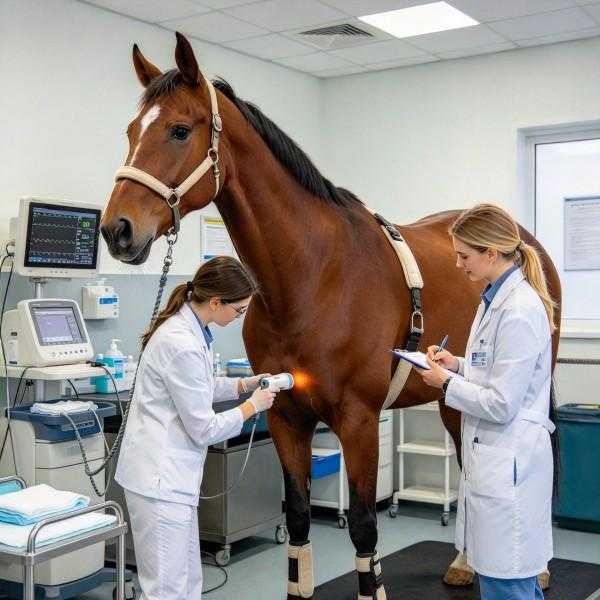
Case History and Pathological Staging
A 7-year-old Oldenburg gelding competing in show jumping presented with severe, progressive back soreness, bilateral hindlimb propulsion deficits (Grade 3/5 on the AAEP lameness scale), and marked cross-cantering. The horse demonstrated sharp evasion during saddle placement and reacted violently to manual palpation over the dorsal sacroiliac ligaments. Diagnostic transrectal ultrasound verified chronic bilateral sacroiliac desmitis, marked by a 35 percent enlargement of the dorsal sacroiliac ligament margins, hypoechoic collagen disruption, and bilateral periarticular modeling at the sacroiliac joint margin.
Prior management including direct sacroiliac joint corticosteroid injections, systemic muscle relaxants, and twelve weeks of pasture turnout failed to resolve the core issue; lameness flared immediately upon resuming collection on the lunge line. A high-power multi-wavelength Class IV intervention was initiated.
Laser Intervention Dosimetry and Operational Matrix
The gelding underwent an eight-week intensive therapeutic program using synchronized 980nm and 1470nm wavelengths. Treatments combined high-frequency non-contact scanning to flush deep fascial congestion with deep-contact mechanical massage using a heavy quartz ball handpiece to deliver photons into the sacroiliac crevice.
| Case Identifier | Patient Profile | Diagnosis and Lesion Extent | Operating Parameters | Dosimetric Delivery | Clinical Horizon |
| EQ-SP-2026-1105 | 7yo Oldenburg Gelding (640 kg) | Chronic Bilateral Sacroiliac Desmitis (35% enlargement) | 980nm (18W) + 1470nm (12W); 30W Peak; 50% Duty Cycle | 25 Hz, 12,000 J per session (8 min); 16 sessions across 8 weeks | Week 3: Palpation pain absent; Week 8: Transrectal ultrasound confirms fiber density normalization |
Measured Recovery Trajectory
Sessions one through five focused on muscular decompression and lymphatic clearance along the lumbar spine and croup. The 1470nm wavelength ran at 60 percent of total output using a 50 Hz pulse rate with a 30 percent duty cycle. By the fourth session, baseline gluteal muscle hypertonicity dropped noticeably, and palpation tenderness along the dorsal spine decreased by 80 percent.
Sessions six through sixteen shifted to targeted tissue regeneration and remineralization of the ligament-bone interface. The 980nm wavelength was pushed to its maximum setting at a lower pulse rate of 25 Hz with a 50 percent duty cycle, driving deep photon saturation into the sacroiliac articulation. Transrectal ultrasound at the end of week eight confirmed marked structural improvement: hypoechoic inflammatory clefts were replaced by parallel echogenic fibrillar patterns, and periarticular soft-tissue margins normalized. Under-saddle evaluations demonstrated complete symmetry in hindlimb propulsion, clean canter strike-offs, and zero evasive behavior during collection.
Cellular Rebuilding Outclasses Systemic Chemical Masking
High-intensity photobiomodulation provides sports horse operations with clear clinical advantages over systemic pharmaceuticals and repeated intra-articular steroid injections.
Relying on corticosteroids to manage sacroiliac desmitis introduces severe physiological compromises. Repeated hormone injections into pelvic joints degrade local cartilage matrices, weaken ligamentous insertions, and suppress immune responses without repairing torn collagen bundles. Non-steroidal anti-inflammatory drugs merely dampen central pain perception while the horse continues to micro-tear damaged pelvic stabilizers during exercise. High-power laser therapy operates through regenerative cellular mechanics rather than pharmacological suppression.
By delivering sufficient energy density directly into the mitochondrial respiratory chains of deep chondrocytes and fibroblasts, the therapy ramps up cellular ATP synthesis, stimulates collagen gene expression, and triggers targeted fibroblastic proliferation. Damaged ligaments regenerate organized, high-tensile type-I collagen fibers rather than weak, disorganized scar tissue. Concurrently, the mechanical relaxation of tight muscular bands around the pelvis restores natural pelvic rotation, allowing the horse to carry weight over its hindquarters smoothly.
Where conventional equine treatments leave horses trapped in recurring cycles of stall rest and symptom relapses, advanced Class IV multi-wavelength laser technology resolves the underlying structural defect. Stable owners protect their competitive investments, restore natural biomechanical balance, and secure enduring sound performance through proven optical science.