 FotonMedix



Upper Airway Dynamic Collapse Overcomes Surgical Scarring
Dual-wavelength vaporizing precision arrests mucosal bleeding, preserves mucosal margins, and triggers deep cellular bio-regeneration via pulsed duty cycles without cartilage distortion.
A three-year-old Thoroughbred colt with Grade 3 recurrent laryngeal neuropathy and axial arytenoid deviation leaves trainers in despair during morning gallops. The tell-tale roaring respiratory noise during peak exertion, accompanied by sudden deceleration and cyanotic gums at the three-furlong mark, confirms dynamic upper airway collapse. Standard scalpel laryngotomy and traditional prosthetic laryngoplasty carry brutal baggage: permanent tracheostomy risks, deep wound infections within the dirty laryngeal lumen, and aggressive granulating scar beds that distort the rima glottidis. Bleeding during mechanical resection blocks endoscopic views, forcing equine surgeons to operate semi-blindly in a restricted mucosal passage where a three-millimeter error ruins an animal’s athletic airway dynamics permanently.
Veterinary surgeons face a relentless biomechanical dilemma in equine upper respiratory tract intervention. The equine larynx undergoes extreme negative pressure swings during high-speed canters, reaching pressure differentials exceeding minus twenty centimeters of water. Traditional electrocautery scorches cartilage, inducing chondritis and extensive mucosal contracture that chokes airflow. What surgical barns demand is an intervention capable of bloodless endoscopic ablation with microscopic margin accuracy, transitioning directly into post-resection photonic repair that speeds epithelization and maintains mucosal suppleness.
Optical Transmission Curves Through Dense Pharyngeal Membranes
Reaching and operating within the pharyngeal and laryngeal cavities through trans-endoscopic delivery fibers requires mastery of optical behavior in wet mucosal tissue. Mucosal layers lining the guttural pouches, vocal folds, and arytenoepiglottic folds possess distinct fluid barriers and microcapillary densities that disperse incoming radiation. The optical scatter coefficient in moist, non-keratinized stratified squamous epithelium causes unfocused light beams to spread laterally, causing collateral collateral edema that compromises the equine airway postoperatively.
Deploying focused Class IV equine laser surgery overcomes this spatial barrier. High-intensity photonic delivery through specialized bare-end or side-firing quartz fibers generates precise energy densities that bypass surface scatter, concentrating photon deposition directly at the mucosal-cartilaginous boundary. By calculating tissue-specific extinction coefficients, surgeons deliver focused cutting energies that cut tissue clean without lateral thermal bleed. When dialed into non-ablative settings, the photonic flux penetrates the deeper intrinsic laryngeal muscles, reaching the cricoarytenoid dorsalis muscle fibers to energize depleted cellular pathways and restore microvascular supply damaged by long-standing hemiplegia.
Chromophore Dissociation and Vascular Sealing via 980nm and 1470nm Photons
Tissue interaction pivots entirely around targeted chromophore affinity during trans-endoscopic intervention. Biological water and hemoglobin dominate the respiratory tract’s light absorption characteristics. The 980nm wavelength demonstrates elevated absorption in oxyhemoglobin and deoxyhemoglobin. During trans-endoscopic mucosal excision or ventriculocordectomy, 980nm light coagulates vessels up to two millimeters in diameter instantly without physical clamping. This photochemical coagulation seals mucosal capillaries ahead of the cutting plane, leaving an immaculate, dry field that ensures unobstructed visualization through the flexible endoscope.
Integrating 1470nm shifts the primary photon capture directly toward water molecules present within intercellular fluids and mucosal epithelium. Because the absorption coefficient of water at 1470nm is significantly higher than that of traditional near-infrared wavelengths, energy concentrates within a shallow sub-millimeter vapor zone. This characteristic permits clean photo-ablation with negligible lateral thermal spread, preventing structural heat transfer into the delicate arytenoid and thyroid cartilages. When using a dual-frequency equine laser therapy device, the practitioner can toggle instantly from razor-sharp vaporizing ablation to broad-beam therapeutic photobiomodulation, bathing the fresh surgical perimeter in non-destructive light that accelerates primary intention closure.
Pulsed Duty Cycle Gating to Prevent Cartilaginous Necrosis
Arytenoid cartilage possesses virtually zero regenerative capacity once thermal necrosis takes hold; cartilage infection or thermal chondritis routinely ends an equine athlete’s career. Delivering continuous-wave optical energy inside the narrow laryngeal lumen elevates local temperatures well beyond the coagulation threshold of structural glycosaminoglycans, inducing structural warpage and permanent lumen narrowing.
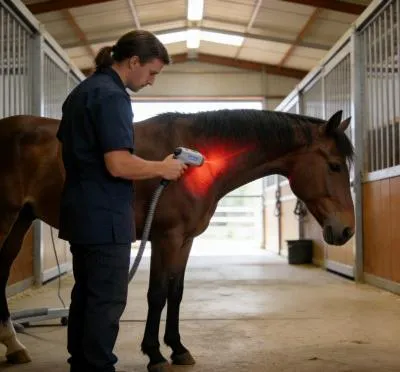
Thermal equilibrium is preserved through microsecond duty cycle modulation. By interrupting continuous emission with rapid pulse gating—cycling between 10% and 35% on-time at repetition rates between 1,000 Hz and 10,000 Hz—the tissue absorbs high peak irradiance for instantaneous ablation, followed by an off-period that accommodates the thermal relaxation time of the tissue. Heat dissipates into the respiratory air currents and adjacent interstitial fluids before conducting into the underlying thyroid or cricoid framework. Clinicians looking for an advanced equine laser therapy machine for sale must demand precise temporal modulation capabilities, ensuring surgical excision transitions seamlessly into rapid, cool-temperature tissue photobiomodulation.
+-----------------------------------------------------------------------------+
| Tissue Layer          | Chromophore Peak   | Clinical Action                |
+=======================+====================+================================+
| Pharyngeal Mucosa     | Water (1470nm)     | Micro-thin Clean Vaporization  |
+-----------------------+--------------------+--------------------------------+
| Submucosal Vessels    | Hemoglobin (980nm) | Instant Hemostasis & Drainage  |
+-----------------------+--------------------+--------------------------------+
| Laryngeal Cartilage   | Controlled Scatter | Thermal Gating via Duty Cycle  |
+-----------------------+--------------------+--------------------------------+
| Deep Musculature      | Cytochrome C Ox.   | ATP Synthesis & Re-innervation |
+-----------------------+--------------------+--------------------------------+
Equine Upper Airway Surgical and Rehabilitation Case Record
The following surgical protocol and subsequent postoperative healing progression took place at the Equine Respiratory Surgical & Sports Medicine Center.
Case Identifier: EQ-SURG-2026-0417
Subject: 3-year-old Thoroughbred Colt, Flat Racing (Classic Distance Group 2 Contender)
Clinical Diagnosis: Left-sided Recurrent Laryngeal Neuropathy, Havemeyer Grade 3.2 with axial deviation of the arytenoepiglottic fold and dynamic vocal fold collapse during high-speed treadmill testing
Baseline Metrics: Severe inspiratory roaring noise, poor performance index, marked exercise intolerance with hypoxemia at 11 m/s; resting endoscopy revealed incomplete abduction of the left arytenoid cartilage with flaccid vocal cord flutter
| Phase and Procedure | Post-Op Day | Optical Blend | Peak Power (W) | Modulation Mode | Duty Cycle | Optical Fluence | Cumulative Energy |
| Surgical: Vocal Cordectomy | Day 0 | 1470nm 80% / 980nm 20% | 22 W Peak | Contact Fiber Cutting | 40% | Ablative | 1,850 Joules |
| Surgical: Mucosal Resection | Day 0 | 1470nm 60% / 980nm 40% | 18 W Peak | Non-contact Vapor | 30% | Coagulative | 1,200 Joules |
| Post-Op Rehab: Phase 1 | Day 2 to Day 6 | 980nm 60% / 1470nm 40% | 12 W Peak | 800 Hz Pulsed | 25% | 5.5 J/cm² | 2,200 Joules |
| Post-Op Rehab: Phase 2 | Day 9 to Day 18 | 980nm 50% / 1470nm 50% | 16 W Peak | 2,500 Hz Pulsed | 35% | 8.0 J/cm² | 3,600 Joules |
| Post-Op Rehab: Phase 3 | Day 22 to Day 35 | 980nm 30% / 1470nm 70% | 20 W Peak | 4,000 Hz Pulsed | 45% | 11.0 J/cm² | 4,500 Joules |
Video-endoscopy at day 14 revealed clean, non-granulating mucosal margins without web formation or chondritis. By day 30, the surgical resection site displayed complete, smooth mucosal coverage with full structural stiffness of the airway walls. Postoperative dynamic treadmill testing on day 45 confirmed complete elimination of the roaring sound, an unobstructed laryngeal lumen under maximal negative pressure, and normal arterial blood oxygen saturation during a 12 m/s sprint.
Class IV Photonic Precision Replaces Outdated Surgical Modalities
Conventional laryngotomy and mechanical tissue stripping subject the horse to general anesthesia, dorsal recumbency risks, post-surgical dysphagia, and prolonged lay-offs. In standard scalpel procedures, excessive bleeding into the trachea causes blood aspiration, reactive bronchospasm, and chronic lower airway inflammation that hampers gas exchange months after the throat has closed. Traditional cryosurgical freeze-thaw cycles produce severe local edema, demanding temporary tracheostomy placement while leaving unpredictable necrosis borders that can slough off weeks later and trigger choke.
Utilizing focused laser therapy for horses within upper airway intervention modernizes every aspect of clinical management. Flexible silica optical fibers maneuver through standard working channels of flexible video-endoscopes, allowing trans-endoscopic surgical resection to be performed on the standing, sedated animal. Eliminating the morbidity of general anesthesia minimizes cardiovascular and musculoskeletal risks while avoiding expensive surgical suites. Because the optical energy seals micro-vessels and lymphatics in real time, swelling inside the narrow airway is virtually eliminated, bypassing the need for a tracheostomy tube. As surgical ablation smoothly gives way to deep therapeutic biostimulation, the laryngeal mucosa regenerates with physiological suppleness rather than contractive, fibrous scar tissue. Racehorse owners and veterinary surgeons secure a bloodless surgical intervention, swift tissue regeneration, and a confident, early return to peak athletic track performance.