 FotonMedix




克服颈椎神经根阻力与肌腱瘢痕
High-peak photon flux overrides fascial scatter, suppresses hyperactive nociceptive signaling, and triggers rapid tenocyte mitochondrial respiration without structural thermal degradation.
Cervical facet joint compression paired with subacute myofascial contracture presents an unforgiving clinical barrier in daily rehabilitation practice. When patients present with radiating occipital pain, paraspinal spasm, or acute athletic ligament tears, traditional physical therapy frequently stalls at the dermal-adipose junction. Clinicians routinely struggle to project sufficient photon intensity through thick paraspinal musculature and dense ligamentous envelopes without overheating superficial skin layers. Delivering meaningful therapeutic irradiance to deeper neural roots and damaged athletic tendons requires precise multi-wavelength photonic control capable of driving reparative energy through dense musculoskeletal barriers.
Photonic Attenuation Physics Across Dense Fascia and Connective Beds
Living human tissue acts as a turbid optical medium characterized by high anisotropic scattering and variable multi-layered absorption. Near-infrared light directed at the posterior cervical spine must traverse stratum corneum, vascularized subcutaneous fat, and thick fibrous fascial sheets before reaching the deep multifidus muscle bundles and target facet capsules located four to six centimeters beneath the cutaneous surface.
Tissue optical attenuation follows an exponential decay curve governed by both scattering coefficients and selective molecular chromophore absorption. Melanin within the epidermal basement membrane and water inside interstitial matrices absorb distinct spectral bands, while cellular membranes and dense collagen fibrils scatter incident photons in multiple directions. In low-power modalities, rapid multi-angle scattering disperses incident beams within the first five to eight millimeters of tissue, leaving deep joint capsules and neural exit foramina starved of photobiomodulation energy.
Deploying high-power, multi-wavelength emission profiles counteracts this rapid photon loss. Utilizing a primary 810nm spectrum targets the copper centers within cytochrome c oxidase, the terminal enzyme of the mitochondrial respiratory chain. This reaction drives elevated adenosine triphosphate synthesis and shifts cellular metabolism out of inflammatory stasis.
To complement this depth profile, incorporating a 980nm component delivers strong simultaneous affinity for microvascular oxyhemoglobin and interstitial fluid. This generates immediate localized micro-thermal vasodilation, opening dormant capillary beds and washing away neurogenic pain irritants like substance P and bradykinin.
When applied to athletic injuries, adding a 1064nm wavelength extends physical penetration even further. This longer near-infrared wavelength exhibits lower melanin absorption and reduced tissue scattering, allowing photons to penetrate thick aponeuroses and reach injured intra-articular structures.
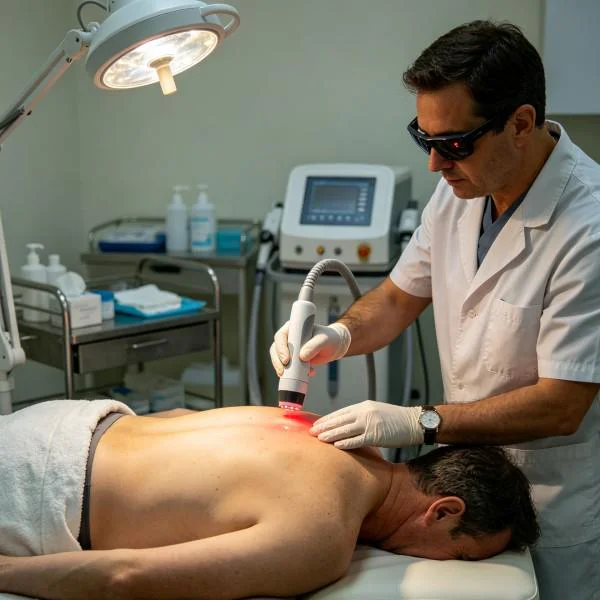
Relying on a calibrated Class IV platform allows targeted application of laser therapy for cervical spondylosis, projecting therapeutic irradiances past the posterior cervical ligaments down to compressed nerve roots without risking superficial epidermal overheating.
热松弛动力学与脉冲占空比门控
Continuous-wave energy emission carries inherent clinical risks when treating dense, highly innervated spinal areas or acute athletic sprains. While continuous output produces steady surface warming, sustained unmodulated energy delivery risks thermal accumulation in static tissue. Once heat diffusion rates lag behind continuous photon absorption, surrounding normal tissues exceed their natural thermal limits, triggering cellular stress or superficial burns.
Clinical protocols eliminate this thermal vulnerability by leveraging the Thermal Relaxation Time of human tissues. Thermal relaxation time represents the duration required for target cellular structures to lose fifty percent of their accumulated heat energy via passive capillary conduction.
Applying structured pulse duty cycles divides energy delivery into microsecond bursts:
占空比(%)= [脉冲导通时间 / (脉冲导通时间 + 脉冲关断时间)] × 100
By restricting the pulse duration to a fraction of the tissue thermal dissipation window, target neurovascular junctions and inflamed periosteal surfaces absorb high-energy packets without retaining excessive heat. During the designated pulse-off interval, local microcirculation dissipates residual warmth safely into adjacent capillary beds.
When managing sharp neuropathic pain or acute soft tissue tears, adjusting duty cycles between 20% and 40% permits peak output levels up to 30W. These brief, high-energy pulses penetrate dense tissue boundaries, triggering deep photobiomodulation while keeping cutaneous temperatures comfortably below the 42-degree Celsius discomfort threshold.
Neuropathic Inhibition Pathways in Degenerative Cervical Pathology
Cervical spondylotic radiculopathy combines mechanical root compression, persistent local ischemia, and chronic perineural inflammation. Patients face unrelenting neck stiffness, debilitating trap spasms, and burning paresthesias radiating down the C5-C7 dermatomes. Standard conservative treatments—such as traction, manual adjustments, or oral non-steroidal anti-inflammatory drugs—rarely penetrate deep enough to soothe irritated neural sheaths or reverse localized fascial fibrosis.
针对颈椎病的靶向激光疗法通过驱动两种截然不同的细胞作用,从而化解了这些深层瓶颈:
- Direct Axonal Pain Transmission Blockade: High-intensity near-infrared photon flux alters axonal membrane permeability along irritated peripheral fibers. Saturating hyperactive A-delta and C nociceptive fibers suppresses ectopic nerve discharge and temporarily slows pain signal conduction, offering immediate relief from radiating arm pain and paraspinal muscle splinting.
- Intervertebral Microcirculatory Restoration: Photons reaching the deep paravertebral venous plexus stimulate targeted nitric oxide release from vascular endothelial cells. This localized vasodilation clears pooled metabolic waste, relieves venous engorgement around neural exit foramina, and delivers fresh oxygenated blood to chronically starved nerve roots.
激光疗法用于缓解运动损伤疼痛的临床方案实施
与慢性退行性脊柱疾病相比,运动创伤在治疗方面有着截然不同的要求。突发性减速造成的拉伤、韧带部分撕裂以及急性肌腱损伤,都需要采取积极干预措施,以控制严重的急性炎症并加速结构修复。
在运动损伤的疼痛缓解中应用激光疗法,可缩短三个关键愈合阶段的康复时间:
- Rapid Extravasation Clearance: In the acute inflammatory phase, calibrated laser irradiation downregulates pro-inflammatory cytokines such as tumor necrosis factor-alpha and interleukin-1 beta. This targeted action reduces microvascular hyperpermeability, halts acute swelling, and quickly drains interstitial hematomas.
- Tenocyte and Fibroblast Activation: During the proliferative phase, photon absorption speeds up tenocyte migration and enhances collagen mRNA transcription. Stimulating damaged fibroblasts promotes the production of robust Type I collagen fibers rather than weak, disorganized Type III scar tissue, restoring normal tensile strength to healing tendons.
- Functional Kinetic Recovery: In the remodeling phase, focused laser therapy for sports injuries softens mature fibrous adhesions around damaged joint capsules. Restoring natural fascial gliding planes allows injured athletes to regain their full active range of motion and return to competitive performance weeks faster than standard physical therapy timelines allow.
标准化临床实践与详细治疗记录
The following treatment log outlines an integrated clinical protocol addressing severe multi-segmental cervical spondylotic radiculopathy combined with an acute sports-related hamstring tear.
Clinical Registry Record: FMX-2026-CS7732
| 参数组 | 规格详情 | 临床目标值 |
| 案例识别 | 临床病例编号 | FMX-2026-CS7732 |
| 患者人口统计学特征 | 年龄 / 生理性别 | 41 Years / Male (Competitive Triathlete) |
| 主要病理 | 脊柱神经根诊断 | C5-C6 / C6-C7 Cervical Spondylosis with Unilateral Right Radiculopathy |
| 继发性病变 | 运动损伤的诊断 | Acute Grade II Biceps Femoris Musculotendinous Tear (Right Leg) |
| 设备配置 | 业务分类 | 多波长高强度IV类医用激光器 |
| 分娩机制(宫颈) | 经皮治疗头 | 带实时热传感器的深层组织准直聚焦手柄 |
| 投球机制(田径) | 经皮治疗头 | Wide-Angle Deep Defocusing Optical Handpiece |
| 波长天平(颈式) | 四频段比值 | 810nm (45%) + 980nm (35%) + 1064nm (20%) |
| 波长平衡(运动) | 三光谱比 | 810nm (40%) + 915nm (30%) + 980nm (30%) |
| 手术功率(颈部) | 功率设置 | 16.0W 峰值占空比脉冲模式 |
| 作战能力(体能) | 功率设置 | 22.0W 峰值占空比脉冲模式 |
| 脉搏频率(颈部) | 重复率 | 10.0 Hz 调制至 2.5 Hz |
| 心率(运动) | 重复率 | 25.0 Hz modulated down to 4.0 Hz |
| 每次颈部治疗的能量剂量 | 总输出焦耳数 | 3,800J across C4-C7 paraspinal and trap trigger zones |
| 每次训练的能量摄入量 | 总输出焦耳数 | 5,400J across biceps femoris tear margin and tendon insertion |
| 分娩过程中的运动轨迹 | 技术规程 | 以每秒2厘米的速度进行缓慢连续的扫掠运动 |
| 表面保护系统 | 皮肤防护 | 接触式低温热电制冷环(4°C) |
治疗进展与客观临床指标
| 治疗阶段 | 颈椎神经根痛评分(VAS 0-10) | Active Cervical Rotation to Right (Degrees) | Hamstring Pain on Isometric Load (VAS 0-10) | Hamstring Defect Gap on Ultrasound (mm) | 功能状态与组织观察 |
| 基线(治疗前) | 8.5 / 10 (Sharp radiating burning to right thumb) | 32° (Severe motor splinting) | 9.0 / 10 (Unable to bear weight) | 8.5 mm transverse tear with localized hematoma | Severe cervical muscular guarding; acute gait deficit requiring bilateral crutches |
| 第4天(第2场) | 5.5 / 10 (Paresthesias retracted to forearm) | 50° | 6.0 / 10 (Weight bearing tolerated) | 5.2 mm (Hematoma 60% reabsorbed) | Significant reduction in trap hypertonicity; crutches discarded for walking boot |
| 第2周(第5节课) | 2.5 / 10 (Occasional mild stiffness) | 68° | 3.0 / 10 | 2.1 mm (Active fibroblastic bridging) | Complete resolution of radiating nerve pain; patient began stationary bicycle spinning |
| 第4周(第9节课) | 0.5 / 10 (Asymptomatic during routine work) | 80° (Full anatomical mobility) | 1.0 / 10 (Pain-free light jog) | 0.0 mm (Full structural defect bridging) | Cervical deep tendon reflexes normalized; dynamic eccentric hamstring loading initiated |
| 第6周(最终评估) | 0.0 / 10 (Complete clinical resolution) | 85° (Symmetrical cervical range) | 0.0 / 10 (Full sprint capability) | Continuous linear Type I collagen alignment | Full athletic clearance granted; athlete completed 15 km endurance training run |
科学引文与生物物理框架
The clinical efficacy of targeted near-infrared irradiation in degenerative spinal pathology is supported by research led by Dr. Roberta Chow and associates, published in The Lancet. Their systematic review and meta-analysis confirmed that therapeutic laser delivery provides immediate, sustained pain relief in acute and chronic neck pain, demonstrating marked reductions in sensory nerve conduction velocities and lasting drops in patient-reported disability indices.
The biophysical mechanisms linking high-irradiance photon absorption to accelerated soft tissue repair were documented by Dr. Chukuka S. Enwemeka in Photomedicine and Laser Surgery. His investigations revealed that high-intensity laser energy significantly upregulates collagen production, organizes newly formed collagen bundles, and accelerates tensile strength recovery in damaged tendons and ligaments compared to untreated controls.
Further validation of cellular repair pathways emerges from research by Dr. Juanita Anders and colleagues, published in Lasers in Surgery and Medicine. Their work established that multi-wavelength near-infrared delivery accelerates peripheral nerve regeneration by activating Schwann cell proliferation and promoting targeted axonal sprouting across compressed or injured neural tracts.
In high-performance sports rehabilitation, clinical trials conducted by Dr. Ernesto Leal-Junior in the American Journal of Physical Medicine and Rehabilitation demonstrated that applying Class IV multi-wavelength laser therapy prior to and following acute muscular stress significantly suppresses blood lactate accumulation, limits post-exercise muscle damage, and shortens return-to-play timelines in elite competitive athletes.
临床现实:高强度激光与传统方法的对比
Transitioning from conventional modalities to high-power Class IV laser therapy transforms recovery curves across both spinal and sports injury clinics.
Traditional management of severe cervical spondylosis relies heavily on symptom masking. Patients are routinely placed on prolonged courses of oral non-steroidal anti-inflammatory drugs, muscle relaxants, or oral gabapentinoids, risking gastrointestinal ulceration, systemic renal stress, and daily cognitive fog. When medications fail, patients face invasive epidural steroid injections that risk dural punctures, localized structural tissue weakening, and fluctuating short-term relief, often ending in surgical discectomy or spinal fusion.
Targeted high-intensity laser therapy provides a non-invasive alternative that treats the underlying pathology directly. By projecting dense photon flux deep into paraspinal beds, it shuts down hyperactive nerve pain, clears deep-seated venous pooling, and reduces perineural swelling without injecting synthetic hormones or relying on habit-forming pharmaceuticals. Patients gain rapid, measurable pain relief and recover full spinal motion while remaining active throughout care.
In competitive sports medicine, standard approaches often default to passive Rest, Ice, Compression, and Elevation protocols followed by basic isometric exercises. Ice restricts regional blood flow, delaying cellular healing and encouraging weak, disorganized scar tissue formation that remains prone to reinjury.
Employing high-intensity laser therapy for sports injuries actively drives physiological repair. Rather than freezing damaged muscle tissue, calibrated multi-wavelength photons accelerate microvascular perfusion, clear inflammatory debris, and stimulate tenocytes to lay down organized, resilient Type I collagen.
Modern athletic training facilities and outpatient clinics adopt these advanced laser systems to elevate their standard of care. By addressing the true cellular drivers of degenerative joint compression and acute sports injuries, they deliver reliable, accelerated functional recovery that gets patients and athletes back to full performance safely.
上一页 竞技短跑运动员如何克服慢性髌腱病下一个 颈椎病中神经血管卡压的处理