 FotonMedix












Deep Flexor Tendon Lesions Overcome Stall Rest Stall
Sub-surface photon penetration with dual absorption dynamics delivers high-fluence biostimulation while micro-pulsed duty cycles suppress thermal buildup in avascular equine tendons.
Winter racing prep grinds to a halt the minute an ultrasound reveals an anechoic core lesion in a thoroughbred’s superficial digital flexor tendon. Barn managers know the drill: twelve months of stall confinement, hand-walking, icing regimes that barely touch the deep fascia, and an agonizing 50% recurrence rate once high-speed gallops resume. Ice boots and oral NSAIDs merely mask surface heat without driving tissue remodeling inside poorly vascularized fibrocartilage. When a three-year-old stakes winner tears deep fibers 12 centimeters distal to the accessory carpal bone, systemic drugs cannot break through the dense extracellular matrix to stop cross-linked scar tissue from ruining athletic elasticity.
Equine practitioners constantly battle this biological bottleneck. Fibroblasts in tendon cores starve for oxygen and adenosine triphosphate under standard rest protocols, laying down chaotic Type III collagen instead of tensile Type I fibers. Field veterinarians need photons to penetrate deep under thick horse hair and dense skin, targeting the exact injury depth without searing the dermal layers or triggering thermal defense mechanisms that cause horse agitation and treatment aborts.
Deep Photon Attenuation Across Dense Equine Soft Tissue
Delivering therapeutic energy through the equine lower limb requires overcoming severe optical scatter. The equine dermis and subcutaneous coat present high scatter coefficients that diffuse continuous-wave radiation within the first three millimeters. In dense anatomical regions like the suspensory ligament branch or the deep digital flexor tendon inside the digital sheath, uncalibrated wavelengths lose over 80% of their incident power density before reaching the target structure.
High-intensity Class IV equine laser therapy overcomes this depth barrier by matching irradiance to tissue-specific attenuation curves. Photon flux must be calculated to deliver between 8 and 12 Joules per square centimeter directly at the lesion site, not merely at the skin surface. As photons travel through tissue layers, exponential decay occurs according to the Beer-Lambert law modified for biological scatter. When treatment heads stay stationary or beam delivery lacks sufficient peak photon density, cellular photoreceptors inside the lesion core remain unactivated, leaving the cytochrome c oxidase enzyme complex in an unexcited state.
Chromophore Affinity Dynamics of 980nm and 1470nm Emission
Clinical efficacy shifts entirely when adjusting energy delivery to the distinct molecular targets within equine anatomy. Biological water and hemoglobin dominate the absorption landscape in performance horses. A system delivering 980nm targets deoxygenated and oxygenated hemoglobin absorption peaks. This energetic transfer alters local microvascular tone, promoting rapid vasodilation through nitric oxide release while dramatically accelerating lymphatic clearance of peri-tendinous edema.
Conversely, incorporating 1470nm shifts primary photon capture toward intracellular and extracellular water molecules. Water absorption at 1470nm is roughly an order of magnitude higher than at traditional near-infrared spectrum bands. In avascular equine structures, this targeted interaction induces controlled, non-destructive localized fluid warming that relaxes collagen tension, improves membrane permeability, and promotes interstitial cellular exchange. Combining these absorption dynamics within a single equine laser platform allows clinicians to simultaneously address acute inflammatory fluid pockets and initiate long-term matrix repair without overloading surrounding healthy tissue.
+-----------------------------------------------------------------------------+
| Tissue Depth Profile | Photon Interaction | Biological Response             |
+======================+====================+=================================+
| Epidermis / Coat     | Optical Scatter    | Minimized via High Peak Power   |
+----------------------+--------------------+---------------------------------+
| Microvasculature     | 980nm Hemoglobin   | Nitric Oxide & Fluid Drainage   |
+----------------------+--------------------+---------------------------------+
| Extracellular Matrix | 1470nm Free Water  | Collagen Matrix Alignment       |
+----------------------+--------------------+---------------------------------+
| Tenocytes            | Cytochrome c Ox.   | ATP Synthesis & Type I Collagen |
+----------------------+--------------------+---------------------------------+
Thermal Mitigation Through Duty Cycle Frequency Modulation
High-output power presents a constant threat of photothermal damage if administered incorrectly. In a nervous 1,100-pound horse, sudden heat spikes cause hoof stamping and dangerous twitching. Biological tissues dissipate heat through conduction and capillary perfusion; however, acute core tendon lesions exhibit minimal microperfusion, making heat accumulation inside the tendon bundle lethal to vulnerable tenocytes.
Precision duty cycle management controls this risk. Splitting power delivery into micro-pulsed duty cycles—such as a 20% to 50% on-time ratio modulated between 200 Hz and 5,000 Hz—gives biological tissues adequate thermal relaxation time between pulses. The target tissue receives massive instantaneous photon bursts to overwhelm cellular thresholds, followed by an off-phase that lets thermal energy bleed into surrounding interstitial spaces. Veterinary practitioners choosing an equine laser therapy machine for sale must verify that pulse timing circuits operate with true square-wave accuracy rather than averaged power ramps, ensuring the machine maintains photobiomodulation thresholds without tissue necrosis.
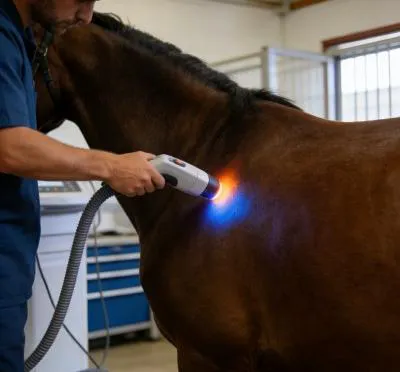
Equine Sports Medicine Clinical Case Record
The following treatment course took place at the Equine Sports Medicine & Rehabilitation Center, documenting an elite jumper presenting with acute lameness.
Case Identifier: EQ-REHAB-2026-0842
Subject: 5-year-old Warmblood Gelding, Show Jumping (1.40m level)
Clinical Diagnosis: Grade 3 Sub-acute Core Lesion of the Left Forelimb Superficial Digital Flexor Tendon (SDFT), 18% cross-sectional area involvement at Zone 1B
Baseline Metrics: Lameness Grade 4/5 (AAEP Scale), severe localized swelling, pain response on digital palpation, ultrasound showing marked hypoechoic core void
| Session Group | Post-Injury Day | Wavelength Blend | Output Power (W) | Modulation Frequency | Duty Cycle | Energy Density | Total Session Energy |
| Phase 1: Sessions 1-3 | Day 3 to Day 7 | 980nm 70% / 1470nm 30% | 15 W Peak | 500 Hz | 25% | 6.0 J/cm² | 2,400 Joules |
| Phase 2: Sessions 4-8 | Day 10 to Day 20 | 980nm 50% / 1470nm 50% | 20 W Peak | 1,200 Hz | 40% | 9.5 J/cm² | 3,800 Joules |
| Phase 3: Sessions 9-14 | Day 24 to Day 38 | 980nm 30% / 1470nm 70% | 25 W Peak | 3,000 Hz | 50% | 12.0 J/cm² | 4,800 Joules |
| Phase 4: Sessions 15-18 | Day 45 to Day 56 | 980nm 40% / 1470nm 60% | 18 W Peak | 200 Hz continuous pulse | 35% | 8.5 J/cm² | 3,400 Joules |
Ultrasonic follow-ups performed at day 30 and day 60 revealed a dramatic drop in hypoechoic area from 18% to under 2%, alongside visible longitudinal fascicular fiber realignment. Digital palpation sensitivity vanished by session 6. The horse advanced to controlled trot work on day 70, completing rehab without any compensatory stress on the contralateral limb.
Comparing High-Fluence Coherent Light to Traditional Modalities
Standard conservative management for soft tissue tears relies on systemic anti-inflammatories, cold hosing, and prolonged rest. While NSAIDs suppress cyclooxygenase pathways to damp down pain, they simultaneously inhibit downstream tenocyte proliferation and impair collagen cross-linking. Corticosteroid injections into adjacent peritendinous spaces risk tendon calcification, spontaneous rupture, and catastrophic sheath infections. Extracorporeal shockwave therapy offers mechanical stimulation, but the intense acoustic shockwaves can cause micro-tearing in healing scar tissue and require sedation that compromises the equine patient.
Deploying focused Class IV optical energy alters the biological equation. Monochromatic coherence penetrates dense connective tissues to stimulate cellular respiration without physical trauma or chemical interference. Mitochondria upregulate adenosine triphosphate production, matrix metalloproteinases normalize to prevent excessive scar build-up, and injured tendons heal with dense, aligned Type I collagen that restores authentic tensile strength. Stable managers witness shorter recovery periods, significantly fewer ultrasound-documented relapses, and a rapid, safe return to competition that traditional rest protocols cannot deliver.