 FotonMedix



Deep Flexor Tendon Strains Defeat Low Power Lasers
Multi-wavelength Class IV delivery prevents deep tissue thermal stall while cutting cellular recovery timelines across dense equine flexor structures.
Cold laser therapy often leaves equine practitioners standing in a wash stall for forty minutes holding a low-power wand against a swollen suspensory branch, watching the horse fidget while zero measurable heat or photon density reaches three centimeters deep. Barn managers get frustrated by endless rehabilitation cycles that yield nothing more than superficial skin warming. When trainers calculate equine laser therapy cost against stalled racing seasons, recurring veterinary stall rest fees, and the sheer labor hours squandered on ineffective treatments, low-wattage therapeutic devices reveal their physical boundaries. A thick equine coat, dense fascia, and deep-seated tendon sheaths demand photobiological power that low-level modalities cannot generate.
Photon Attenuation Defeats Standard Low Level Modalities
Treating dense flexor tendons requires understanding the severe exponential loss of photons moving through biological barriers. Equine skin pigmentation and coarse hair coats scatter nearly sixty percent of incident light immediately at the epidermal boundary.
According to optical transport models developed by Jacques in biomedical laser physics, photon irradiance decays exponentially with depth based on tissue absorption and scattering coefficients. Superficial tissue absorbs low-energy outputs within the first two to four millimeters. By the time light waves attempt to penetrate the dense, fibrous type-I collagen matrix of the superficial digital flexor tendon, an initial milliwatt beam degrades into random background scatter.
True cellular repair requires a minimum threshold of photon density reaching the target chromophores. When light lacks sufficient entry power, target mitochondria inside deep tenocytes never hit the stimulation threshold required to upregulate adenosine triphosphate synthesis. The result is an unresolved core lesion and a continuous buildup of disorganized scar tissue that breaks down the moment the horse returns to light trot work.
Dual Wave Absorption Physics Inside Deep Tendon Lesions
To deliver actual clinical results deep inside tendon bundles, laser emission must leverage specific absorption characteristics across multiple wavelengths simultaneously. Relying on a single spectral band fails because water and hemoglobin create competitive absorption traps within inflamed, vascularized injuries.
Water absorption dominates the longer infrared spectrum. The 1470nm wavelength targets intracellular and interstitial water molecules with exceptional specificity. In acute and subacute desmitis, excessive edema pools inside the tendon sheath, creating mechanical pressure that chokes microvascular perfusion. By targeting water molecules directly, 1470nm induces localized, non-destructive acoustic vibrational energy that mobilizes interstitial fluid, clears localized inflammation, and opens clogged lymphatic drainage pathways.
Conversely, the 980nm wavelength coincides directly with the secondary absorption peaks of deoxygenated and oxygenated hemoglobin. In chronic core lesions where dense fibrous scarring has created an avascular zone, 980nm photostimulation dumps energy into micro-capillary walls. This localized absorption stimulates endothelial cells, triggers the targeted release of nitric oxide, and accelerates localized microcirculation.
Combining high-energy water absorption with targeted hemoglobin excitation delivers therapeutic photons directly through the fluid barrier into the hypoxic tendon core.
Eliminating Thermal Accumulation via Pulsed Duty Cycles
Delivering high therapeutic wattages through thick tissue presents a major physiological hurdle: the risk of overheating superficial skin layers before reaching deep lesions. The biological thermal relaxation time of equine skin dictates how fast surface tissue sheds heat relative to the underlying collagen fibers. Continuous-wave high power builds surface heat rapidly, forcing practitioners to sweep the handpiece too fast or pull away entirely, which ruins energy accumulation at depth.
Thermal accumulation is eliminated by running high peak power through strict duty-cycle modulation. By utilizing microsecond pulse bursts separated by planned off-times, the epidermal layer cools down while deep tissue retains the cumulative photobiological stimulation.
If a system delivers 25 watts of peak power on a 50 percent duty cycle with a 100-millisecond pulse width, tissue experiences immediate high-density photon penetration during the on-phase without continuous heat stacking. During the 100-millisecond quiescent inter-pulse interval, the surface vascular bed dissipates thermal buildup. This pulsing dynamic allows practitioners to deliver therapeutic dosages deep into dense suspensory branches, annular ligaments, and sacroiliac joints while maintaining surface tissue safely below the thermal damage threshold of 42 degrees Celsius.
High Power Class IV Performance Versus Equine Cold Laser
Equine therapy protocols have split into two distinct methodologies: low-level light therapy delivered by milliwatt devices and high-power deep-tissue therapy delivered by Class IV platforms. Understanding these functional differences clarifies why traditional applications stall when treating heavy performance horses.
| Clinical Parameter | Class IV High-Power Deep System | Low-Level Equine Cold Laser |
| Peak Power Output | Up to 30W multi-wavelength continuous/pulsed | 100mW to 500mW total diode capacity |
| Penetration Depth | 5 cm to 10 cm through muscle and dense tendon | 0.5 cm to 1.5 cm maximum penetration |
| Treatment Duration | 5 to 10 minutes per anatomical zone | 30 to 60 minutes per anatomical zone |
| Chromophore Activation | Simultaneous water and hemoglobin absorption | Limited single-band superficial activation |
| Thermal Gating | Adjustable pulse duty cycle protects skin | Continuous wave or fixed slow pulsing |
| Rehabilitation Horizon | Measurable structural fiber alignment in 4 to 8 weeks | Protracted 16 to 24 week timeline with plateau risk |
While an equine cold laser provides basic wound closure and superficial ringbone management, its low power cannot overcome the mathematical barrier of photon attenuation across deep musculoskeletal injuries. A 500-milliwatt device requires over two hours of contact time to match the energy density that an advanced high-power multi-wavelength system delivers in eight minutes.
Adopting high-power platforms shifts the economics of rehabilitation. Trainers and clinic managers evaluating equine laser therapy cost must account for prolonged stall rest, recurring ultrasound scans, and staff hours. Cutting session times by seventy-five percent while accelerating core lesion closure creates major operational and financial advantages for performance stables.
Clinical Case Protocol: Grade III Superficial Digital Flexor Desmitis
Clinical tracking demonstrates the performance difference high-power multi-wavelength protocols deliver over conventional rest and cold treatments.
Case History and Pathological Staging
A 6-year-old Thoroughbred gelding presented with acute right forelimb lameness (Grade 3/5 on the AAEP scale) following a high-speed turf workout. Palpation revealed prominent localized heat, severe swelling over the mid-metacarpal zone, and marked pain on direct pressure. High-resolution diagnostic ultrasound confirmed a Grade III lesion affecting 42 percent of the cross-sectional area of the superficial digital flexor tendon, with disruption of parallel collagen architecture and active hypoechoic hemorrhage in the central core.
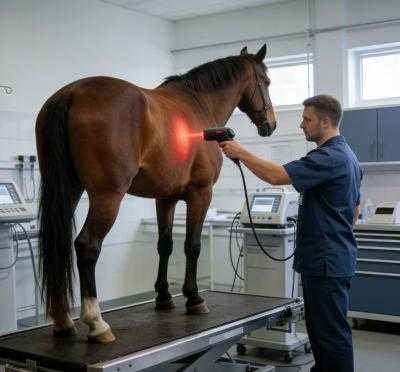
Previous management with stall rest, ice water boots, and non-steroidal anti-inflammatory drugs yielded zero reduction in core lesion size over a three-week baseline period. High-power photobiomodulation therapy was initiated using a targeted Class IV multi-wavelength protocol.
Laser Intervention Dosimetry and Operational Matrix
The horse underwent a four-week intensive therapeutic protocol utilizing synchronized 980nm and 1470nm wavelengths. Energy was delivered via a non-contact sweeping technique during acute stages, progressing to deep-tissue contact massage as swelling dropped.
| Case Identifier | Patient Profile | Diagnosis and Lesion Extent | Operating Parameters | Dosimetric Delivery | Clinical Horizon |
| EQ-PT-2026-088 | 6yo Thoroughbred Gelding (520 kg) | Grade III SDFT Core Lesion (42% cross-section) | 980nm (15W) + 1470nm (10W); 25W Peak; 50% Duty Cycle | 20 Hz, 7,500 J total per session (5 min); 12 sessions across 4 weeks | Day 14: Lesion down to 18%; Day 28: Complete hypoechoic fill, parallel collagen alignment |
Measured Recovery Trajectory
During sessions one through four, the protocol focused on lymphatic drainage using the 1470nm wavelength at higher pulse rates (100 Hz, 30 percent duty cycle). Digital calipers verified a 32 percent reduction in soft-tissue circumference across the metacarpus within 72 hours. Pain on palpation resolved by session four.
From sessions five through twelve, parameters shifted to stimulate collagen synthesis and neovascularization. The 980nm wavelength was elevated to its maximum ratio with a lower pulse frequency of 20 Hz at a 50 percent duty cycle to maximize tissue saturation. Ultrasonographic re-evaluation on Day 28 demonstrated complete resolution of the central fluid pocket, with hypoechoic areas replaced by dense, aligned echogenic fibrillar patterns. The horse advanced to hand walking eight weeks ahead of historical recovery curves without localized heat recurrence.
Biomechanical Restoration Across Tendon Architecture
High-power photobiomodulation delivers functional advantages over traditional immobilization, non-steroidal anti-inflammatory protocols, and cold treatment regimens.
Immobilization and anti-inflammatory drugs halt inflammation by blunting natural repair, often resulting in disorganized type-III collagen. This scar tissue lacks the elasticity of native tendon fibers, leading to recurring tears once the horse returns to full training. Deep-tissue laser therapy works via completely different biological pathways.
The photobiological reaction activates cytochrome c oxidase in the mitochondrial respiratory chain. This reaction surges cellular ATP production, ramps up fibroblast proliferation, and accelerates the conversion of fragile type-III collagen into organized, load-bearing type-I collagen fibers. Tendons heal with their natural spring and tensile strength intact.
Furthermore, high-power therapy does not require joint immobilization. Maintaining micro-mobility throughout treatment guides newly formed collagen along natural stress vectors, preventing the formation of rigid intra-sheath adhesions.
Where long recovery regimens cost performance stables months of track time, high-power multi-wavelength laser technology delivers the photon density required to rebuild damaged tissue from within. Stables recover lost training time, reduce recurring breakdown rates, and resolve difficult musculoskeletal injuries using precise, measurable light energy.