 FotonMedix












Protocolos Neuro-Regenerativos: Avances en el tratamiento de la neuropatía periférica mediante fotobiomodulación de alta intensidad
En el campo especializado de la neurología clínica y el tratamiento del dolor, el objetivo terapéutico ha pasado del simple enmascaramiento analgésico al restablecimiento activo de la función neuronal. Durante décadas, los facultativos confiaron en los dispositivos de terapia láser de baja potencia para tratar el dolor localizado leve. Sin embargo, estos sistemas de baja potencia a menudo se quedaban cortos a la hora de abordar las complejidades sistémicas y profundamente arraigadas de la neuropatía periférica (NP). La llegada de los sistemas de alta intensidad, en concreto los utilizados en la fuerza ligera terapia láser, ha introducido una nueva capacidad: la de influir en el transporte axonal y en la actividad de las células de Schwann a grandes profundidades tisulares.
La neuropatía periférica, especialmente en sus formas diabética o idiopática, implica la degradación progresiva de las vainas de mielina y la ralentización de la velocidad de conducción nerviosa. El tratamiento de estas afecciones requiere algo más que una aplicación superficial de luz; requiere un suministro preciso de energía a los vasa nervorum (los pequeños vasos sanguíneos que irrigan los nervios) y a los propios troncos nerviosos. Aprovechando los principios de láser lightforce los médicos pueden ahora administrar dosis terapéuticas al nervio ciático o al plexo braquial -zonas a las que antes no llegaban dispositivos de categoría inferior- desencadenando una cascada de acontecimientos neuroregenerativos que antes se consideraban imposibles fuera de la intervención quirúrgica.
El modelo biológico de la reparación nerviosa y la sinergia de longitudes de onda
La eficacia de la terapia láser de fuerza lumínica en el tratamiento de los nervios dañados radica en su capacidad para modular el entorno celular del sistema nervioso periférico. Cuando examinamos la fisiopatología de la neuropatía, observamos un estado de isquemia crónica y estrés oxidativo dentro del haz nervioso. La terapia láser de alta intensidad (HILT) interviene abordando tres vías críticas: la mejora metabólica, la optimización vascular y la supresión de las citoquinas proinflamatorias.
En la práctica clínica, la elección de la longitud de onda es la variable más significativa. Mientras que una dispositivo de terapia con láser bajo podrían utilizar un único diodo de 660 nm u 808 nm, los sistemas avanzados de alta potencia emplean la suma de longitudes de onda para lograr un efecto biológico multicapa.
- 810nm (El activador metabólico): Esta longitud de onda es esencial para la reparación nerviosa porque maximiza la activación de la citocromo c oxidasa en las mitocondrias de las células de Schwann. Las células de Schwann son las responsables de producir la vaina de mielina; al aumentar su producción de ATP, aceleramos el proceso de remielinización.
- 915nm (El conductor de oxigenación): Los nervios periféricos son muy sensibles a los niveles de oxígeno. Esta longitud de onda tiene un pico específico de absorción de hemoglobina, lo que facilita la liberación de oxígeno en los tejidos nerviosos hipóxicos, que es vital para revertir la “inanición” de las fibras nerviosas.
- 980 nm (El catalizador microcirculatorio): Esta longitud de onda se dirige al agua del líquido intersticial, creando un efecto térmico controlado que induce la vasodilatación. Esto aumenta el drenaje de los productos metabólicos de desecho y reduce la presión endoneurial que suele causar la sensación de “quemazón” asociada a la neuropatía.
Al combinar estas longitudes de onda en un protocolo de terapia láser lightforce, no sólo tratamos el dolor, sino que rehabilitamos todo el microentorno que rodea al nervio.
Superar la barrera de la profundidad: Por qué la potencia influye en los resultados neurológicos
Uno de los mitos más persistentes en la medicina láser es que “menos es más”. Aunque esto puede aplicarse al cuidado de heridas superficiales, es una falacia clínica en el tratamiento de patologías nerviosas profundas. El cuerpo humano es un filtro muy eficaz de la luz. Para cuando los fotones de un dispositivo de terapia con láser de baja potencia de 0,5 W alcanzan una profundidad de 3 a 5 centímetros -donde residen los principales troncos nerviosos-, la densidad de potencia a menudo ha descendido por debajo del umbral necesario para fotobiomodulación (PBM).
Para lograr un resultado clínico en afecciones como la radiculopatía o el síndrome del túnel tarsiano, el clínico debe tener en cuenta la “densidad de potencia en profundidad”. La terapia láser de fuerza luminosa de alta intensidad resuelve este problema proporcionando una “potencia inicial” suficiente en la superficie de la piel. Si necesitamos 5 J/cm² a nivel del nervio a 4 cm de profundidad, y sabemos que sólo 3% de luz alcanzan esa profundidad en determinados tipos de tejido, debemos suministrar una intensidad mucho mayor en la superficie para garantizar que el objetivo reciba la “dosis mínima efectiva.” Esta es la razón por la que los láseres de clase IV son ahora el estándar de oro para la rehabilitación neurológica; proporcionan la energía necesaria para impulsar el cambio biológico a través de gruesas capas musculares y fasciales.
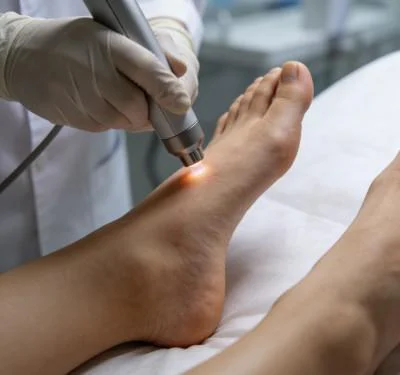
Estudio de caso clínico: Neuropatía diabética periférica crónica (DPN)
Este caso pone de relieve la transición de los cuidados paliativos a la terapia regenerativa con láser de fuerza luminosa en un paciente con complicaciones metabólicas de larga evolución.
Antecedentes del paciente:
Mujer de 67 años con una historia de 12 años de Diabetes Mellitus Tipo 2. Presentaba entumecimiento por “distribución en medias” y dolor urente en ambos pies (predominantemente el izquierdo). Sus síntomas habían progresado hasta el punto de que ya no podía sentir el suelo con claridad, lo que había provocado múltiples incidentes de “casi caída”. Los tratamientos anteriores incluían gabapentina (900 mg diarios) y duloxetina, que controlaban el dolor pero no mejoraban el entumecimiento ni la propiocepción.
Diagnóstico preliminar:
Neuropatía diabética periférica grave (DPN). Las pruebas de electromiografía (EMG) y de velocidad de conducción nerviosa (NCV) mostraron una ralentización significativa de los nervios sural y peroneo. El Toronto Clinical Neuropathy Score (TCNS) de la paciente era de 14 (indicativo de neuropatía grave). Su dolor basal en la escala VAS era de 7/10.
Estrategia de tratamiento:
El objetivo clínico era utilizar la terapia láser de fuerza lumínica de alta intensidad para estimular la regeneración axonal y mejorar la microcirculación en las extremidades inferiores. Se utilizó una técnica de exploración para tratar todo el trayecto de los nervios ciático, tibial y peroneo, desde el hueco poplíteo hasta la superficie plantar del pie.
Parámetros clínicos y protocolo:
| Parámetro | Entorno clínico | Justificación clínica |
| Longitudes de onda primarias | 810nm + 980nm + 1064nm | Triple acción para ATP, flujo sanguíneo y profundidad |
| Potencia Intensidad | 20 vatios (CW/mezcla pulsada) | Vencer la resistencia de la piel y el tejido adiposo |
| Dosis por pie | 4500 julios | Dosis completa para cobertura bilateral |
| Ajustes de frecuencia | 20 Hz (profundo) a 5000 Hz (superficial) | Salto de frecuencias para evitar la adaptación de los tejidos |
| Frecuencia de tratamiento | 2 sesiones por semana | Permitir 48-72 horas para la síntesis de proteínas celulares |
| Curso total | 15 sesiones | Calendario estándar para el cambio estructural neural |
| Método de aplicación | Barrido sin contacto | Cobertura de gran superficie para seguir el recorrido del nervio |
El proceso de tratamiento:
Durante las 5 primeras sesiones, el paciente informó de una sensación de “hormigueo”, que suele indicar la reactivación de fibras nerviosas latentes. En la sesión 8, el dolor “quemante” había disminuido significativamente. Entre las sesiones 10 y 15, el tratamiento se centró en la aplicación de 1064 nm de alta energía en la columna lumbar (L4-S1) para tratar las raíces nerviosas y garantizar la estimulación de toda la “cadena nerviosa”.
Recuperación y resultados tras el tratamiento:
- Reducción del dolor: La puntuación de la EAV disminuyó de 7/10 a 2/10. La paciente solicitó una reducción de la dosis de Gabapentina bajo la supervisión de su médico.
- Mejora sensorial: Las pruebas con monofilamento mostraron una mejora de 50% en la sensación táctil ligera.
- Resultado funcional: La paciente dijo sentirse “estable” sobre sus pies y reanudó sus paseos diarios de 20 minutos.
- Seguimiento (6 meses): Se mantuvieron las mejoras. La puntuación del TCNS descendió a 6 (categoría de neuropatía leve).
Conclusión final:
Este resultado clínico sugiere que la administración de alta potencia de la terapia láser lightforce superó eficazmente las limitaciones de un dispositivo estándar de terapia láser de baja potencia, proporcionando energía suficiente para estimular los vasa nervorum y restaurar la conductividad nerviosa. El tratamiento no sólo abordó los síntomas, sino que pareció modificar la degradación neural subyacente.
Transporte axonal e influencia glinfática de la PBM de alta intensidad
Aunque la producción de ATP es el beneficio más citado de la terapia láser, su impacto en el transporte axonal es quizá más crítico para los pacientes con neuropatía. Las neuronas son las células más largas del cuerpo; dependen de un “sistema ferroviario” de microtúbulos para transportar proteínas y nutrientes desde el cuerpo celular en la columna vertebral hasta las puntas de los dedos de manos y pies. En la neuropatía, este sistema de transporte se rompe.
Investigaciones recientes sobre la terapia láser de fuerza luminosa sugieren que la PBM estabiliza estos microtúbulos y aumenta la velocidad de la kinesina y la dineina (las proteínas motoras). Además, se ha demostrado que la aplicación de láser de alta intensidad mejora la limpieza “glinfática” de los nervios periféricos, ayudando a eliminar los subproductos metabólicos tóxicos (como los productos finales de glicación avanzada en los diabéticos) que se acumulan en el espacio endoneuronal. Esta “limpieza y alimentación” del nervio es la diferencia fundamental entre un efecto analgésico temporal y un resultado regenerativo a largo plazo.
Seguridad del láser de clase IV y el mito de la “relajación térmica
Una preocupación habitual en la terapia láser de alta intensidad es la posibilidad de que se produzcan daños térmicos. Sin embargo, cuando es administrada por un clínico formado que utiliza una técnica de pieza de mano móvil, el riesgo es prácticamente inexistente. La clave es comprender el “tiempo de relajación térmica” (TRT). Se trata del tiempo que tarda el tejido en disipar 50% del calor que ha absorbido.
Mediante el uso de una onda pulsada (PW) en lugar de una onda continua (CW), o simplemente moviendo el cabezal del láser a una velocidad constante, el clínico se asegura de que el tejido diana nunca alcance una temperatura que provoque la desnaturalización de las proteínas. De hecho, la leve elevación térmica producida por un sistema de terapia láser de fuerza lumínica de clase IV es terapéuticamente beneficiosa: reduce la viscosidad del líquido intersticial, lo que facilita que los fotones penetren aún más profundamente en el tejido.
Integración de la terapia láser de alta potencia en el tratamiento del dolor crónico
La clínica del dolor moderna debe evolucionar más allá del modelo de “una inyección y una pastilla”. La terapia con láser de fuerza luminosa de alta intensidad ofrece un puente entre los cuidados conservadores y la cirugía invasiva. Para los pacientes con dolor de espalda crónico, ciática o síndrome de dolor regional complejo (SDRC), el láser actúa como un potente neuromodulador no invasivo.
Cuando comparamos la relación coste-beneficio a largo plazo de un dispositivo de terapia láser de baja intensidad frente a un sistema de alta intensidad, el sistema de alta potencia gana en rendimiento clínico. Tratar una columna lumbar con un láser de 500 mW podría llevar una hora de aplicación estacionaria, lo que resulta poco práctico y a menudo ineficaz por falta de profundidad. Un sistema de 25 W de clase IV puede administrar una dosis terapéutica en la misma zona en 8 a 10 minutos, lo que permite un mejor cumplimiento por parte del paciente y resultados más uniformes en una población de pacientes diversa.
PREGUNTAS FRECUENTES: Preguntas clínicas sobre LightForce y la regeneración nerviosa
1. ¿Puede la terapia láser de fuerza lumínica “regenerar” realmente los nervios?
La terapia láser estimula el “brote” de axones y la reparación de la vaina de mielina. Aunque no crea un nuevo nervio desde cero, acelera considerablemente los mecanismos naturales de reparación de los nervios periféricos dañados.
2. ¿Es seguro utilizar la terapia láser lightforce si tengo una barra metálica en la pierna?
Sí. A diferencia de la terapia por ultrasonidos, que puede provocar “quemaduras periósticas” al calentar los implantes metálicos, la luz láser no se refleja ni es absorbida por el metal de forma que provoque una peligrosa acumulación de calor. Es segura para pacientes con prótesis articulares o herrajes para la columna vertebral.
3. ¿Por qué no me ha funcionado el aparato de terapia con láser de baja intensidad para la ciática?
La razón más probable es la “infradosificación”. El nervio ciático se encuentra muy por debajo de los músculos glúteos. Un láser de baja potencia simplemente no puede mantener la intensidad suficiente a esa profundidad para desencadenar una respuesta biológica. Es probable que necesite la mayor densidad de potencia de un sistema de clase IV.
4. ¿Cuándo notaré un cambio en los síntomas de mi neuropatía?
La reparación neurológica es más lenta que la muscular. Mientras que algunos pacientes sienten una reducción inmediata del dolor “quemante” debido al efecto analgésico, las mejoras estructurales en el entumecimiento y el equilibrio suelen tardar entre 6 y 10 sesiones en hacerse perceptibles.
5. ¿Duele la terapia láser de alta intensidad?
En absoluto. La mayoría de los pacientes lo describen como una sensación cálida y profundamente relajante. Si la zona es muy sensible, el médico puede ajustar la frecuencia de pulsación para garantizar un confort total sin dejar de suministrar la energía necesaria.