 FotonMedix












El cambio de paradigma en la fotobiomodulación: De la curación superficial a la regeneración tisular profunda
El panorama de la rehabilitación clínica ha experimentado una importante transformación en las dos últimas décadas. Hemos pasado del simple alivio sintomático a una comprensión más profunda de la bioenergética celular. En el centro de esta evolución se encuentra la terapia láser de alta intensidad (HILT), a menudo englobada bajo el término terapia láser de fuerza lumínica. Mientras que las primeras iteraciones de la medicina láser se basaban en la baja terapia láser restringido principalmente a la curación de heridas superficiales y a la terapia de puntos gatillo menores debido a las limitaciones de potencia, la práctica clínica moderna exige ahora la capacidad de alcanzar estructuras profundas como la cápsula de la cadera, la columna lumbar y grandes grupos musculares.
La transición de “baja” a “alta” potencia no es una mera cuestión de intensidad; es una cuestión de profundidad terapéutica y de eficacia “tiempo-dosis”. En un entorno clínico, el principal reto siempre ha sido la dispersión y absorción de la luz por la melanina y la hemoglobina de la dermis superficial. Para superarlo, la aplicación de láser lightforce utiliza potencias más elevadas (a menudo superiores a 15 o 25 vatios) para garantizar que un número suficiente de fotones llegue a las mitocondrias diana de los tejidos profundos. Esta es la piedra angular de Terapia láser de clase IV, que se diferencia por su capacidad de proporcionar una alta densidad de energía en una fracción del tiempo requerido por los métodos tradicionales.
La física de la penetración de fotones y la ventana óptica
Para comprender la eficacia de la terapia láser de fuerza lumínica es necesario profundizar en la “ventana óptica” del tejido biológico. Esta ventana, que abarca aproximadamente de 600 nm a 1100 nm, representa el espectro en el que la penetración de la luz es máxima porque la absorción por el agua, la melanina y la hemoglobina es mínima. Sin embargo, dentro de esta ventana, las distintas longitudes de onda tienen diferentes fines fisiológicos.
- 810nm: Esta longitud de onda es el “patrón oro” para la producción de ATP. Coincide perfectamente con el pico de absorción de la citocromo c oxidasa, la enzima terminal de la cadena respiratoria mitocondrial.
- 980 nm: A menudo utilizada en sistemas de alta intensidad, esta longitud de onda tiene una mayor tasa de absorción en el agua, lo que ayuda a la modulación térmica y mejora la circulación local a través de la vasodilatación.
- 1064nm: Es la longitud de onda más larga que se utiliza habitualmente en este campo y ofrece la menor dispersión, lo que permite que la energía eluda las capas superficiales y penetre profundamente en los espacios articulares.
Cuando un clínico elige un protocolo de terapia láser lightforce, no está simplemente “encendiendo una luz”. Está gestionando una compleja interacción de potencia (vatios), tiempo (segundos) y superficie (cm²). La dosis resultante, medida en julios (J), debe administrarse con una densidad de potencia específica (W/cm²) para desencadenar una respuesta biológica sin causar daños térmicos. Aquí es donde la experiencia clínica de un veterano con 20 años de experiencia resulta vital: saber cuándo pulsar el haz para permitir la relajación térmica y cuándo utilizar una onda continua para conseguir la máxima estimulación metabólica.
Mecanismos biológicos: Más allá de la superficie
El principal mecanismo de acción de cualquier dispositivo de terapia con láser bajo o sistema de alta intensidad es la Fotobiomodulación (PBM). Cuando los fotones son absorbidos por la citocromo c oxidasa, se produce una serie de acontecimientos intracelulares. En primer lugar, el óxido nítrico (NO) se disocia de la enzima. El óxido nítrico es un potente vasodilatador, pero cuando se une a la mitocondria, inhibe la respiración. Al “expulsar” el NO, la terapia láser permite que el oxígeno se una en su lugar, restableciendo el proceso de fosforilación oxidativa.
El consiguiente aumento de ATP (trifosfato de adenosina) proporciona a la célula la “moneda” que necesita para la reparación. Además, la PBM modula las especies reactivas del oxígeno (ROS) y activa factores de transcripción como el NF-kB, que influyen en la expresión de genes relacionados con la inflamación y la reparación tisular. Esta es la razón por la que la terapia láser de fuerza lumínica es tan eficaz en el tratamiento de afecciones crónicas como la artrosis o la neuropatía periférica; no se limita a enmascarar el dolor, sino que restablece el entorno celular de un estado proinflamatorio a uno regenerativo.
Clase IV frente a Clase IIIb: El debate sobre la eficacia clínica
En los primeros tiempos de la terapia láser, el dispositivo de terapia láser de baja intensidad de clase IIIb era la norma. Estos dispositivos suelen emitir menos de 500mW (0,5W). Aunque son eficaces en zonas pequeñas y superficiales, tienen problemas con la “ley del cuadrado inverso” y la dispersión tisular. Si un clínico necesita administrar 10 julios por centímetro cuadrado a un objetivo situado a 5 cm de profundidad, un láser de clase IIIb puede requerir de 30 a 40 minutos de aplicación estacionaria, lo que aumenta el riesgo de dosificación incoherente.
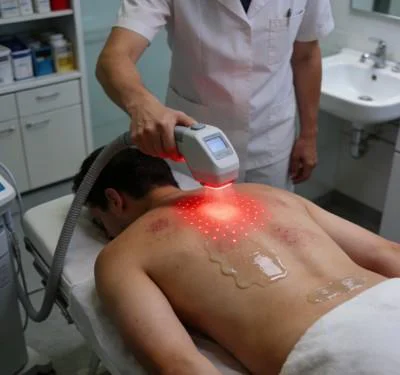
En cambio, los sistemas de terapia láser de clase IV proporcionan la potencia necesaria para administrar esa misma dosis en 5 minutos, al tiempo que cubren una superficie mayor con un movimiento de barrido. Este método de administración “activa” evita la formación de “puntos calientes” y garantiza una distribución más uniforme de la energía. La eficacia de la fotobiomodulación está directamente ligada al alcance del “umbral terapéutico”. Si la potencia es demasiado baja, el tejido diana nunca recibe suficientes fotones para activar la cadena respiratoria, lo que conduce a resultados clínicos subóptimos.
Aplicación clínica: El reto del “tejido profundo
La ventaja más significativa de la terapia láser de fuerza luminosa de alta intensidad es su aplicación en medicina deportiva y ortopedia. En afecciones como distensiones musculares de grado II, tendinopatías crónicas y lesiones ligamentosas, la profundidad de la lesión suele ser de 3 a 7 cm por debajo de la piel. Un dispositivo estándar de terapia con láser bajo suele perder 90% de su energía en el primer centímetro de tejido.
Al utilizar densidades de potencia más elevadas, podemos conseguir un efecto de “calentamiento volumétrico” en el tejido profundo. Aunque la PBM es principalmente una reacción fotoquímica no térmica, el leve efecto térmico asociado a los láseres de clase IV aumenta la energía cinética de las moléculas, mejorando aún más la difusión de oxígeno y nutrientes en la zona dañada. Este enfoque de doble acción -estimulación fotoquímica y modulación térmica- acelera la transición de la fase inflamatoria a la fase proliferativa de la cicatrización.
Estudio de caso clínico: Tendinitis calcificante crónica del manguito de los rotadores
Para ilustrar la aplicación práctica de la terapia con láser de fuerza luminosa de alta intensidad, examinemos un caso clínico complejo tratado en un entorno de rehabilitación multidisciplinar.
Antecedentes del paciente:
Varón de 54 años, arquitecto profesional, que presenta una historia de 14 meses de dolor crónico en el hombro derecho. El paciente refería un dolor nocturno importante y una limitación de la amplitud de movimiento (ADM), especialmente en abducción y rotación interna. Las intervenciones previas incluyeron dos inyecciones de corticosteroides (alivio mínimo) y seis meses de fisioterapia convencional.
Diagnóstico preliminar:
La ecografía y la resonancia magnética confirmaron una tendinitis calcificante del tendón supraespinoso (depósito de tipo II, de aproximadamente 1,2 cm de diámetro) con bursitis subacromial asociada. La escala analógica visual (EAV) del dolor de la paciente era de 8/10 durante la actividad.
Estrategia de tratamiento:
Dada la naturaleza crónica y la profundidad de la calcificación, se seleccionó un protocolo de terapia láser de clase IV de alta intensidad para penetrar en el músculo deltoides y alcanzar el espacio subacromial. El objetivo era reducir las citocinas inflamatorias en la bursa y estimular los tenocitos para la remodelación de la matriz.
Parámetros clínicos y protocolo:
| Parámetro | Ajuste/Valor | Justificación |
| Longitud de onda | 810nm + 980nm (doble) | 810nm para ATP; 980nm para flujo sanguíneo |
| Potencia de salida | 15 vatios (media) | Gran potencia para superar el grosor del deltoides |
| Frecuencia | 5000Hz (pulsado) | La pulsación se utiliza para gestionar la acumulación térmica |
| Energía total | 3000 julios por sesión | Dosis dirigida a estructuras articulares profundas |
| Densidad de potencia | 5,0 W/cm². | Garantiza el umbral de intensidad en el tendón |
| Área de tratamiento | 100 cm² (Cintura escapular) | Incluye supraespinoso y bursa |
| Duración | 6-8 minutos | Optimizado para el flujo de trabajo clínico y la eficacia |
El proceso de tratamiento:
La terapia se administró tres veces por semana durante cuatro semanas. Durante las dos primeras semanas, el tratamiento se centró en la “Modulación del dolor agudo”, utilizando una frecuencia más alta (10.000 Hz) para inducir un efecto analgésico temporal a través de la teoría de la puerta de control y la reducción de la bradicinina. En las semanas tres y cuatro, la frecuencia se redujo a 500 Hz para maximizar la “fase regenerativa”, centrándose en la síntesis de colágeno.
Recuperación y resultados tras el tratamiento:
- Semana 2: La puntuación de la EAV bajó de 8/10 a 4/10. Cesó el dolor nocturno.
- Semana 4: El ROM en abducción aumentó de 90° a 160°. El paciente reanudó la natación ligera.
- Seguimiento (3 meses): La repetición de la ecografía mostró una reducción de 40% en la densidad del depósito calcificado. La paciente refirió una puntuación VAS de 1/10, sólo durante esfuerzos extremos.
Conclusión final:
Este caso demuestra que la terapia con láser de fuerza luminosa de alta intensidad puede tener éxito allí donde fracasan los cuidados paliativos tradicionales. Al administrar una dosis masiva de fotones directamente en el lugar de la calcificación, estimulamos una respuesta inmunitaria localizada que inició la reabsorción de los cristales de hidroxiapatita y, al mismo tiempo, curó las fibras deshilachadas del tendón circundante.
El papel de la bioestimulación en la geriatría moderna
A medida que envejece la población mundial, aumenta la prevalencia de las enfermedades articulares degenerativas. Aquí es donde el dispositivo de terapia láser de baja intensidad encuentra a menudo sus limitaciones. En el caso de un paciente anciano con artrosis de rodilla (OA) grave, la patología afecta no sólo al cartílago, sino también al hueso subcondral y a la membrana sinovial.
La terapia con láser de fuerza luminosa de alta intensidad ofrece una alternativa no farmacológica para el tratamiento del dolor en geriatría. A diferencia de los AINE, que pueden tener efectos secundarios sistémicos sobre la salud renal y gastrointestinal, la terapia láser es localizada y no invasiva. Estudios recientes sobre la eficacia de la fotobiomodulación han demostrado que los tratamientos regulares con láser pueden aumentar la viscosidad del líquido sinovial al estimular la producción de ácido hialurónico por parte de los sinoviocitos. Esta “lubricación biológica” es fundamental para mantener la movilidad en las personas mayores, reducir la dependencia de medicamentos opiáceos y retrasar las intervenciones quirúrgicas.
Protocolos avanzados: La importancia de la suma de longitudes de onda
En el contexto de la terapia láser de fuerza luminosa, a menudo hablamos de “Suma de longitudes de onda”. Los sistemas avanzados modernos no se basan en un único diodo láser. En su lugar, combinan múltiples diodos para crear un efecto sinérgico.
- El componente de 650 nm: Incluida a menudo en un dispositivo de terapia láser de baja intensidad, esta luz roja es absorbida por la piel y resulta excelente para tratar los puntos gatillo y los nervios superficiales que a menudo remiten el dolor de lesiones más profundas.
- El componente de 915 nm: Esta longitud de onda tiene una afinidad específica por la oxigenación de la hemoglobina, lo que ayuda a descargar el oxígeno de forma más eficaz en el lugar del tejido.
- El componente de 1064 nm: Como ya se ha comentado, esto proporciona el “impulso profundo” necesario para las aplicaciones pélvicas y de la columna vertebral.
Combinándolos, un clínico puede tratar toda la “cadena de lesiones” -desde la tensión muscular compensatoria superficial hasta la lesión primaria profunda- en una sola sesión. Este enfoque holístico de la medicina láser es lo que diferencia a un técnico estándar de un experto clínico.
Seguridad, contraindicaciones y ética clínica
A pesar de la elevada potencia de la terapia láser lightforce, el perfil de seguridad es notablemente alto, siempre que se sigan los procedimientos operativos estándar. El requisito de seguridad más importante es la protección ocular. Tanto el clínico como el paciente deben llevar gafas de seguridad de longitud de onda específica, ya que el haz colimado de un láser de clase IV puede causar daños permanentes en la retina incluso por reflexión indirecta.
Las contraindicaciones siguen siendo las habituales: evitar el tratamiento directo sobre un tumor maligno conocido, la glándula tiroides o un útero grávido. Sin embargo, un error frecuente es creer que el láser no puede utilizarse sobre implantes metálicos. Dado que la luz no es ionizante y su interacción principal es con los cromóforos (no con el metal), la terapia con láser de fuerza lumínica es perfectamente segura para pacientes con prótesis totales de cadera o rodilla, siempre que se controle el efecto térmico.
El futuro de la medicina láser de alta intensidad
De cara al futuro, la integración de sensores de diagnóstico con la administración de tratamientos es la próxima frontera. Imaginemos un sistema de terapia láser de fuerza luminosa que utilice termografía en tiempo real para ajustar su potencia de salida en función de la temperatura de la piel del paciente, o un sistema que utilice biorretroalimentación para detectar el “punto de saturación” exacto de las mitocondrias.
Hasta entonces, la eficacia de la terapia láser de clase IV depende de la sinergia entre el hardware de alta gama y la inteligencia clínica. Avanzamos hacia un mundo en el que la “medicina regenerativa” es la primera línea de defensa, no la última. La capacidad de poner en marcha de forma no invasiva los mecanismos de reparación del propio cuerpo mediante la aplicación precisa de luz es quizá el avance médico más significativo del siglo XXI.
PREGUNTAS FRECUENTES: Preguntas frecuentes sobre la terapia con láser de alta intensidad
1. ¿Es el calor de un láser LightForce lo que produce la curación?
No. Aunque sentirá un calor relajante, la curación procede de una reacción fotoquímica denominada fotobiomodulación. El calor es un efecto secundario de la alta densidad de potencia, que ayuda a la vasodilatación, pero el verdadero trabajo se produce a nivel mitocondrial, donde la luz se convierte en energía celular.
2. ¿Cuántas sesiones suelen ser necesarias para ver resultados?
En el caso de lesiones agudas, los pacientes suelen sentir un alivio significativo en 1 a 3 sesiones. Para afecciones crónicas como la tendinitis calcificada mencionada en nuestro estudio de caso, suele ser necesaria una serie de 10-12 sesiones a lo largo de 4 semanas para lograr cambios estructurales duraderos en el tejido.
3. ¿Por qué es mejor un láser de clase IV que un aparato de terapia con láser bajo?
No es necesariamente “mejor” para todo, pero es mucho más eficaz para los tejidos profundos. Un láser de baja potencia no puede enviar suficientes fotones a una articulación profunda (como la cadera o la zona lumbar) en un tiempo razonable. El sistema de clase IV proporciona la potencia necesaria para superar la dispersión tisular y alcanzar el umbral terapéutico.
4. ¿Puede utilizarse la terapia láser junto con otros tratamientos como la fisioterapia?
Por supuesto. De hecho, la terapia láser de fuerza lumínica es más eficaz cuando se utiliza como “complemento” de la fisioterapia. Al reducir primero el dolor y la inflamación, el láser permite al paciente realizar sus ejercicios de rehabilitación con mayor eficacia y menos molestias.
5. ¿Tiene efectos secundarios?
Los efectos secundarios son poco frecuentes. Algunos pacientes pueden experimentar un “efecto rebote” en el que sienten un ligero aumento del dolor 24 horas después del primer tratamiento, ya que se acelera el proceso inflamatorio. Se trata de una parte normal de la respuesta curativa y suele desaparecer rápidamente.