 FotonMedix












nouvelles
Nouvelles de l'entreprise丨Nouvelles de l'industrie丨Nouvelles des produits
Recherche dans l'ensemble de la station
Nouvelles de l'entreprise丨Nouvelles de l'industrie丨Nouvelles des produits
Dans le paysage évolutif de la rééducation vétérinaire et de la gestion de la douleur, peu de modalités ont modifié les protocoles cliniques de manière aussi significative que les lasers thérapeutiques de haute puissance. L'arthrose canine, une affection envahissante, progressive et débilitante qui touche une grande partie de la population canine gériatrique, nécessite une approche multimodale qui dépasse le simple masquage des symptômes. Thérapie laser de classe 4, La photobiomodulation (PBM) est apparue non seulement comme un moyen auxiliaire de soulager la douleur, mais aussi comme un outil fondamental capable de modifier le microenvironnement inflammatoire de l'articulation malade.
Pour tirer pleinement parti des capacités de l thérapie laser de classe iv, Les cliniciens doivent aller au-delà de la compréhension rudimentaire de “faire briller la lumière sur un point douloureux”. Une utilisation efficace exige une connaissance approfondie de la bioénergétique cellulaire, des propriétés optiques des tissus canins et de la dosimétrie précise nécessaire pour surmonter les obstacles uniques que constituent la fourrure et la pigmentation.
Une idée fausse persistante en médecine vétérinaire consiste à assimiler les lasers thérapeutiques à de simples dispositifs de chauffage. Bien qu'un effet thermique réconfortant soit souvent présent avec les systèmes de forte puissance, l'action thérapeutique principale est photochimique et non photothermique. L'efficacité des lasers laser pour l'arthrite chez le chien réside dans sa capacité à influencer le métabolisme cellulaire au niveau des mitochondries.
Le protagoniste central de ce récit cellulaire est la cytochrome c oxydase (CcO), l'enzyme terminale de la chaîne de transport d'électrons de la mitochondrie. La CcO agit comme un photoaccepteur ou chromophore, absorbant spécifiquement les photons dans le spectre du proche infrarouge (NIR), typiquement entre 800nm et 980nm.
Dans les états d'inflammation chronique ou de stress cellulaire - conditions endémiques d'une articulation arthritique - la fonction mitochondriale est supprimée. Le monoxyde d'azote (NO) se lie de manière compétitive au site de liaison de l'oxygène de la CcO, ce qui a pour effet d'étrangler la respiration cellulaire et d'arrêter la production d'adénosine triphosphate (ATP), la principale source d'énergie de la cellule.
Lorsqu'une densité suffisante de photons provenant d'un laser de classe IV atteint le tissu en détresse, ces photons sont absorbés par le CcO. Cette absorption déstabilise et déplace la molécule inhibitrice de NO. Cet événement, connu sous le nom de photodissociation, rétablit immédiatement la capacité de l'enzyme à utiliser l'oxygène. La conséquence immédiate est une augmentation significative de la synthèse d'ATP.
Cette poussée d'énergie cellulaire n'est pas abstraite ; c'est le carburant nécessaire aux processus énergivores de réparation des tissus, de synthèse du collagène et de rétablissement de l'homéostasie. En outre, le déplacement du NO lui permet d'agir comme un vasodilatateur dans la microcirculation locale, améliorant ainsi l'oxygénation des tissus précédemment ischémiques.
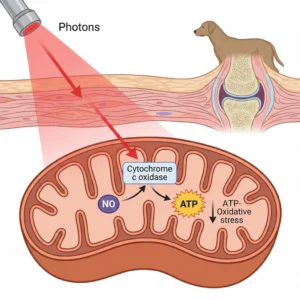
Au-delà de l'ATP, la PBM a un impact direct sur les médiateurs inflammatoires. Des études cliniques suggèrent que des doses appropriées de laser peuvent inhiber l'expression de la cyclooxygénase-2 (COX-2), de manière similaire au mécanisme d'action des AINS, mais sans les effets secondaires gastro-intestinaux ou rénaux associés. En outre, il a été démontré que la PBM réduit les niveaux de prostaglandines pro-inflammatoires (comme la PGE2) tout en stimulant la libération de cytokines anti-inflammatoires.
Pour le patient arthritique, cela signifie que nous nous attaquons à la “soupe inflammatoire” qui baigne la capsule articulaire, réduisant ainsi les signaux chimiques qui perpétuent la douleur et la dégradation.
La classification des lasers est basée sur leur danger potentiel pour les yeux et la peau, directement lié à leur puissance de sortie. Un laser de classe IV est un appareil dont la puissance continue est supérieure à 500 milliwatts (0,5 watt). Dans le domaine de la rééducation vétérinaire, cependant, la distinction est pratique : la puissance équivaut à la pénétration et à la vitesse de traitement.
Historiquement, les lasers de classe IIIb de faible puissance (moins de 500 mW) étaient utilisés pour les affections superficielles. Bien qu'ils soient efficaces pour les plaies ou les tendinites peu profondes, ils n'ont pas la densité de photons nécessaire pour traiter les structures musculo-squelettiques profondes, sauf chez les patients les plus petits. La “fenêtre thérapeutique” correspond au nombre de photons qui doivent atteindre le tissu cible (la capsule articulaire, les terminaisons nerveuses périostées et les muscles environnants) pour déclencher la réponse de la PBM.
Chez un chien de grande race souffrant d'arthrose de la hanche, le tissu cible peut se trouver à plusieurs centimètres de profondeur, protégé par la peau, la graisse sous-cutanée et une masse musculaire importante. Lorsque la lumière laser pénètre dans les tissus, elle se disperse et est absorbée. Pour délivrer une dose thérapeutique à une articulation profonde de la hanche, une dose superficielle élevée est nécessaire. Les lasers de classe IV, dont la puissance est souvent comprise entre 10 et 30 watts, fournissent la puissance nécessaire pour délivrer ces photons de manière efficace dans un temps de traitement raisonnable. Essayer de traiter la hanche d'un grand danois avec un laser de 200 mW est cliniquement futile ; les photons n'atteindront tout simplement pas la cible en nombre suffisant pour déclencher un changement biologique.
Le succès clinique de la thérapie laser pour l'arthrite chez le chien dépend fortement de l'utilisation des longueurs d'onde correctes qui se situent dans la fenêtre optique de la transparence des tissus (environ 600nm à 1100nm). Toutes les longueurs d'onde ne se comportent pas de la même manière.
Un protocole clinique de qualité supérieure implique souvent une approche à plusieurs longueurs d'onde pour traiter simultanément différents aspects de la pathologie : stimulation cellulaire profonde, amélioration de la circulation superficielle et modulation des récepteurs de la douleur.
L'élément le plus critique d'une thérapie au laser de classe quatre est la dosimétrie. Le dosage suit la loi d'Arndt-Schulz, qui suggère un “point idéal” pour la stimulation biologique. Une énergie trop faible n'apporte aucun bénéfice ; une énergie trop forte peut être inhibitrice.
La dose est mesurée en joules par centimètre carré (J/cm²), ce qui représente la densité énergétique. Pour l'arthrose profonde, le consensus vétérinaire suggère une dose cible à la surface du tissu de 8 à 12 J/cm² pour s'assurer qu'une énergie adéquate atteint l'articulation.
La médecine vétérinaire présente un défi unique, absent de la thérapie humaine : la fourrure et la pigmentation dense. La mélanine est un puissant absorbeur de lumière. Un Labrador noir absorbera superficiellement beaucoup plus d'énergie laser qu'un Labrador jaune. Si elle n'est pas prise en compte, cette absorption superficielle peut entraîner un échauffement inconfortable de la peau sans qu'une énergie suffisante n'atteigne l'articulation profonde.
Pour atténuer ce problème, les cliniciens doivent utiliser un technique de contact. En appuyant fermement la tête de l'émetteur laser sur la peau et en séparant les poils, le clinicien atteint deux objectifs :
Pour illustrer l'application pratique de ces principes, nous examinerons la prise en charge d'un cas d'arthrose chronique et complexe.
Un examen orthopédique complet a révélé une restriction sévère de l'amplitude de mouvement des deux articulations coxo-fémorales (hanches) avec des crépitations palpables. Les groupes musculaires fessiers et quadriceps présentaient une atrophie marquée. Les radiographies ont confirmé une arthrose bilatérale au stade terminal, caractérisée par un aplatissement de la tête fémorale, une formation importante d'ostéophytes sur le rebord acétabulaire et une sclérose de l'os sous-chondral.
Jasper est actuellement traité avec des doses maximales tolérées de gabapentine et un AINS sélectif de la COX-2. Malgré cela, son score de qualité de vie (QoL) a été jugé médiocre en raison de la douleur chronique qui franchit la barrière pharmacologique.
L'objectif était d'introduire le PBM de classe IV en tant que puissant agent anti-inflammatoire et analgésique afin d'abaisser le seuil de douleur de base, ce qui permettrait d'améliorer la mobilité et la reconstruction musculaire ultérieure. Un protocole à double longueur d'onde et à forte puissance a été choisi pour assurer une pénétration profonde dans la capsule de l'articulation de la hanche.
| Paramètres | Réglage/Valeur | Raison d'être |
| Longueurs d'onde | Mélange de 810nm et 980nm | 810nm pour la stimulation maximale de la CcO ; 980nm pour le gradient thermique analgésique. |
| Puissance | 15 watts (moyenne) | Puissance élevée nécessaire pour une pénétration profonde chez un chien de 34 kg. |
| Mode | Ondes continues (CW) et multifréquences | CW pour une délivrance maximale de l'énergie ; fréquences mixtes (par exemple, 20Hz, 500Hz, 5000Hz) pour cibler différents types de tissus et de récepteurs de la douleur. |
| Dose cible | 12 J/cm² | Dosage élevé en raison de la gravité et de la profondeur de la pathologie. |
| Zone de traitement | environ 400 cm² par hanche | Couvrant la capsule articulaire, les fessiers, l'origine des ischio-jambiers et la région lombo-sacrée. |
| Énergie totale | 4 800 joules par hanche | Énergie totale nécessaire pour atteindre la fluence cible sur la grande surface. |
| Technique | Contact direct, Scanner | Exercer une pression ferme pour contourner la fourrure et blanchir la peau. |

La phase d'induction a consisté en trois traitements par semaine pendant les deux premières semaines, avec une diminution progressive en fonction de la réponse clinique.
Semaines 1-2 (phase d'induction) : Après la première séance, Jasper a semblé plus à l'aise pour se reposer, mais n'a pas montré de changement significatif dans sa mobilité. Lors de la quatrième séance (fin de la première semaine), le propriétaire a signalé que Jasper avait spontanément monté deux marches du porche, ce qu'il n'avait pas fait depuis des mois. La démarche “traînante” a commencé à montrer des signes d'augmentation de la longueur de la foulée.
Semaines 3-4 (phase de transition) : La fréquence a été réduite à deux fois par semaine. La capacité de Jasper à se relever de la position couchée s'est nettement améliorée. La chaleur palpable et l'épanchement sur les articulations de la hanche ont diminué. Surtout, sous la supervision d'un vétérinaire, la dose d'AINS a été réduite de 25% sans que les symptômes de la douleur ne réapparaissent.
Semaines 5-8 (phase d'entretien) : La fréquence du traitement a été réduite à une fois par semaine, puis à une fois toutes les deux semaines. Jasper a commencé à faire des promenades courtes et lentes sans se fatiguer immédiatement. Le tonus musculaire de l'arrière-train s'est amélioré de façon palpable grâce à une utilisation accrue.
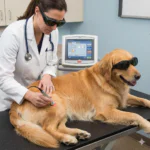
Au bout de huit semaines, Jasper a été maintenu à une séance mensuelle de thérapie laser de classe IV et à une dose réduite de 50% de son traitement AINS d'origine. Bien que la pathologie radiographique soit restée inchangée - le laser ne régénère pas le cartilage perdu - le résultat fonctionnel a été transformé. En gérant efficacement l'inflammation chronique et la douleur neuropathique, thérapie au laser de classe quatre a brisé le cycle douleur-inactivité-atrophie, rétablissant une qualité de vie respectable pour un patient gériatrique.
Bien que la PBM soit remarquablement sûre et présente peu d'effets secondaires, la puissance élevée des appareils de classe IV exige un respect strict des protocoles de sécurité.
L'intégration des laser pour l'arthrite chez le chien représente le passage d'un modèle réactif et médicamenteux de gestion de la douleur à une stratégie proactive et multimodale. En s'attaquant aux racines cellulaires de l'inflammation et de la douleur, la thérapie laser de classe IV offre une opportunité cruciale. Elle abaisse suffisamment la barrière de la douleur pour permettre aux patients de s'engager dans des exercices thérapeutiques, ce qui est la clé ultime de la mobilité gériatrique à long terme.
Au fur et à mesure que nous approfondissons notre compréhension de la photobiologie, les protocoles deviendront encore plus raffinés, s'éloignant des “paramètres de douleur” génériques pour aller vers des traitements personnalisables basés sur le type de tissu, la chronicité et la physiologie individuelle du patient. Pour le clinicien vétérinaire moderne, la technologie laser Master Class IV n'est plus un luxe ; c'est un élément essentiel des soins orthopédiques complets.
Q : La thérapie laser de classe IV est-elle douloureuse pour le chien pendant le traitement ? R : Non, le traitement est indolore. La puissance élevée des lasers de classe IV crée une chaleur douce et apaisante dans les tissus, que la plupart des chiens trouvent très relaxante. De nombreux patients, y compris ceux qui souffrent de douleurs chroniques, se penchent vers la sonde ou s'endorment pendant la séance en raison du soulagement immédiat et de la libération d'endorphines.
Q : En combien de temps puis-je espérer voir des résultats sur l'arthrite de mon chien ? R : Le temps de réponse varie en fonction de la gravité et de la chronicité de l'arthrite. Certains propriétaires constatent une amélioration du confort immédiatement après la première séance. Cependant, la PBM est cumulative. En général, des améliorations significatives et durables de la mobilité et une réduction des comportements douloureux sont observées après la troisième à la sixième séance de la phase d'induction.
Q : La thérapie laser peut-elle remplacer les médicaments contre la douleur que prend actuellement mon chien ? R : La thérapie laser est un outil puissant qui permet souvent aux vétérinaires de réduire considérablement la dose d'AINS ou d'autres médicaments contre la douleur, diminuant ainsi le risque d'effets secondaires à long terme sur le foie ou les reins. Dans certains cas légers ou modérés, elle peut éventuellement remplacer complètement les médicaments, mais cette décision doit toujours être prise sous la supervision directe d'un vétérinaire, en fonction de la réaction du chien.
Q : Les effets de la thérapie laser sont-ils permanents ? R : L'arthrose est une maladie progressive, dégénérative et incurable. Par conséquent, la thérapie au laser est un outil de gestion et non une solution permanente. Une fois la douleur et l'inflammation initiales maîtrisées pendant la phase d'induction, la plupart des patients souffrant d'arthrite chronique ont besoin de traitements d'entretien - toutes les deux à six semaines - pour maintenir leur qualité de vie améliorée et prévenir une rechute des symptômes graves.
Q : Y a-t-il un risque de brûler mon chien avec un laser de forte puissance ? R : Lorsqu'il est utilisé par un vétérinaire professionnel formé et utilisant une technique appropriée (en déplaçant continuellement la pièce à main ou en utilisant une grande tête de contact), le risque de lésion thermique est extrêmement faible. Les dispositifs médicaux modernes de classe IV sont également équipés de logiciels sophistiqués et de protocoles de sécurité pour gérer l'apport d'énergie et éviter la surchauffe des tissus.