 FotonMedix












High Power Photomedicine Overcomes Deep Joint Stagnation
Multi-wavelength Class IV photon targeting penetrates heavy canine hip musculature, selectively heating targeted synovial vascular beds without epidermal overheating through calibrated duty cycle thermal dissipation.
A 42 kg Rottweiler lies stiffly across the treatment mat, unable to rise without rear-leg tremors, and your schedule is backed up by forty minutes. You run a cold hand over the lateral hip joint: the capsule feels thick, fibrotic, and unyielding. Oral non-steroidal anti-inflammatories reached their ceiling three months ago, leaving the animal with elevated hepatic enzymes and a persistent grade 3 lameness that leaves the owner frustrated and questioning your clinic’s conservative plan. Standard low-level therapies barely warm the dermis; five minutes with low-output units does not even nudge the mitochondrial threshold inside an arthritic joint buried under five centimeters of dense gluteal muscle and subcutaneous fat.
When deep tissue chronic osteoarthritis reaches this stage, superficial photobiomodulation fails purely on physics. Light is scattered, diffused, and converted to unproductive surface heat long before reaching the subchondral bone plate. Navigating this clinical dead-end requires genuine multi-wavelength emission, shifting away from superficial toys to industrial-grade veterinary laser equipment capable of driving real joules past dense coats and pigmented skin into the vascular bed of the joint capsule.
The Tissue Attenuation Bottleneck in Large Breed Rehabilitation
Photons encounter immediate resistance the millisecond they strike dense fur and melanin-heavy epidermis. Rayleigh scattering and strong absorption peaks by cutaneous chromophores cause standard single-wavelength emitters to lose over eighty percent of their energy within the first four millimeters of soft tissue. For canine hip dysplasia, lumbosacral stenosis, or equine suspensory desmitis, superficial exposure yields negligible biological response at the target pathology.
Delivering therapeutic photon density into deep articular structures requires understanding the optical window of biological tissue. Light between 650 nm and 1100 nm demonstrates the lowest combined absorption across water and melanin, yet distinct target chromophores within this band behave drastically differently:
- 980 nm Hemoglobin Resonance: Light at 980 nm matches the local absorption peak of deoxygenated and oxygenated hemoglobin. Rather than scattering aimlessly, it interacts with microvascular networks, generating localized mild thermal gradients that stimulate immediate local vasodilation, relax muscle spasm, and initiate lymphatic drain without systemic vascular compromise.
- 1064 nm and 915 nm Deep Parenchymal Penetration: Because scattering coefficients drop consistently as wavelength lengthens past the visible spectrum, longer near-infrared bands bypass dense fibrous scar tissue to reach ischemic connective layers where cellular energy deficits linger.
- Water Interaction and Interstitial Pressure Modulation: In degenerative synovial fluid filled with inflammatory cytokines, targeted near-infrared absorption gently mobilizes interstitial fluid pockets, reducing intra-articular pressure and mechanical nerve impingement.
Achieving these physiological shifts without burning the patient requires high sustained irradiance. Relying on an underpowered handheld emitter forces the clinician to stand stationary for forty-five minutes to deliver marginal energy. Deploying an adaptable veterinary laser machine engineered with targeted multi-wavelength capability allows the operator to saturate thick fascial planes in under ten minutes, shifting the tissue environment from chronic inflammatory stagnation into active osteochondral repair.
Thermal Management Mechanics and Duty Cycle Modulation
The central clinical contradiction of Class IV photomedicine is simple: therapeutic outcome requires high total energy, but high continuous energy creates excessive epidermal heat. When treating dark-coated, double-coated, or heavily muscled animals, continuous-wave emission at high wattage quickly triggers cutaneous nociceptors, causing patient distress, flinching, and thermal burn risks.
Overcoming this limitation requires precise pulse duration control and duty cycle modulation. By cycling emission on and off within microsecond windows, tissue undergoes photothermal relaxation during the dark phases.
Continuous Wave: [======== 100% Heat Accumulation ========] -> Epidermal Spike
Pulsed Mode:     [== ON ==] [ off ] [== ON ==] [ off ]     -> Thermal Dissipation Window
When emission pulses rapidly with a fifty percent duty cycle, peak power delivers deep-penetrating photons that overcome scatter barriers, while the intermediate off-cycle allows the dermis to vent heat through local capillary perfusion. The deep tissue, which possesses lower vascular cooling rates than the skin surface, retains therapeutic photon density without thermal injury.
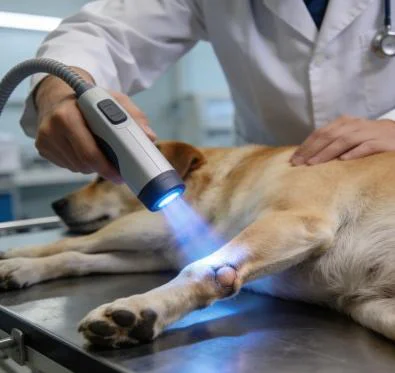
Clinicians utilizing modern veterinary lasers can alternate between high-frequency superpulsing for acute neurological desensitization and lower-frequency duty cycles for structural remodeling. This balance preserves patient comfort while delivering the requisite fluence to initiate real biological repair.
Clinical Protocol and Hemodynamic Outcomes
According to clinical photobiology frameworks outlined by Hamblin and substantiated across peer-reviewed veterinary orthopedic literature, photobiomodulation hinges on mitochondrial cytochrome c oxidase activation. Elevating cellular adenosine triphosphate production and transiently generating reactive oxygen species downregulates nuclear factor kappa B, effectively cutting off interleukin-1 beta and tumor necrosis factor-alpha production within the joint capsule.
To show how this operates in a demanding daily clinical environment, the following case record details treatment of severe bilateral coxofemoral osteoarthritis in a working canine.
Case Record: Canine Hip Dysplasia and Secondary Osteoarthritis
- Case Identifier: ORTHO-2026-VET-0842
- Patient Profile: 7-year-old male intact German Shepherd Dog, active patrol service
- Body Mass: 41.5 kg
- Diagnosis: Bilateral severe coxofemoral osteoarthritis, secondary to grade 4 hip dysplasia, profound muscle atrophy of the right semitendinosus and gluteus medius, severe joint capsule fibrosis
- Prior Conservative Therapy: Carprofen at 4.4 mg/kg once daily for eight months; gradual loss of efficacy, patient showed reluctance to sit, rear-limb proprioceptive deficits, and severe morning stiffness lasting over forty minutes
Comprehensive Treatment Protocol Parameters
| Session Number | Clinical Phase | Output Power (W) | Operating Mode & Duty Cycle | Target Wavelength Balance | Frequency (Hz) | Total Joules (J) | Energy Density (J/cm²) |
| 01 | Acute Desensitization | 8.0 W | Pulsed (40% Duty Cycle) | Balanced 980 nm / 1064 nm | 2,500 Hz | 2,400 J | 6.0 J/cm² |
| 02 | Hemodynamic Activation | 12.0 W | Pulsed (50% Duty Cycle) | High 980 nm Vasodilation | 1,000 Hz | 3,600 J | 9.0 J/cm² |
| 03 | Deep Fibrosis Remodeling | 15.0 W | Superpulsed (50% Duty Cycle) | Penetration Dominant (1064 nm) | 500 Hz | 4,500 J | 11.2 J/cm² |
| 04 | Synovial Inflammation Clearing | 15.0 W | Continuous sweep, fast scan | Equal multi-spectral mix | CW / Dynamic | 5,000 J | 12.5 J/cm² |
| 05 | Connective Tissue Repair | 18.0 W | Pulsed (60% Duty Cycle) | Deep Collagen Activation | 250 Hz | 5,400 J | 13.5 J/cm² |
| 06 | Deep Articular Saturation | 20.0 W | Pulsed (50% Duty Cycle) | High-penetration spectrum | 100 Hz | 6,000 J | 15.0 J/cm² |
| 07 | Functional Consolidation | 20.0 W | Pulsed (50% Duty Cycle) | Equal multi-spectral mix | 50 Hz | 6,000 J | 15.0 J/cm² |
| 08 | Maintenance Stabilization | 16.0 W | Pulsed (50% Duty Cycle) | Mixed regenerative bands | 20 Hz | 4,800 J | 12.0 J/cm² |
Longitudinal Recovery Data Across Treatment Milestones
Stiffness Duration (Minutes Post-Rest):
Week 0: [========================================] 45 min
Week 2: [========================] 25 min
Week 4: [============] 12 min
Week 6: [===] 3 min

Peak Vertical Force (% Body Weight on Affected Limb):
Week 0: [=============] 28%
Week 2: [=================] 38%
Week 4: [=======================] 51%
Week 6: [=============================] 64%
By the third intervention, the dog showed marked softening of the periarticular myofascial trigger points. At the completion of the eight-session protocol over four weeks, morning stiffness dropped from forty-five minutes to under three minutes, allowing carprofen dosage to be reduced by seventy-five percent without symptom recurrence. The animal returned to light active patrol duty within forty-five days of treatment completion.
The Economic and Clinical Practicality of High-Power Systems
Veterinary practices are often trapped between the economic burden of surgery and the frustrating plateaus of long-term pharmacology. Surgical joint replacements carry heavy capital entry points for clients, long convalescence periods, and infection risks. Long-term pharmacology, while cheap at the onset, carries persistent blood monitoring costs and eventual organ toxicity, frequently driving pet owners into burnout when clinical progress stalls.
Upgrading treatment infrastructure to capable multi-spectrum Class IV laser therapy completely reshapes patient turnover and client retention:
1. Hands-On Time Efficiency
Low-power equipment takes twenty-five minutes per hip to achieve minor surface-level effects. A high-energy platform delivers therapeutic energy in six to eight minutes of continuous, comfortable sweeping application. This speed enables a single veterinary technician or rehabilitation specialist to handle three times the daily patient volume without therapist fatigue.
2. Immediate Palpatory and Functional Feedback
Clients observe real improvements within forty-eight hours. Muscle relaxation around locked pelvic structures occurs during the session, giving the owner immediate tactile proof of comfort when the pet walks out of the treatment room without trembling.
3. Broadened Therapeutic Range
Modern clinical units are not single-disease tools. The same platform handling canine hip rehabilitation transitions directly to feline stomatitis, postoperative celiotomy incisions, acute equine flexor tendonitis, and open wound debridement simply by adjusting the pulse profile, fluence, and handpiece optics.
High-power photobiomodulation is not an experimental luxury; it is a clinical workhorse that resolves everyday therapeutic roadblocks. Bypassing the tissue attenuation barrier with genuine high-power multi-wavelength photon delivery offers a non-invasive, drug-sparing resolution for the complex mobility disorders that walk into the clinic every day.