 FotonMedix



Overcoming Deep Tissue Photonic Attenuation in Chronic Rotator Cuff Tears
Simultaneous multi-wavelength emission delivers verified therapeutic photon densities through dense subacromial fascia, preventing epidermal thermal accumulation via dynamically modulated duty cycles while accelerating tenocyte microvascular repair.
When an overhead athlete or manual laborer enters an orthopedic clinic with chronic shoulder stiffness, standard conservative protocols frequently hit a wall. Corticosteroid injections weaken the collagen matrix, oral NSAIDs provide transient relief while upsetting gastrointestinal balance, and conventional low-power physical modalities rarely penetrate past the deltoid muscle fascia. By the time the patient describes the sensation of a burning ache radiating down the upper arm whenever they reach overhead, the underlying subscapularis or supraspinatus tendon is trapped in a hypoxic, fibrotic state. The primary obstacle confronting physical therapists and rehabilitation physicians is optical physics: dense human tissue scatters, absorbs, and disperses non-coherent light within the first few millimeters of the dermis. Delivering effective photon dosages past the thick subacromial architecture to stimulate tenocyte ATP synthesis demands an understanding of photon transmission, thermal diffusion kinetics, and cellular chromophore saturation.
Optical Penetration Dynamics and Cellular Photobiomodulation Mechanics
Delivering high photon counts across multi-layered human anatomy requires overcoming tissue-specific absorption and dispersion coefficients. As light enters the stratum corneum, it encounters alternating refractive indices across the dermal matrix, adipose barriers, and thick muscular envelopes before reaching articular capsular regions.
Wavelength-Targeted Chromophore Saturation
The biological response depends on matching the correct wavelength to the target chromophore. Standard single-wavelength units fail because they hit an operational dead end: they are either absorbed prematurely by superficial melanin or water, or they scatter uncontrollably before reaching sub-fascial structures.
Bi-wavelength and multi-wavelength architectures operate within the therapeutic optical window to accomplish two distinct physiological objectives simultaneously:
- Deoxygenated and oxygenated hemoglobin target windows: Emission around the 980nm peak matches the absorption spectrum of oxygenated hemoglobin and dermal water layers. This produces controlled, localized thermal gradients that widen microvascular capillary beds, promoting vasodilation, increasing perfusion pressures, and stimulating lymphatic clearance in stagnant, fibrotic beds.
- Cytochrome c oxidase stimulation: Photons operating around the 1064nm and adjacent near-infrared spectrum face minimal scatter inside biological tissues. These photons penetrate deep into connective sheaths, where they are absorbed by unit IV of the mitochondrial respiratory chain, known as cytochrome c oxidase. This absorption displaces inhibitory nitric oxide, restructures mitochondrial membrane potential, and drives adenosine triphosphate (ATP) generation inside dormant tenocytes and damaged myofibrils.
Thermal Relaxation Time and Duty Cycle Management
Delivering sufficient Joules to an anatomical depth of 3.5 to 5 centimeters without thermal injury to the superficial skin presents an engineering challenge. Continuous wave (CW) delivery at high power levels quickly exceeds the thermal relaxation time (TRT) of human skin, triggering thermal nociceptors and risking epidermal blistering long before the tendon receives a therapeutic dose.
Advanced high-intensity class IV platforms solve this by utilizing variable pulse duty cycles. By pulsing emission at high repetition rates (such as 10 Hz to 20,000 Hz) with an adjustable on/off pulse ratio, the peak power delivers photons deep into tissues during the “on” cycle. The subsequent “off” phase allows surrounding capillaries and cutaneous water molecules to conduct heat away, keeping epidermal temperatures below the 42°C threshold for thermal pain. This precise duty cycle modulation allows clinicians to direct continuous high energy deep into subacromial bursae, providing targeted laser therapy for rotator cuff lesions without compromising skin integrity.
+--------------------------------------------------------------------------------------------------+
|                              MULTI-LAYER PHOTON TRANSMISSION MODEL                                |
+--------------------------------------------------------------------------------------------------+
| Laser Handpiece Contact Emission                                                                 |
|   |                                                                                              |
|   v                                                                                              |
| [Epidermis & Dermis]        ---> High scatter zone; controlled via pulse duty cycle cooling      |
|   |                                                                                              |
|   v                                                                                              |
| [Subcutaneous Adipose]     ---> Wavelength dependent bypass (low lipid attenuation profile)     |
|   |                                                                                              |
|   v                                                                                              |
| [Deltoid Muscle Fascia]     ---> 980nm induces localized vasodilation & perfusion surge          |
|   |                                                                                              |
|   v                                                                                              |
| [Subacromial Bursa]         ---> Lymphatic drainage initiated; clearing inflammatory cytokines    |
|   |                                                                                              |
|   v                                                                                              |
| [Supraspinatus Tendon]      ---> Deep photons target Cytochrome C Oxidase to restore ATP flow    |
+--------------------------------------------------------------------------------------------------+
Clinical Protocol Implementation: Shoulder Rotator Cuff vs. Paraspinal Muscle Sprain
Treating a tendon is biologically distinct from managing deep paraspinal muscle sprains or acute hamstring tears. Tendinous tissue is bradytrophic, possessing poor vascularization and high collagen density. Muscles, by contrast, are densely vascularized and susceptible to ischemia-induced intramuscular spasm, triggering hyperactive motor endplates and myofascial trigger points.
When using high-intensity laser for muscle pain, the delivery protocol shifts toward hyper-perfusion and the reduction of substance P. Rapid photon perfusion calms overactive sensory C-fibers, breaks actin-myosin contractures, and speeds the clearance of lactic acid and bradykinin. For muscle tissue, higher frequency pulsing paired with broader contact scanning patterns ensures muscular sheaths relax without localized hot spots.
When managing partial-thickness tendon tears, the goal shifts to structural remodeling. Research published by Hamblin and colleagues in photomedicine establishes that tendon collagen repair requires a precise threshold dose: typically between 6 and 12 Joules per square centimeter at the target anatomical plane. Under-dosing leaves mitochondrial synthesis unactivated, while excessive power can push cells into bio-inhibition. Delivering reliable laser therapy for muscle strain and connective tissue damage requires calibrated contact handpieces that compress the skin, displacing capillary blood and adipose scatter to minimize the physical distance to the target injury.
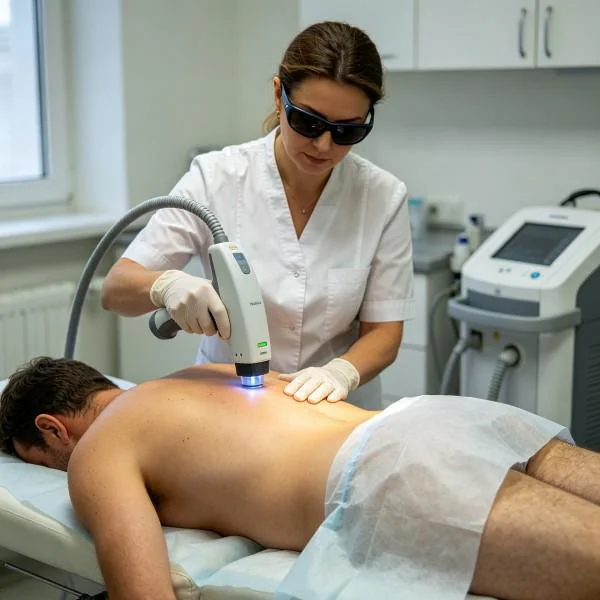
Clinical Case Documentation: Outpatient Orthopedic Rehabilitation
The following data represents a documented outpatient clinical course for a patient treated with a multi-wavelength Class IV rehabilitation laser system equipped with a specialized quartz-glass contact massage probe.
Patient Profile and Clinical Baseline
- Case Identifier: ORTHO-REHAB-2026-0814
- Patient Age / Sex: 52-Year-Old Male
- Primary Diagnosis: Chronic Supraspinatus Tendinopathy with Partial-Thickness Intrasubstance Tear (Grade II, confirmed via High-Frequency Musculoskeletal Ultrasound) alongside secondary Deltoid Myofascial Pain Syndrome.
- History: 7 months of persistent anterolateral shoulder pain, unresponsive to physical therapy and oral analgesics. Night pain preventing sleep; inability to perform active shoulder abduction past 65 degrees.
- Baseline Metrics: Numerical Pain Rating Scale (NPRS) at 8/10 during movement; QuickDASH functional disability score at 68.2/100; Active Range of Motion (AROM) Abduction at 65°.
Multi-Stage Treatment Regimen
The course was divided into an acute desensitization phase, an active vascular recruitment phase, and a collagen synthesis phase over four weeks.
| Session No. | Clinical Phase & Objective | Wavelength Setup | Operating Power (W) | Pulse Frequency (Hz) | Duty Cycle (%) | Energy Delivered (J) | Cumulative Dose (J) |
| Session 01 | Acute Analgesia / Nociceptive Gating | 980nm (60%) + 1064nm (40%) | 12.0 W | 10,000 Hz | 40% | 3,600 J | 3,600 J |
| Session 02 | Trigger Point Release & Microcirculation | 980nm (50%) + 1064nm (50%) | 15.0 W | 5,000 Hz | 50% | 4,500 J | 8,100 J |
| Session 03 | Subacromial Lymphatic Drainage | 980nm (70%) + 1064nm (30%) | 16.0 W | 2,500 Hz | 60% | 4,800 J | 12,900 J |
| Session 04 | Tendon Insertion Site Biostimulation | 980nm (30%) + 1064nm (70%) | 18.0 W | 500 Hz | 70% | 5,400 J | 18,300 J |
| Session 05 | Deep Fascial Expansion / Perfusion | 980nm (40%) + 1064nm (60%) | 20.0 W | 200 Hz | 75% | 6,000 J | 24,300 J |
| Session 06 | Extracellular Matrix Synthesis Induction | 980nm (20%) + 1064nm (80%) | 22.0 W | 50 Hz | 80% | 6,600 J | 30,900 J |
| Session 07 | High-Density Tenocyte Proliferation | 980nm (20%) + 1064nm (80%) | 24.0 W | Continuous (CW) | 100% | 7,200 J | 38,100 J |
| Session 08 | Active Remodeling & Fibroblast Realignment | 980nm (25%) + 1064nm (75%) | 24.0 W | Continuous (CW) | 100% | 7,200 J | 45,300 J |
| Session 09 | Functional Range Stress Integration | 980nm (30%) + 1064nm (70%) | 20.0 W | 100 Hz | 75% | 6,000 J | 51,300 J |
| Session 10 | Final Tissue Consolidation & Discharge | 980nm (40%) + 1064nm (60%) | 18.0 W | 500 Hz | 70% | 5,400 J | 56,700 J |
Clinical Progression and Outcome Metrics
WEEK 1 (Sessions 1-3):
- Post-session NPRS dropped from 8/10 to 4/10 within 30 minutes due to photomechanical C-fiber conduction blocking.
- Patient reported the first night of unbroken sleep after Session 2.
- Deltoid muscular splinting decreased noticeably during manual palpation.

WEEK 2 (Sessions 4-6):
- Active abduction expanded from baseline 65° to 110°.
- Crepitus around the subacromial arch decreased as bursal effusion resolved.
- QuickDASH score declined from 68.2 to 38.5.

WEEK 3 (Sessions 7-8):
- Shifted to CW high-density delivery with circular contact application directly over the greater tubercle.
- Patient began active-resisted internal and external rotation without catching or sharp pain.
- Ultrasound evaluation showed reduced peritendinous halo edema and improved hypoechoic fibrillar alignment.

WEEK 4 (Sessions 9-10):
- Full active elevation achieved (170° active abduction).
- Final NPRS at 0/10 at rest, 1/10 under resisted eccentric contraction.
- QuickDASH score reached 8.4/100, indicating near-complete restoration of functional capacity.
Comparative Analysis: High-Intensity Laser vs. Conventional Modalities
Understanding how high-intensity optical delivery compares to standard treatments helps clarify its clinical efficiency.
Corticosteroid Infiltration
Steroids suppress localized gene expression of inflammatory cascades, offering swift symptom relief. However, multiple corticosteroid injections into the rotator cuff interval suppress tenocyte proliferation, reduce collagen tensile strength, and elevate the long-term risk of complete structural rupture. In contrast, non-invasive coherent photon delivery addresses the underlying metabolic deficit. Stimulating microcirculatory beds and elevating intracellular ATP reserves strengthens the structural collagen framework instead of weakening it.
Low-Level Laser Therapy (LLLT / Cold Laser)
Standard milliwatt-range cold lasers are limited by optical physics. Scattering through adipose tissue and the dense fibers of the deltoid muscle leaves only negligible fractions of milliwatt light to reach structures 4 centimeters deep. Treating a rotator cuff with a 500mW emitter requires unreasonable treatment durations to reach minimal therapeutic thresholds, often under-dosing deeper tissues. High-intensity multi-wavelength systems solve this by delivering 15W to 30W of total power through variable pulse frequencies, transporting therapeutic photon levels into the joint capsule within an 8- to 12-minute treatment session.
Radial Extracorporeal Shockwave Therapy (rESWT)
Radial shockwave works via mechanical micro-trauma, triggering a local healing cascade. While effective for calcific tendinitis, the intense mechanical impact can be painful for patients with hyperalgesic tears or acute muscle spasms. Class IV multi-wavelength laser therapy provides a pain-free, non-invasive alternative. The soothing thermal curve produced by calibrated 980nm/1064nm blending relaxes protective muscular guarding around an injured joint, allowing clinicians to combine phototherapy directly with passive stretching and manual adjustments during the same visit.
Practical Clinical Application and Operational Takeaways
Adopting high-power laser therapy for rotator cuff and acute soft tissue tears requires moving away from the “wave-and-point” approach used with older modalities. Modern clinical efficiency depends on the following mechanical steps:
- Physical tissue compression: Using a rigid quartz-glass roller or curved spacer directly against the skin displaces venous blood and subcutaneous interstitial fluids away from the beam path. This creates a temporary optical window, cutting absorption loss in superficial water layers and delivering higher photon densities directly into the tendon.
- Dynamic multi-axis scanning: Hovering in one spot invites rapid heat accumulation. Clinicians maintain slow, steady circular or perpendicular passes over the entire muscle group, moving from peripheral lymphatic drainage basins inward to the focal injury zone.
- Matching phase to pulse rate: Clinicians start with high-frequency pulsing (5,000 Hz to 10,000 Hz) to quickly ease pain in acutely sensitive joints, shift down to medium frequencies (200 Hz to 500 Hz) as inflammation calms to mobilize fluid, and finish with continuous wave (CW) delivery over firm scar tissue to encourage new collagen alignment.
When applied based on the underlying optical physics of human tissue, high-intensity laser systems help sports medicine clinics and rehabilitation facilities consistently resolve stubborn, complex tendon and muscle conditions.