 フォトンメディックス












Overcoming Articular Hypoxia and Compromised Dermal Barriers
Dual-band coherent optical wavelengths bypass periarticular connective tissue scattering, synchronized microsecond duty cycles prevent epidermal thermal stacking, and targeted photon density triggers mitochondrial respiration in chondrocytes while accelerating granulation tissue closure across ulcerated margins.
A 67-year-old retired heavy-machinery mechanic enters the multidisciplinary outpatient clinic supported by an adult daughter on one side and a rolling walker on the other. Every attempt to bear weight on the left leg elicits a grimace and an audible clicking groan from the knee joint. The knee is visibly distorted by advanced valgus collapse and chronic capsular edema, with a secondary complication complicating standard care: over the pretibial skin and inferior patellar border, chronic venous stasis and skin thinning from prior topical steroid applications have produced a shallow, non-healing ulcerated erosion measuring nearly three centimeters across. The surrounding skin is indurated, purpuric, and fragile. The orthopedic team cannot schedule surgical total knee arthroplasty due to the open cuticular ulceration and elevated infection risks, while the wound care team cannot apply sustained mechanical compression dressings because the patient cannot tolerate contact pressure over the hyperalgesic arthritic joint. Conventional treatments fall short when confronted with this compound pathology. Oral anti-inflammatories exacerbate the patient’s stage-three chronic kidney disease, while direct needle injections risk introducing cutaneous bacteria into an already compromised synovial space. The primary clinical dilemma centers on light attenuation and thermal threshold control: the physician must project therapeutic photon fluxes four to five centimeters into the joint space to decompress capsular tension and stimulate hypoxic subchondral osteocytes, while simultaneously treating the superficial dermal wound bed without inducing thermal necrosis or tearing fragile granulation buds. Solving both conditions non-operatively demands an understanding of optical tissue absorption, precise wave selection, and thermal relaxation kinetics.
Multi-Layered Tissue Penetration Curves and Selective Chromophore Dynamics
Projecting photons through compromised skin into a degenerate joint capsule requires managing differing optical absorption and scattering coefficients. Photons encounter melanin, cellular water, hemoglobin pools, fibrous capsular retinacula, and pockets of joint effusion, with energy dropping along an exponential decay path if wavelengths are poorly matched to tissue targets.
Spectral Separation for Joint Articulation and Dermal Granulation
Achieving targeted tissue saturation without superficial heat damage relies on matching high-intensity class IV light to specific chromophore groups across deep and superficial compartments:
- Microvascular recruitment and hemocoagulation control at 980nm: The 980nm wavelength matches the optical absorption curve of oxygenated hemoglobin and dermal water layers. In degenerative joint capsules and chronic ulcer margins, localized microcirculation is sluggish and clogged with metabolic debris. High-intensity 980nm photons create controlled, sub-ablative thermal gradients within endothelial walls, stimulating endogenous nitric oxide release, opening dormant microcapillary loops, and initiating lymphatic drainage without mechanical trauma.
- Mitochondrial cytochrome c oxidase saturation at 1064nm: The 1064nm band exhibits the lowest scattering coefficient among near-infrared therapeutic spectra in dense human connective tissue. These photons travel straight through dense capsular ligaments, subcutaneous fat, and synovial effusion pockets to reach the subchondral bone plate and articular cartilage. Inside dormant chondrocytes and subchondral osteoblasts, 1064nm light binds to cytochrome c oxidase, displacing inhibitory nitric oxide, rebuilding the mitochondrial proton gradient, and driving adenosine triphosphate (ATP) production required for cellular repair.
- 650nmにおける表層上皮マトリックスの誘導:赤色スペクトルの光子は、表層のケラチノサイトおよび真皮線維芽細胞内のチトクロームcオキシダーゼを標的とし、I型およびIII型プロコラーゲンの合成を刺激することで、深部への熱の浸透を引き起こすことなく、開放性潰瘍を閉鎖させる。.
デューティサイクル変調および熱的緩和による安全対策
Projecting fifteen to twenty-five Watts of continuous optical energy across an area with open skin ulceration and an inflamed joint quickly challenges the thermal relaxation time of human skin. Continuous wave delivery causes heat to accumulate rapidly in superficial dermal tissues, setting off epidermal pain receptors, risking skin burns, and destroying fragile capillary buds forming in an open wound bed.
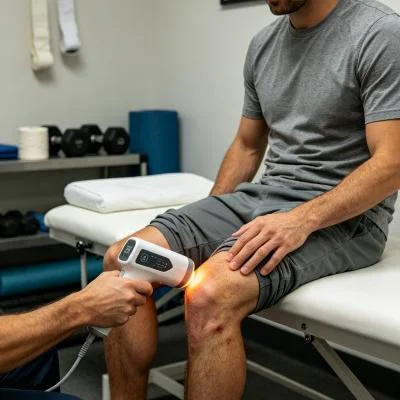
可変パルスデューティサイクルのゲーティングにより、この技術的な問題が解決されます。パルス幅と休止間隔を制御してビーム照射をマイクロ秒単位のバースト(10 Hz~20,000 Hzの範囲)に変調することで、アクティブフェーズには高いピーク出力が深部の組織に到達し、休止フェーズには表層の毛細血管が熱を放散します。 この熱調節により、皮膚表面温度を42℃以下に安全に維持できるため、臨床医は関節炎に対して持続的なレーザー治療を行うと同時に、周囲のデリケートな皮膚や潰瘍の縁を保護することができます。.
+--------------------------------------------------------------------------------------------------+
|                    COMPOUND ARTICULAR AND CUTANEOUS PHOTON PROPAGATION                           |
+--------------------------------------------------------------------------------------------------+
| Non-Contact / Contact Fluid-Displacement Probe                                                   |
|   |                                                                                              |
|   v                                                                                              |
| [Epithelial Margin / Ulcer Bed] ---> 650nm accelerates fibroblast migration and closure          |
|   |                                                                                              |
|   v                                                                                              |
| [Dermal Papillary Capillaries]  ---> 980nm resolves stasis and clears pooled inflammatory fluid   |
|   |                                                                                              |
|   v                                                                                              |
| [Prepatellar Bursa & Retinaculum] -> Dynamic pulse duty cycle prevents surface thermal stacking   |
|   |                                                                                              |
|   v                                                                                              |
| [Synovial Joint Capsule]        ---> Suppression of IL-1beta, TNF-alpha, and COX-2 cascades      |
|   |                                                                                              |
|   v                                                                                              |
| [Articular Cartilage & Bone]    ---> 1064nm stimulates Cytochrome C Oxidase, restoring ATP flow   |
+--------------------------------------------------------------------------------------------------+
Biomolecular Mechanics of Chronic Joint Relief and Epithelial Closure
Treating coexisting articular cartilage degeneration and superficial skin loss requires balancing inflammatory cytokine suppression with tissue matrix synthesis. Degenerated chondrocytes and inflamed synovial cells produce catabolic cytokines, including interleukin-1 beta (IL-1β), tumor necrosis factor-alpha (TNF-α), and matrix metalloproteinases (MMPs), which break down type II collagen and aggrecan while sensitizing articular nociceptors.
Applying high-intensity coherent light directly interrupts this degenerative cycle. Targeted near-infrared irradiation downregulates nuclear factor kappa B (NF-κB) transcription inside synovial fibroblasts, decreasing the production of inflammatory mediators like prostaglandin E2 (PGE2) and cyclooxygenase-2 (COX-2) to help protect remaining cartilage integrity. This cellular stabilization underpins the documented long-term effects of laser therapy on arthritis, preventing the rebound stiffness and progressive capsular fibrosis that commonly follow temporary steroid blocks.
同時に、関節炎を患った関節上の脆弱な皮膚の管理には、専用の処置手順が有効です。臨床医は、もろく硬化した皮膚に従来の粘着力の強いテープを直接貼るのではなく、光線療法と体系化された創傷被覆用レーザー治療プロトコルを組み合わせています。 非粘着性のシリコーンフォームドレッシングを貼付する前に、洗浄済みの創床に非接触の多波長光を直接照射することで、肉芽組織の形成が促進され、細菌のバイオバーデンが低減され、上皮縁の進展のための保護された環境が整えられます。.
同時に、関節炎の痛みに対する構造化レーザー療法の実施は、感覚神経経路に直接作用します。高光子線量を照射することで、関節包内の非髄鞘化C線維および薄髄鞘化A-δ線維が過分極されます。 ハンブリンらによる光医学の研究では、高エネルギーの近赤外光照射が末梢神経伝導速度を低下させ、関節周囲組織におけるサブスタンスPの蓄積を抑制することが確認されており、全身的な副作用を伴わずに迅速かつ持続的な痛みの緩和をもたらすことが示されています。.
Clinical Case Documentation: Outpatient Orthopedic and Tissue Viability Service
The documented case below details the outpatient treatment course of a patient with advanced knee osteoarthritis complicated by an open pretibial stasis ulceration, treated using a multi-wavelength Class IV rehabilitation laser platform equipped with interchangeable quartz contact and non-contact optical heads.
患者のプロファイルおよび臨床的ベースライン
- Case Identifier: OSTEO-WOUND-2026-0924
- Patient Age / Sex: 67-Year-Old Male
- Primary Diagnosis: Advanced Left Knee Osteoarthritis (Kellgren-Lawrence Grade IV) with Severe Medial Joint Space Loss, Tricompartmental Osteophytosis, and Secondary Flexion Deformity, complicated by a Chronic Pretibial Cutaneous Stasis Ulcer measuring 2.8 cm x 1.9 cm x 0.3 cm with indurated peri-wound margins.
- History: 7 years of progressive joint pain and stiffness, with a non-healing lower leg ulcer persisting for 14 weeks. Systemic NSAIDs contraindicated due to baseline renal insufficiency; intra-articular steroid injections declined due to infection risks from the adjacent ulcer; surgical arthroplasty deferred until complete cutaneous closure is achieved.
- Baseline Metrics: Numerical Pain Rating Scale (NPRS) at 9/10 during weight-bearing attempts; Western Ontario and McMaster Universities Osteoarthritis Index (WOMAC) at 78/96; Knee Active Range of Motion (AROM) Flexion restricted to 75°, Extension lacking 16°; Bates-Jensen Wound Assessment Tool (BWAT) score at 34/65.
多段階治療レジメン
The treatment course comprised twelve clinical sessions scheduled over four weeks, progressing from acute wound decontamination and nociceptive gating to deep capsular saturation and functional mobility integration.
| セッション番号. | 臨床段階および目的 | 波長の設定 | 動作電力(W) | パルス周波数 (Hz) | デューティ・サイクル(%) | 供給エネルギー (J) | 累積線量(J) |
| セッション01 | 潰瘍の除菌と侵害受容ゲート現象 | 650nm (30%) + 980nm (50%) + 1064nm (20%) | 10.0 W | 10,000 Hz | 30% | 3,000 J | 3,000 J |
| セッション02 | Popliteal Drainage & Wound Edge Perfusion | 650nm (20%) + 980nm (50%) + 1064nm (30%) | 12.0 W | 5,000 Hz | 40% | 3,600 J | 6,600 J |
| セッション03 | Synovial Retinacular Flushing & Biofilm Control | 650nm (20%) + 980nm (40%) + 1064nm (40%) | 14.0 W | 2,500 Hz | 50% | 4,200 J | 10,800 J |
| セッション04 | Granulation Bed Activation & Fat Pad Release | 650nm (25%) + 980nm (35%) + 1064nm (40%) | 16.0 W | 1,000 Hz | 60% | 4,800 J | 15,600 J |
| セッション05 | Deep Medial Capsule Softening | 980nm (40%) + 1064nm (60%) | 18.0 W | 300 Hz | 65% | 5,400 J | 21,000 J |
| セッション06 | Subchondral Plate Perfusion & Epithelial Edge Adv. | 650nm (20%) + 980nm (30%) + 1064nm (50%) | 20.0 W | 150 Hz | 70% | 6,000 J | 27,000 J |
| セッション07 | High-Flux Chondrocyte Respiration Induction | 980nm (25%) + 1064nm (75%) | 22.0 W | 連続(CW) | 100% | 6,600 J | 33,600 J |
| セッション08 | 緻密な線維軟骨マトリックスのリモデリング | 980nm (20%) + 1064nm (80%) | 24.0 W | 連続(CW) | 100% | 7,200 J | 40,800 J |
| セッション09 | Cutaneous Re-Epithelialization Consolidation | 650nm (40%) + 980nm (30%) + 1064nm (30%) | 18.0 W | 100 Hz | 70% | 5,400 J | 46,200 J |
| セッション10 | 動的伸展による生体力学的再教育 | 980nm (30%) + 1064nm (70%) | 20.0 W | 200 Hz | 75% | 6,000 J | 52,200 J |
| 第11回 | 機能的な歩行運動連鎖の統合 | 980nm (30%) + 1064nm (70%) | 20.0 W | 連続(CW) | 100% | 6,000 J | 58,200 J |
| 第12回 | 最終的な組織の固化および排出 | 650nm (20%) + 980nm (40%) + 1064nm (40%) | 16.0 W | 500 Hz | 65% | 4,800 J | 63,000 J |
臨床経過および転帰指標
WEEK 1 (Sessions 1-3):
- Non-contact scanning over the pretibial ulcer cleared slough; healthy red granulation islands appeared in the wound bed.
- Gentle contact sweeping over the popliteal drainage basin and medial joint line reduced periarticular tension.
- Resting nocturnal pain subsided; NPRS dropped from 9/10 to 5/10.
- Patient slept through the night without waking from positional joint aching after Session 2.

WEEK 2 (Sessions 4-6):
- Pretibial ulcer margins advanced inward; wound surface area shrank from 2.8 x 1.9 cm to 1.6 x 1.1 cm with zero maceration.
- Knee active flexion expanded from 75° to 102°; extension deficit reduced from 16° to 6°.
- Patient stood from a seated position without pulling on assistive furniture arms.
- BWAT wound score improved from 34/65 to 20/65; WOMAC functional score improved from 78 to 44.

WEEK 3 (Sessions 7-9):
- Continuous wave delivery applied over the patellar retinaculum and tibiofemoral margins with firm compression.
- Complete epithelial closure of the pretibial ulcer achieved by Session 9, presenting a fully re-epithelialized skin layer.
- Patient walked 500 meters using only a single-point cane without triggering joint instability or skin breakdown.
- Crepitus during active knee flexion softened considerably as synovial congestion cleared.

WEEK 4 (Sessions 10-12):
- Full active knee extension achieved (0° neutral); active flexion reached 124°.
- Ulcer site completely healed (BWAT score 13/65, representing closed skin); no localized breakdown under direct pressure.
- Final NPRS recorded at 1/10 during extended walking and 0/10 at rest.
- WOMAC score reached 12/96, restoring daily mobility and clearing the patient medically for elective surgical review.
比較分析:高出力レーザーと従来の治療法
Evaluating high-intensity class IV light alongside traditional clinical options shows why modern physical medicine centers integrate multi-wavelength lasers into daily care:
関節内コルチコステロイド注射
Steroid injections act as broad chemical immunosuppressants that temporarily mask joint inflammation. However, when an adjacent skin ulcer or vascular breakdown is present, puncturing the joint capsule risks introducing surface pathogens into the synovial cavity, potentially causing septic arthritis. Repeated intra-articular steroid exposure also accelerates cartilage loss, damages native chondrocyte viability, and risks narrowing the joint space over time. High-intensity multi-wavelength laser therapy provides a non-invasive, non-destructive alternative. Rather than damaging chondrocytes, concentrated photons stimulate microvascular circulation, boost cellular ATP synthesis, and reduce joint discomfort without chemical toxicity or infection risks.
Surgical Debridement and Skin Grafting
Surgical debridement of stasis ulcers followed by autologous split-thickness skin grafting requires donor site harvesting and prolonged limb immobilization. In patients with severe arthritis, immobilization causes joint contracture, muscular atrophy, and increased pain upon remobilization. Class IV laser protocols allow simultaneous wound healing and joint mobilization in an outpatient setting, promoting steady re-epithelialization while preserving joint movement without surgical trauma.
経口非ステロイド性抗炎症薬(NSAIDs)
Systemic anti-inflammatory medications circulate throughout the body, inhibiting protective prostaglandins in the gastric lining and kidneys while delivering limited drug concentrations into poorly vascularized articular cartilage and ulcerated skin margins. Chronic NSAID use carries well-documented risks of gastric ulceration, hypertension, and renal impairment. High-intensity laser therapy targets therapeutic energy directly into the damaged joint capsule and wound bed, relieving joint pain and stiffness locally without systemic adverse effects.
臨床現場での実践的な応用と運用上のポイント
皮膚縁の状態が不良な複雑な関節炎に対して高出力レーザーシステムを使用する際、一貫した臨床結果を得るには、体系的な実施が求められます:
- 2ゾーン治療の実施:治療部位を「開放創ゾーン」と「深部被膜ゾーン」に分けます。 開放性皮膚潰瘍の上、2~3センチメートルの距離に非接触型石英ディフレクターを配置し、脆弱な肉芽組織に触れることなく、生体刺激作用のある赤色光および近赤外光を照射する。閉鎖された関節周囲の軟部組織の上では、滑らかな石英製圧迫プローブに切り替え、表層の体液を排除し、関節包の深部まで光子を届ける。.
- Regional lymphatic clearing: Always treat proximal lymphatic pathways first. Sweeping the popliteal space, femoral triangle, and proximal calf musculature before directing energy into the joint capsule clears fluid pathways and accelerates tissue recovery.
- 周波数漸増プロトコル:初回の来院時には、過敏な末梢神経経路を鎮静させるため、高いパルス周波数(4,000 Hz~10,000 Hz)から開始し、局所の血流を改善して関節包の硬さを解消するために中程度のパルス(100 Hz~500 Hz)に移行し、 急性疼痛が治まった後は、連続波(CW)照射に切り替えて、軟骨細胞の代謝と構造的リモデリングを促進する。.
Applying class IV multi-wavelength laser therapy grounded in tissue optical physics allows outpatient orthopedic and wound care clinics to resolve stubborn, chronic joint degeneration and help patients return to active, pain-free daily lives.