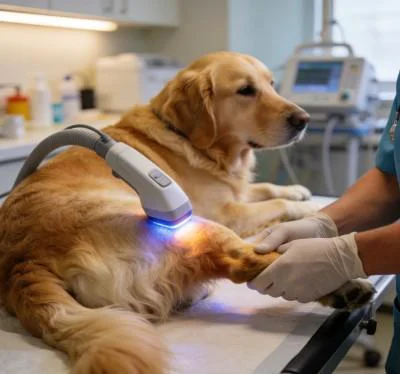
精密光バイオモジュレーション:犬の変形性関節症管理における多波長レーザーシステムの臨床的有効性
High-power Class IV laser therapy optimizes chondrocyte proliferation and downregulates pro-inflammatory cytokines, offering a non-invasive, drug-free alternative for long-term mobility restoration in geriatric canines.
The management of canine osteoarthritis (OA) has transitioned from purely pharmacological intervention to multimodal integrative protocols. While Non-Steroidal Anti-Inflammatory Drugs (NSAIDs) remain a staple, their long-term systemic adverse effects—specifically renal compromise and gastrointestinal mucosal erosion—necessitate more biologically synergistic modalities. High-power クラスIVレーザー systems, such as the VetMedix 3000U5, have emerged as the gold standard for triggering cellular photobiomodulation (PBM) in deep synovial tissues.
The Physics of Deep Tissue Penetration and Energy Fluence
The therapeutic window for effective 犬の関節炎のレーザー治療 lies within the 650nm to 1064nm spectrum. However, achieving clinical results in large breed canines requires more than just wavelength selection; it demands precise control over power density ($W/cm^2$) and energy fluence ($J/cm^2$).
To calculate the total energy delivered to a specific joint capsule, clinicians must utilize the following formula:
$$E = P \times t$$
Where $E$ is the total energy in Joules, $P$ is the power in Watts, and $t$ is the treatment time in seconds. For a chronic coxofemoral (hip) arthritic condition, the target energy density typically ranges from 10-15 $J/cm^2$. Using a low-power Class III laser would require prohibitive treatment times, often leading to patient non-compliance and superficial thermal buildup without reaching the subchondral bone. In contrast, a 30W high-power system allows for the delivery of therapeutic doses to the targeted mechanoreceptors and mitochondria within minutes.

Molecular Mechanisms: Beyond Surface Heating
The primary chromophore involved in PBM is Cytochrome C Oxidase (CCO) located in the mitochondrial respiratory chain. When targeted by specific wavelengths during 犬のレーザー治療, CCO dissociation of Nitric Oxide (NO) occurs, which subsequently increases Oxygen ($O_2$) consumption and Adenosine Triphosphate (ATP) production.
This cellular “up-regulation” triggers a secondary cascade of signaling molecules, including reactive oxygen species (ROS) and transcription factors, which accelerate tissue repair and induce analgesia. Specifically, the 980nm wavelength targets water and hemoglobin, creating a thermal gradient that enhances local microcirculation, while the 810nm wavelength is optimized for CCO absorption, driving the primary photochemical reaction.
Clinical Comparison: Laser Therapy vs. Conventional Pharmacological Management
For veterinary procurement managers, the ROI of a 犬用レーザー治療器 is measured by clinical outcomes and patient retention. The following table illustrates the comparative advantages of integrating high-power laser protocols over exclusive NSAID reliance.
| パラメータ | Conventional NSAID Protocol | High-Power Laser Therapy (FotonMedix) |
| システミック・インパクト | Potential hepatic/renal toxicity | Localized, non-systemic |
| Pain Onset | 1-4 hours post-ingestion | Immediate neural blockade |
| 組織再生 | Inhibitory (potential cartilage degradation) | Stimulatory (ATP & Collagen synthesis) |
| 治療頻度 | Daily (lifetime) | 2-3 times/week (induction), monthly (maintenance) |
| Hemorrhage Risk | Increased (anti-platelet effect) | Zero |
Clinical Case Study: Advanced Rehabilitation of a 10-Year-Old Golden Retriever
患者のプロフィール “Max,” a 34kg neutered male Golden Retriever, presented with Grade III/IV lameness in the right stifle and bilateral hip dysplasia. Previous treatments included Carprofen (NSAID) and Glucosamine supplements with diminishing efficacy.
最初の診断 Radiographic evidence showed significant osteophyte formation, subchondral sclerosis, and reduced joint space in the stifle. The patient exhibited a 4/10 pain score on the Glasgow Composite Measure Pain Scale.
治療パラメータ(VetMedix 3000U5を使用):
- 波長: Simultaneous 810nm/980nm/1064nm
- モードだ: Pulsed (to minimize thermal accumulation)
- パワーだ: 15W Average
- スポットサイズ: 5cm diameter (non-contact)
- 総合エネルギー: 3,000 Joules per hip; 1,500 Joules per stifle
- 頻度: 3 sessions per week for 3 weeks, followed by a tapering schedule.
治療後の進行:
- 第1週 Patient showed improved sleep quality and increased willingness to ascend stairs. Pain score reduced to 2/10.
- 第3週 Significant reduction in joint effusion. The owner reported the cessation of NSAID use.
- 追跡調査(3ヶ月目): Full weight-bearing on the right stifle. Range of motion (ROM) increased by 15 degrees in the coxofemoral joints.
| セッション | エネルギー (J) | Time (min) | 臨床観察 |
| 1-3 | 4,500 | 10 | Reduced stiffness post-treatment |
| 4-6 | 4,500 | 10 | Visible improvement in gait symmetry |
| 7-9 | 3,000 | 7 | Sustained analgesia, increased activity |
メンテナンス、安全性、B2Bコンプライアンス
For a private clinic or a large-scale veterinary hospital, equipment longevity is as critical as clinical efficacy. High-power lasers are precision instruments that require strict adherence to safety protocols to mitigate ocular hazards.
- 眼球保護: Both the operator and the canine patient must wear wavelength-specific safety goggles. The Nominal Ocular Hazard Distance (NOHD) for a 30W system is significant; therefore, treatment must occur in a controlled, “Laser Controlled Area.”
- 光ファイバーの完全性: The delivery system is the most vulnerable component. FotonMedix utilizes premium armored fibers to prevent fractures during high-volume clinical use. Regular inspection of the SMA-905 connector is mandatory.
- Calibration and Software: Advanced systems feature self-diagnostic modules that verify output power at the handpiece. For B2B partners, this ensures that the device maintains its 12-15% efficiency rating without degradation over years of service.
- 規制遵守: Ensure all devices meet IEC 60825-1 standards for laser safety. For international distributors, CE and FDA certifications are non-negotiable prerequisites that FotonMedix maintains across its VetMedix and SurgMedix lines.
結論
The integration of high-power laser systems into veterinary practice represents a shift toward biological-centric medicine. By delivering high energy fluence to deep-seated pathologies, clinicians can achieve results that were previously unattainable with lower-class devices. For the hospital administrator, investing in a multi-wavelength platform is not merely a service expansion; it is a commitment to the highest standard of E-E-A-T in veterinary care.
よくある質問
Q: Can laser therapy be used in conjunction with orthopedic implants?
A: Yes. Unlike short-wave diathermy, PBM does not heat metallic implants significantly. However, clinicians should use a scanning technique rather than a stationary spot to ensure even energy distribution.
Q: How many sessions are required before clinical results are visible?
A: Acute pain often subsides after the first session due to immediate endorphin release and neural suppression. For chronic osteoarthritis, structural improvements and sustained mobility usually manifest after the 4th or 5th treatment.
Q: Is there a risk of tissue burning with 30W systems?
A: When operated by a trained professional using the correct handpiece movement and pulsing frequencies, the risk is negligible. High power is used to achieve depth, not to increase surface temperature.
フォトンメディックス