 フォトンメディックス




犬の関節炎には、過剰な熱を伴わない、より深いエネルギーが必要だ
深部組織へのエネルギー伝達、波長特異的吸収、制御された熱投与
慢性関節炎を患っている犬は、必ずしも痛がっているように見えるとは限りません。.
それでも、しっぽを振ったり、餌皿まで歩いて行ったり、飼い主にあいさつしたりといった行動を普段通りに行う犬もいます。変化が現れるのは、そのあとです。階段を上る前にためらったり、前足から先に立ち上がったり、散歩の途中で立ち止まったりします。休んだ後、最初の数歩は動きがぎこちなく、不快そうに見えます。.
獣医リハビリテーションチームにとって、ここが治療が難しくなるポイントです。.
関節には痛みがありますが、関節は皮膚のすぐ下にあるわけではありません。治療ヘッドと病変部の間には、皮膚、毛髪、皮下組織、筋膜、筋肉、血管、結合組織があります。各層を通過するたびに、標的へ向かう光エネルギーの量や分布が変化します。.
だからこそ 犬の関節炎のレーザー治療 これは、単に能力を高めるという単純な問題として捉えるべきではない。.
実際の臨床上の問題は、もっと根深いものです:
痛みを伴う関節に十分な光エネルギーを届ける一方で、表在組織には繰り返し治療を行える程度の快適さを保つにはどうすればよいでしょうか?
この点が、高強度のクラスIVレーザー療法が一般的な温熱療法とは一線を画すところなのです。.
臨床医は、波長、組織吸収、光減衰、出力、パルス周波数、デューティサイクル、治療部位、ハンドピースの動き、および総エネルギーを、ひとつの治療システムとして管理しなければならない。.
レーザーの発射点は関節ではない
獣医師が犬の膝関節、股関節、または肘関節に治療用ヘッドを当てても、光子はすぐには関節炎の患部には到達しません。.
彼らはまず組織に遭遇する。.
一部の光子は吸収される。.
いくつかは散らばっている。.
さらに奥へと進む者もいる。.
したがって、残りのフルエンスは深さが増すにつれて減少する。.
これを理解する上で役立つのは、光路を一連のフィルターとして想像することです。各層は、利用可能なエネルギーの一部を除去したり、方向を変えたりします。皮下組織の層が厚い場合、比較的浅い関節と比較して、治療結果に大きな違いが生じることがあります。.
これにより、以下の間に重要な違いが生じます。 表面線量 そして 目標投与量.
あるシステムが治療ヘッドで一定量のエネルギーを照射したとしても、その同じ量のエネルギーが関節包、滑膜、関節周囲組織、あるいはより深部の筋肉にまで到達するとは限らない。.
この違いは、特に大型犬において顕著に現れます。.
体重7kgのヨークシャー・テリアと38kgのラブラドールでは、股関節までの光路が異なります。.
したがって、治療方針は患者の診断のみに基づいて決定すべきではない。.
また、解剖学的側面も考慮すべきである。.
深さによる組織減衰の変化
生体組織には、ここで重要な2つの主要な光学的挙動、すなわち吸収と散乱があります。.
吸収とは、組織の構成要素がどれだけの光エネルギーを取り込むかを決定するものです。.
散乱により光子の方向が変わり、その結果、治療領域内でのエネルギーの広がり方が変化します。.
どちらも波長によって変化する。.
『』に掲載された組織の光学特性に関する総説 『Journal of Biomedical Optics』 生物組織における吸収と散乱の波長依存性について解説し、組織の組成を考慮せずに光の透過について論じることはできない理由を示している。.
だからこそ、仕様書上では魅力的に見える波長であっても、必ずしもすべての解剖学的標的にとって最適な選択肢であるとは限らないのです。.
何よりもまず、臨床上の目標が最優先です。.
なぜ犬の関節炎はレーザー治療の難しい対象なのか
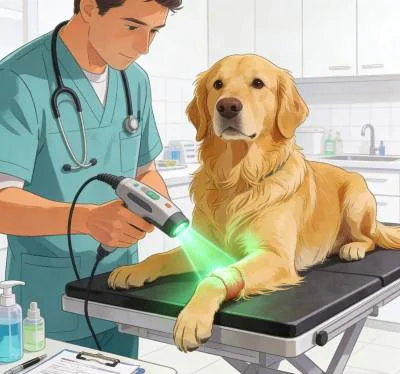
変形性関節症は、単一の組織の問題というわけではありません。.
慢性関節炎を患っている関節には、軟骨の変性、滑膜の変化、関節包の肥厚、骨棘、関節周囲組織の変化、および二次的な筋機能障害が見られることがある。.
犬の動きも変わります。.
膝関節に痛みがあると、犬は後ろ足の片方の体重をかけなくなることがあります。.
股関節の痛みは、骨盤の動きに影響を与える可能性があります。.
肘に違和感があると、犬が前肢全体を置く姿勢が変わってしまうことがあります。.
その結果、治療範囲は関節の正確な中心点より外側まで及ぶ必要がある場合があります。.
これがその理由の一つです 動物用レーザー治療 機能的リハビリテーション計画に組み込まれた場合に、最も効果を発揮します。.
臨床医は、関節部位を治療すると同時に、周囲の筋肉や軟部組織も考慮に入れることができます。.
レーザーに「関節炎を治す」ことが求められているわけではない。“
これは、疼痛管理、組織反応、およびリハビリテーションへの参加促進を目的とした、より広範な戦略の一環として用いられている。.
多波長戦略において、なぜ810 nmが有用なのか
800 nm前後の近赤外領域は、その散乱および吸収特性が深部組織への光到達において良好なバランスをもたらすため、光生体調節の研究において長年にわたり重要な役割を果たしてきた。.
約810 nm付近では、光子は多くのより短い波長よりも効果的に透過できますが、減衰は依然として生じ、実際の透過度は組織の種類によって大きく異なります。.
このため、臨床医がより深部の筋骨格構造を検討する際には、810 nmが有用となります。.
それは、810 nmの光が犬の体をまっすぐに通り抜けるという意味ではありません。.
そうではありません。.
エネルギーは依然として散逸し、吸収されている。.
実用上の利点は、治療対象が表層組織の下にある場合、この波長が有用な出発点となり得るという点である。.
FotonMedix社の「VetMedix-Max」プラットフォームは、650、810、915、940、980 nmの波長に対応しており、公称ピーク出力は38 Wで、連続、パルス、スーパーパルスの各動作モードを備えています。.
この構成の価値は、単に波長の数だけにあるわけではありません。.
これにより、臨床医はさまざまな組織環境に対処するための選択肢を増やすことができます。.
表層的な治療では、必ずしも深層の股関節と同じ光学的なアプローチが必要とは限りません。.
筋肉の治療は、必ずしも関節包の治療と同じアプローチを必要とするわけではありません。.
慢性疾患は、必ずしも術後の急性期と同じ治療パターンを必要とするわけではありません。.
980 nmでは、温度管理がより重要になる
波長が980 nmに近づくにつれて、組織との相互作用が変化する。.
吸水の影響がますます顕著になるため、近赤外領域のより短い波長と比較して、光エネルギーのより大きな割合が局所的な熱効果に寄与することになる。.
これは、それ自体が悪いことというわけではありません。.
熱的影響は、適切に制御されれば、臨床的に有用となる。.
この問題は、操作者が、組織がエネルギーを再分配・除去できる速度よりも速いペースでエネルギーが蓄積される状態を許容した場合に発生する。.
深部にある対象物が意図した処理を受ける前に、表面が高温になる可能性があります。.
これが高強度レーザー治療における根本的な矛盾である:
強度を高めることでエネルギー伝達効率を向上させることができますが、過度に長時間さらされ続けると、熱が制限要因となる可能性があります。.
だからこそ、高出力システムには、単にワット数が高いだけでは不十分なのです。.
時間的な制御が必要です。.
デューティサイクルは、見た目以上に重要だ
デューティサイクルとは、パルスシーケンス中にレーザーが実際に発振している時間の割合を指します。.
連続的ではなく、断続的に供給される高ピーク出力を想定してください。.
活性期間中、組織は多量の光エネルギーを受け取ります。.
不活性期間中、熱は吸収領域のすぐ外側へと拡散して失われ、組織灌流によって熱の再分布が生じることがあります。.
したがって、平均エネルギー供給量は、同じピーク出力での連続運転の場合よりも低くなる可能性があります。.
これにより、治療上の実用的な利点が生まれます。.
臨床医は、全体的な熱負荷を制御しつつ、比較的強い瞬間的な光刺激を維持することができる。.
しかし、デューティサイクルが低いからといって、すべての治療が自動的に安全になるわけではない。.
患者の体格、解剖学的部位、治療部位、組織の特性、照射時間、そして施術者の技術は、依然として重要な要素です。.
デューティサイクルは、単に別の制御変数に過ぎません。.
FotonMedix社の「VetMedix-Max」は、連続モード、パルスモード、スーパーパルスモードを備えており、熱感の調整が可能です。記載されている最大ピーク出力は38 Wです。.
獣医リハビリテーションチームにとって、これは、このシステムが単なる連続加熱源としてではなく、制御可能なエネルギー供給プラットフォームとして運用できることを意味します。.
関節炎の治療において、なぜ1470 nmを自動的に用いるべきではないのか
1470 nmの挙動は、波長の選択が臨床上の目的に沿って行われる必要がある理由を説明する一助となる。.
水は、980 nmの波長よりも1470 nmの波長をはるかに強く吸収する。.
これにより、はるかに局所的な相互作用が生じます。.
外科分野での応用においては、これは非常に有用である。.
FotonMedix社のSurgMedixプラットフォームは、制御された組織の切断、凝固、アブレーションが求められる高エネルギー外科用途向けに、1470 nmおよび980 nmの波長構成を採用しています。.
しかし、手術と非侵襲的な関節炎のリハビリテーションでは、その目的が異なります。.
外科医は、ごくわずかな組織領域に集中してエネルギーを照射したいと考えることがある。.
股関節の関節炎を治療するリハビリテーション臨床家は、通常、表層に過度な熱が蓄積することなく、より深部の筋骨格組織に対して治療範囲を制御したいと考える。.
したがって、同じ物理的原理であっても、ある臨床状況では有用である一方、別の状況では不適切となる場合がある。.
これは、……にとって極めて重要な区別である。 ペット・レーザー療法.
ペットの飼い主は、「吸収力が高い」と聞くと、吸収力が高いことが自動的に治療効果が高いことを意味すると誤解してしまうかもしれません。.
そうではありません。.
問題は、そのエネルギーがどこで吸収されるかということです。.
水、ヘモグロビン、および980 nm付近の波長域
980 nm付近における光学的挙動は、単純な波長表記が誤解を招きかねない理由も示している。.
ヘモグロビンは、波長や酸素化状態に応じて光を吸収します。また、水も主要な吸収成分の一つとなっています。したがって、組織は単一の吸収体としてではなく、複数の発色団の組み合わせとして振る舞います。.
980 nmでは、水の吸収がますます重要になってきます。.
血管が通っている組織は、光の吸収と熱伝達の両方に変化をもたらすため、血液は依然として重要な要素である。.
If energy is absorbed by tissue and converted to heat, blood flow can help move that heat away.
At the same time, local vascular characteristics can change the amount of energy absorbed.
For canine arthritis, this matters in muscle-rich areas surrounding the hip and stifle.
A clinician should therefore think about both optical delivery and thermal behavior.
The goal is not to maximize absorption everywhere.
The goal is to produce a controlled biological response in the intended treatment volume.
The Practical Difference Between Peak Power and Average Power
This is one of the easiest concepts to misunderstand.
Suppose a system can generate 30 W of peak output.
That does not mean the patient necessarily receives 30 W continuously.
If the system operates in a pulsed mode, peak output describes the intensity during the active portion of the pulse.
Average power depends on how long the laser is actually emitting.
Duty cycle therefore changes the relationship between the two.
This distinction matters because tissue responds not only to the instantaneous optical intensity but also to cumulative energy and thermal exposure.
A high peak with controlled duty cycle can produce a different thermal profile from continuous operation at the same peak value.
That is why a high-intensity Class IV system should be evaluated by its control architecture, not just its maximum output.
Simulated Clinical Case of Canine Hip Arthritis
以下は simulated veterinary rehabilitation case created for clinical training and SEO education. It is not presented as a published patient record, and the treatment parameters are not a universal prescription.
事案の特定
A 10-year-old female spayed Labrador Retriever weighing 36.5 kg presents with bilateral hip osteoarthritis.
The right side is clinically worse.
Radiographs demonstrate moderate-to-severe degenerative joint changes, classified as Grade III on the rehabilitation department’s four-level training scale.
The owner reports difficulty rising, reduced willingness to climb stairs and stiffness after prolonged rest.
The dog can still walk for approximately 15 minutes but begins shortening the hind-limb stride after several minutes.
The veterinary rehabilitation team decides to introduce high-intensity laser treatment alongside controlled exercise and veterinary pain management.
治療記録のシミュレーション
| 臨床パラメーター | 治療記録 |
|---|---|
| 部署 | 小動物リハビリテーション |
| ケース番号 | SAR-HILT-2026-052 |
| 患者 | ラブラドール・レトリーバー |
| 年齢 | 10年 |
| セックス | メス、避妊手術済み |
| 体重 | 36.5 kg |
| 主診断 | 両側の股関節変形性関節症 |
| 利き側 | 右股関節 |
| 病理学的悪性度 | Grade III, moderate-to-severe |
| Baseline Pain Interference | 7/10 |
| 主要目標 | Reduce pain interference and improve walking tolerance |
| レーザークラス | 高強度のクラスIV |
| 波長 | 810 nm + 915 nm + 940 nm + 980 nm |
| 初期ピーク出力 | 24 W |
| シミュレーションによる最大ピーク出力 | 32 W |
| 頻度 | 15 Hz |
| 初期デューティサイクル | 40% |
| 第1セッション エネルギー | 1,000 J |
| 第3セッション エネルギー | 1,250 J |
| 第6セッション エネルギー | 1,500 J |
| Sessions Per Week | 2 |
| 入門コース | 3週間 |
| 治療エリア | Hip, periarticular tissue and surrounding musculature |
| 温度監視 | Patient response and surface temperature assessment |
| 追加のリハビリテーション | Controlled walking and hip strengthening |
The protocol deliberately does not begin at the maximum available output.
The first session is partly a tolerance assessment.
A large dog with a deep hip target may need substantial energy, but the operator still needs to determine how rapidly the patient’s superficial tissue heats under the selected wavelength combination.
セッション1
The dog initially stands slowly.
The treatment begins with 24 W peak output, 15 Hz and a 40% duty cycle.
The handpiece is continuously moved across the hip and periarticular region.
The operator avoids parking the treatment head over a small point.
Total delivered energy is approximately 1,000 J.
The dog remains relaxed.
Mild warmth is observed, but there is no withdrawal response or behavioral sign of discomfort.
Immediately after treatment, the dog rises more quickly.
The gait remains abnormal.
That result is clinically plausible.
The purpose of the first treatment is not to produce a dramatic transformation.
It is to establish a reproducible and tolerated treatment condition.
Week 1 Shows Why Treatment Progression Matters
After two sessions, the owner reports that the dog is getting up faster after naps.
The dog still hesitates before stairs.
Pain interference is recorded at a simulated 6/10.
The treatment remains at the same frequency and duty cycle.
The total energy increases modestly to approximately 1,100 J.
The clinician does not increase everything simultaneously.
これは重要です。.
If power, frequency, duty cycle and treatment time all change at once, the team cannot determine what caused a change in patient response.
Controlled progression produces better clinical information.
セッション3
The dog now tolerates longer walking before shortening the stride.
The treatment energy is increased to approximately 1,250 J.
Peak output rises to 27 W.
デューティサイクルは40%のままです。.
The treatment field includes the gluteal and periarticular muscles.
This broader treatment field is based on the dog’s altered movement pattern.
The clinician is not treating the radiographic image.
The clinician is treating the functional consequences of the painful joint.
セッション6
At the end of the initial three-week course, the simulated treatment energy reaches 1,500 J.
Peak output is increased to 32 W.
The duty cycle is increased only modestly to 45%.
The dog now stands with much less hesitation.
The owner reports improved willingness to walk.
The dog climbs several steps without stopping.
The simulated pain interference score falls from 7/10 to 3/10.
Simulated Outcome Table
| 成果 | ベースライン | 第1週 | 第3週 |
|---|---|---|---|
| 痛みによる干渉 | 7/10 | 6/10 | 3/10 |
| 休息からの立ち上がり | 著しく遅い | やや遅い | やや遅い |
| 歩行耐性 | 15分 | 20分 | 30分 |
| 階段の許容誤差 | 階段を避ける | 3つのステップ | 8つのステップ |
| 後肢の歩幅 | 明らかに短縮されている | やや短め | 少し短め |
| オーナーの活動スコア | 4/10 | 5/10 | 8/10 |
| セッションエネルギー | 1,000 J | 1,100 J | 1,500 J |
| ピーク出力 | 24 W | 24 W | 32 W |
| デューティサイクル | 40% | 40% | 45% |
| 頻度 | 15 Hz | 15 Hz | 15 Hz |
These results are simulated and should not be interpreted as expected clinical outcomes.
The important point is the structure of the protocol.
The clinician progressively adjusts energy while monitoring function and thermal tolerance rather than automatically applying maximum output.
Why the Laser Is Not Treated as a Standalone Cure
A dog with Grade III osteoarthritis still has degenerative joint disease after a successful treatment session.
The osteophytes do not disappear overnight.
Cartilage degeneration is not reversed by simply increasing the laser dose.
This is why the rehabilitation team continues controlled exercise.
As pain decreases, the dog can participate more comfortably in strengthening.
Improved muscle function can support joint stability.
Weight management can reduce mechanical loading.
それでも、薬物療法が適切である可能性があります。.
The laser therefore becomes one part of a larger treatment strategy.
This is a much more realistic role for ペット・レーザー療法.
What Published Canine Research Tells Us
Clinical evidence for laser therapy in canine osteoarthritis is encouraging but not uniform.
A randomized double-blinded controlled trial published in 2022 evaluated 20 dogs and 40 osteoarthritic joints. The investigators compared a three-week Class IV photobiomodulation protocol with meloxicam treatment and assessed pain, gait, function, stiffness and quality-of-life-related measures.
Several outcomes favored photobiomodulation at specific follow-up points, including days 8, 15 and 30.
That study is useful because it used multiple clinical measurements rather than relying on a single subjective endpoint.
Another study involving 23 dogs with naturally occurring osteoarthritis used accelerometers to measure activity during a six-week treatment period.
The investigators reported increased daily activity and step counts during treatment.
This is an important distinction.
The dog does not care whether the treatment produces a certain optical dose.
The owner cares whether the dog moves.
The veterinarian cares whether that movement improvement is clinically meaningful and sustainable.
The rehabilitation team therefore benefits from combining pain scores with functional measurements.
Why Evidence Quality Still Matters
The veterinary laser literature contains many different protocols.
Different wavelengths.
エネルギー密度の違い。.
Different treatment schedules.
Different disease states.
Different outcome measurements.
That makes it difficult to compare studies directly.
A systematic review of laser therapy in veterinary medicine has highlighted the heterogeneity of treatment parameters and the limited quality of evidence for several indications.
This should change how veterinary laser equipment is marketed.
The responsible claim is not:
“Every dog with arthritis will improve.”
A more defensible statement is:
“High-intensity laser therapy may be incorporated into multimodal rehabilitation, with treatment parameters adjusted according to the patient, tissue depth, clinical objective and response.”
That wording reflects the current evidence much better.
The Role of Veterinary Laser Therapy in a Real Rehabilitation Department
プロフェッショナル 動物用レーザー治療 program should fit into the normal clinical workflow.
A typical patient may receive:
Diagnostic Assessment
The veterinarian identifies the underlying orthopedic or soft-tissue condition.
Baseline Functional Measurement
The team records gait, pain behavior, range of motion, activity tolerance or another measurable endpoint.
レーザー治療
The clinician selects wavelength, output, pulse mode, duty cycle and treatment field according to the target.
Rehabilitation Exercise
The patient performs controlled mobility or strengthening exercises when appropriate.
再評価
The team evaluates whether function is changing.
プロトコルの調整
Treatment is modified according to patient response rather than simply increasing energy at every visit.
This creates a repeatable clinical pathway.
It also gives a veterinary hospital something much more valuable than a machine sitting in a treatment room.
It creates a service.
Why Multi-Wavelength Systems Make Sense for Different Pets
A multi-wavelength platform is particularly useful because veterinary patients vary dramatically in anatomy.
A Chihuahua’s elbow is not a Great Dane’s hip.
A Labrador’s stifle is not a horse’s tendon.
A superficial wound is not a deep muscular target.
A chronic arthritic joint is not an acute surgical incision.
One wavelength cannot be expected to behave identically in all these situations.
VetMedix-Max provides five wavelengths: 650, 810, 915, 940 and 980 nm.
This allows clinicians to consider the optical properties of the target rather than treating wavelength as a fixed setting.
The lower near-infrared region can support deeper photon delivery.
The higher near-infrared wavelengths introduce different absorption behavior.
The operator can combine these characteristics with pulse control.
This is where the engineering becomes clinically useful.
Thermal Sensation Is a Clinical Feedback Signal
Dogs cannot tell the operator that the treatment feels too hot.
Their behavior becomes part of the feedback system.
A dog that repeatedly moves away, turns its head toward the treatment head, becomes restless or attempts to leave may be communicating that the treatment needs adjustment.
Surface temperature monitoring provides another layer of information.
But temperature alone is not enough.
A comfortable skin temperature does not prove that a deep target has received an optimal dose.
Conversely, a rapidly increasing surface temperature may indicate that energy is being absorbed too superficially.
The clinician therefore needs to combine:
- Patient behavior
- Surface temperature
- 治療時間
- パワー
- デューティサイクル
- 波長
- 組織の深さ
- 治療エリア
This is why thermal management should be considered part of treatment design rather than a secondary safety feature.
Why Continuous Maximum Power Is Usually the Wrong Mental Model
2つの治療法を想像してみてください。.
Treatment A uses moderate continuous output.
Treatment B uses a higher peak output but a controlled duty cycle and continuous handpiece movement.
The total energy can be similar while the instantaneous tissue behavior differs.
Treatment B may produce a stronger optical stimulus during the active portion while allowing more time for thermal redistribution during the inactive portion.
That is the reason pulse control matters.
The clinician is not simply choosing between “weak” and “strong.”
The clinician is shaping how energy enters tissue.
For deep canine arthritis, that distinction can be valuable because superficial tissues can become the limiting factor before the deeper target receives sufficient energy.
Where 1470 nm Belongs in the Broader Laser Ecosystem
A sophisticated veterinary buyer may encounter both rehabilitation and surgical laser platforms.
This is where wavelength specifications need to be interpreted correctly.
1470 nm has strong water absorption.
That makes it highly useful for controlled surgical tissue interaction.
980 nm has a different absorption profile and can provide a combination of penetration and thermal interaction.
The two wavelengths should therefore not be marketed as interchangeable.
FotonMedix’s SurgMedix system uses 1470 nm and 980 nm configurations for surgical applications.
VetMedix-Max, by contrast, uses a broader five-wavelength architecture intended for veterinary treatment and rehabilitation.
The distinction makes commercial sense.
A rehabilitation clinic generally needs a broad treatment envelope.
A surgical department may need precise tissue interaction.
The machine should match the workflow.
What a Clinic Should Record for Every Laser Session
A professional laser record should make the treatment reproducible.
The following information is especially useful.
患者
Species, breed, age, weight and diagnosis.
ターゲット
Joint, muscle, tendon, ligament, wound or anatomical region.
波長
Exact wavelengths used.
ピーク・パワー
Maximum instantaneous output.
平均パワー
When available and relevant.
頻度
Pulse frequency.
デューティ・サイクル
Percentage of active emission.
治療時間
Duration of the session.
総合エネルギー
供給されたジュール。.
治療エリア
Approximate surface area treated.
熱応答
Patient comfort and observed temperature behavior.
Functional Response
Pain score, gait, range of motion, activity tolerance or another objective measurement.
This information allows the veterinary team to identify patterns.
If a certain protocol consistently produces improved function without thermal discomfort, it becomes a useful starting point for similar patients.
If a protocol produces discomfort without functional improvement, the team has evidence for changing it.
The Business Case for Pet Laser Therapy
For a veterinary hospital, ペット・レーザー療法 can become more than an additional treatment line.
It can support a broader rehabilitation service.
A clinic can incorporate laser treatment into:
- Canine osteoarthritis programs
- 術後のリハビリテーション
- Sports injury management
- Muscle rehabilitation
- 創傷ケア
- 慢性疼痛プログラム
- Senior pet mobility services
The commercial value comes from repeatable clinical workflows.
A dog with chronic osteoarthritis may require multiple visits.
That gives the clinic an opportunity to combine laser treatment with reassessment, exercise therapy, mobility evaluation and owner education.
The treatment becomes part of a continuing-care relationship rather than a single machine-based procedure.
For B2B buyers, this is an important distinction.
The question is not only whether the equipment can produce high output.
The question is whether the equipment supports a service that clinicians can use repeatedly and document consistently.
Why Large Dogs Expose Weak Treatment Strategies
Small dogs can sometimes be easier to treat because the target tissue is relatively close to the skin.
Large dogs expose the limitations of shallow treatment strategies.
A deep hip joint may be surrounded by thick muscle.
A heavy dog may also have substantial subcutaneous tissue.
If the operator uses low-energy treatment simply because it feels comfortable at the skin, the deep target may receive an inadequate dose.
If the operator responds by dramatically increasing continuous power, the surface may become too warm.
That is the central contradiction.
High-intensity treatment solves part of the energy-delivery problem.
Pulse control solves part of the thermal-management problem.
Multi-wavelength selection solves part of the tissue-interaction problem.
Clinical monitoring connects all three.
Laser Therapy Compared With Conventional Treatment
Traditional veterinary care remains the foundation of canine arthritis management.
Anti-inflammatory medication can reduce pain.
Weight reduction can decrease joint loading.
Exercise can maintain muscle strength.
Hydrotherapy can provide low-impact conditioning.
Joint injections can be appropriate in selected cases.
Surgery may be indicated for specific structural conditions.
Laser therapy does not eliminate the need for these interventions.
Its value lies elsewhere.
It offers a non-invasive modality that can be repeated and integrated with rehabilitation.
For a dog that is reluctant to exercise because movement hurts, improving comfort may make rehabilitation easier.
For a postoperative patient, controlled treatment may become part of the recovery workflow.
For an older dog with chronic arthritis, repeated sessions can be incorporated into a broader mobility program.
The clinical advantage is therefore not “laser instead of medicine.”
それは laser as another controllable tool within multimodal care.
What the Owner Actually Notices
The technical specification may say 38 W.
The owner does not care.
The owner notices whether the dog gets off the bed.
They notice whether the dog wants to go outside.
They notice whether stairs become easier.
They notice whether the dog sleeps comfortably and moves more willingly the following day.
These functional changes should be part of the clinical conversation.
A veterinary team that documents these outcomes can explain treatment value much more effectively than one that reports only energy.
This is especially important for chronic osteoarthritis because radiographic disease may remain visible even when functional comfort improves.
The objective is not to make the X-ray look normal.
The objective is to improve the patient’s quality of movement within the limitations of the underlying disease.
高出力レーザーについて考えるためのより良い方法
High-intensity Class IV treatment is sometimes described as simply “more powerful laser therapy.”
That description misses the important part.
The real advancement is controllability.
The system can deliver more energy when depth demands it.
The clinician can choose different wavelengths according to tissue characteristics.
Pulse modes can separate peak intensity from average thermal load.
Duty cycle can help control heat accumulation.
Treatment movement can distribute energy across the target.
Temperature monitoring can provide another feedback signal.
The result is a treatment process that can be adjusted rather than a fixed output applied to every patient.
That is particularly relevant to 犬の関節炎のレーザー治療 because canine arthritis patients vary enormously in size, tissue depth, disease severity and treatment tolerance.
最終的な臨床的見解
The strongest case for high-intensity veterinary laser treatment is not built around the biggest power number.
It is built around solving a real treatment problem.
A painful canine hip sits beneath several layers of tissue.
光エネルギーは伝播するにつれて減少する。.
Different wavelengths interact differently with water, blood and other tissue components.
980 nm produces stronger thermal interaction than many lower near-infrared wavelengths and therefore requires deliberate thermal management.
1470 nm has much stronger water absorption and demonstrates why highly absorbed wavelengths are particularly useful for localized surgical tissue effects rather than being automatically transferred into non-invasive arthritis treatment.
810 nm and other near-infrared wavelengths can provide useful deeper-tissue delivery characteristics.
Pulse frequency and duty cycle then determine how the energy is distributed over time.
That is the engineering behind modern 動物用レーザー治療.
について ペット・レーザー療法, the clinical opportunity is to turn that engineering into a repeatable rehabilitation service.
The dog should not be treated according to a generic number printed on a protocol sheet.
The clinician should consider the patient’s weight, anatomy, tissue depth, diagnosis, treatment area, thermal response and functional goals.
The same principle applies to every serious high-intensity laser application.
More power is useful when more power is needed.
More energy is useful when the target requires more energy.
But uncontrolled power is not a treatment strategy.
A well-designed protocol uses wavelength, intensity, pulse structure, duty cycle and treatment geometry together.
That allows the clinician to address the central contradiction of deep-tissue therapy:
Deliver enough energy to matter without allowing superficial heat to become the reason treatment has to stop.
For an older dog with chronic arthritis, that can mean the difference between a treatment that merely feels warm and a structured rehabilitation program designed around measurable functional improvement.
For a veterinary hospital, it can mean the difference between owning a laser and building a meaningful laser therapy service.
SEO
标题 Canine Arthritis Needs Deeper Energy Without Excess Heat
描述 High-intensity Class IV laser therapy for canine arthritis using wavelength selection, tissue absorption, duty cycle and thermal control.
中文总结:本案例是一只10岁雌性绝育拉布拉多犬的模拟三级髋关节骨关节炎康复病例,围绕 laser therapy for canine arthritis、pet laser therapy 和 veterinary laser therapy 生成的第3篇文章。